
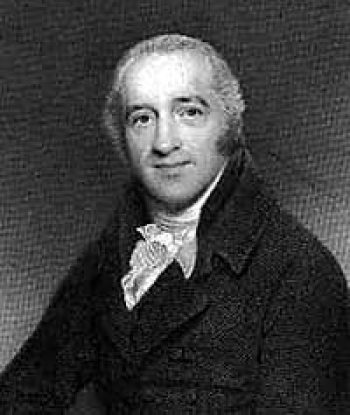
On 13 November the Church remembers, and gives thanks to God for, the life and ministry of Charles Simeon, priest, evangelical divine, 1759 – 1836.
Charles Simeon is one of my ‘spiritual heroes’ and, in the year 2000, an article I wrote about him was printed in ‘Churchman’ (an international theological journal) asking the question: Are the Priorities and Concerns of Charles Simeon Relevant for Today?
You can read/download the article here Churchman 114-2 (2000) Paul Carr – Simeon
I’m sure you will find it an interesting, encouraging, challenging and relevant read.
But who was Charles Simeon?
Born in Reading in 1759, Charles Simeon was educated at Eton and King’s College, Cambridge. Here, a requirement to attend Holy Communion in the college chapel caused him weeks of mental agony and resulted in his conversion in 1779.
In 1782 he became a Fellow of King’s and was ordained. After a curacy at St Edward’s, Cambridge, Simeon became Vicar of Holy Trinity in 1783. He remained at this parish in the centre of Cambridge for 53 years. Initially his parishioners did not welcome his evangelical style of ministry but his assiduous pastoral care eventually won them over.
He set up a regular weekly prayer and Bible class, out of which developed a system of group meetings, which gave him the opportunity to aid individuals’ spiritual growth. He also began a specifically student-orientated ministry, later to be followed in many churches in university towns, with his famous Friday evening ‘conversation parties’. By this means he was able to influence the future ministry of the Church of England by encouraging vocations in able students. He also encouraged some of them (most notably Henry Martyn – see 19 October) to become East India Company chaplains. In 1799 he was involved in establishing a more systematic form of missionary enterprise by the foundation of the Church Missionary Society.
But Simeon’s legacy to Anglican ministry was not yet complete. He was particularly concerned with the quality of preaching from Church of England pulpits. By his example and by his books on the art of preaching he perhaps did more than anyone else to draw English preaching away from the long moral lectures fashionable in the eighteenth century to systematic biblical exposition. Yet he was clear that quantity did not equal quality: ‘Never weary your hearers by long preaching,’ he told his students and ‘leave off whilst your congregation are still hungry. That will bring them back for more.’
Simeon was also concerned that work such as his should not be undone after his death by the appointment of an anti-evangelical successor. He began the process of systematizing patronage by buying up advowsons (the right of presentation to a parish) and assigning them to trustees to administer.
After his death they became the ‘Simeon Trustees’ and remain today one of the largest evangelical patronage societies. His ideas were later adopted by those of other traditions and, though sometimes criticized for polarizing parishes, have assisted in creating continuity of ministry over the long term. In September 1836 Simeon travelled from Cambridge to Ely to see his new bishop. There he caught a cold, which developed into a fatal fever, and he died on 13 November.
A Prayer
Hear our prayer, O Lord,
that we who give thanks this day for the work of grace
in the life of your servant Charles Simeon,
may ourselves be given his love of souls,
and his zeal for the proclamation of your word:
through Jesus Christ our Lord.
Amen.
Revd Paul A. Carr and extract from ‘Saints on Earth: A biographical companion to Common Worship’ by John H Darch and Stuart K Burns
 revPACman