
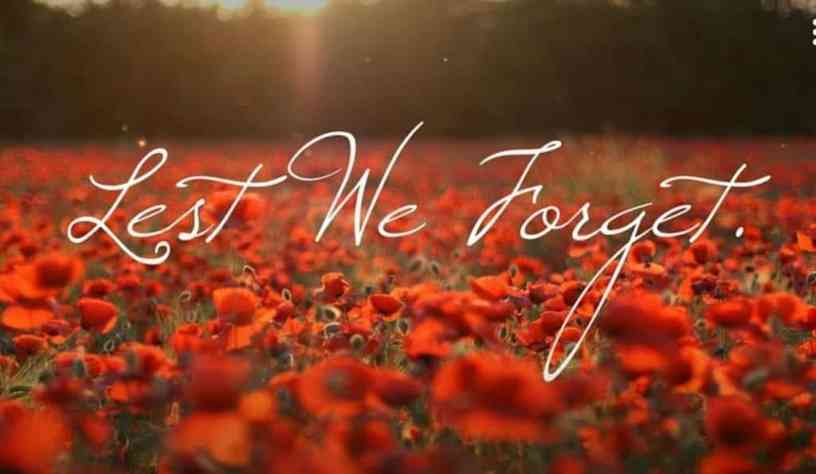
This is a copy of my talk given on Remembrance Sunday 2023 at Emmanuel Church, Billericay. My Bible Readings were Deuteronomy 4:32-39, 5:15a & John 15:9-17.
1) Remembering
We all have special occasions that we remember, don’t we? Birthdays. Holidays. Anniversaries. I’ve thought a lot in recent weeks about my time as Rector in Billericay. Such as Hatches, Matches & Dispatches, setting up Street Pastors, introducing the OCC weekend and Christmas Events, founding the Community Garden, starting the Civic Service and Messy Church, Foodbank … all of these, and many more, are special to me.
But on a day like today there’s one thing that is special, not only to me, but to each of us here this morning and that is a Poppy – and most of us are wearing one. These are an important reminder of the suffering and sacrifice made by ordinary men and women who gave their lives for our freedom and for the freedom of others. We wear our Poppies with pride so that we don’t forget what took place on our behalf!
The Israelites had a problem with forgetfulness, and I want to briefly think about this from our reading from Deuteronomy – often referred to as the Book of Remembrance.
2) Remember: What You Were!
The Israelites had been captured and taken to Egypt as slave labour – probably building the Pyramids. The Bible tells us that God heard their cries of desperation and chose Moses to lead the people in a great deliverance that we call the Exodus. It’s an incredible story of Moses leading his people to freedom through the Red Sea and into the Promised Land.
But incredible as it seems, they were so caught up with their ‘journey in the wilderness’ that they forgot their miraculous deliverance. That’s why, when God gave Moses the Ten Commandments, He said these words: Remember that you were slaves in Egypt and that the Lord your God brought you out of there with a mighty hand and an outstretched arm (Deuteronomy 5:15).
They were to ‘remember’ the past so that they might better understand the present and look forward to a brighter future. They were to remember so they wouldn’t forget.
3) Remember: What Happened!
Pharaoh was a cunning and stubborn ruler who desperately wanted to keep his source of cheap labour. Moses tried to persuade Pharaoh to ‘let his people go’ but he wouldn’t change his mind. God had to show Pharaoh that he meant business and so He sent several plagues: frogs; locusts, boils, blood etc., to persuade him to think again – all to no avail.
The final plague was the passing of the Angel of Death on the first-born. Moses told the people that the only way of escape was to sacrifice a perfect lamb and paint the blood on the doorposts of each of their homes and then the Angel of Death would pass over – this was the sign for the Israelites to make their escape. Sounds quite barbaric, doesn’t it?
But no more barbaric than the horrors of war. It’s beyond words to remember that WW1 saw a soldier die every 15 seconds. A total of 10 million in all, 888, 246 of them British, along with 7 million civilian casualties. In WW2, 22 million military personnel lost their lives, but even more incredible is the fact there were 28 million civilian casualties.
Another amazing statistic is that more than 135 million people have died, or been injured, as a result of war since 1945. Its sobering to be reminded that around 250 million people have been killed as a result of war in the 20C – without a doubt, the bloodiest century in the history of the world – casualties probably stand at a similar total. 10 million deaths in the past 23 years and who knows how many casualties.
I wonder what the true cost may have been if evil regimes were not stood against as they have been down the years? But it’s because of that loss of life, that it’s right for us to remember those who fought for our freedom and it’s right that we honour their sacrifice.
William Shakespeare wrote on his stirring Saint Crispin’s Day speech from Henry V, when the English vanquished the French in the Battle of Agincourt, which fell on Saint Crispin’s Day:
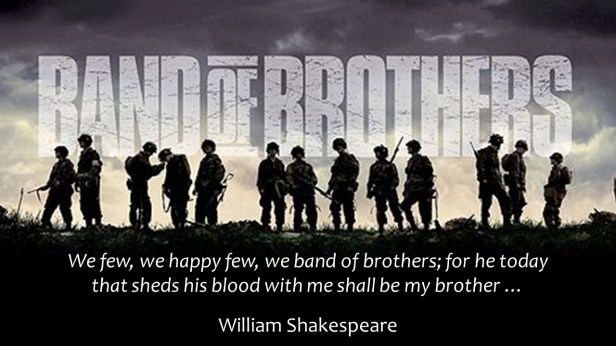
As Dire Straits sang in their song Brothers In Arms (which we’ll listen to at the end of the service, played by The bands of the HM Royal Marines): We’re fools to make war with our brothers in arms.
Yet, here in 2023, we still haven’t learnt the lessons of history. War continues in Israel & Gaza and Ukraine & Russia and Syria and in many other places – and the effects are seen on a daily basis across the world as Armed Forces, civilians and refugees suffer the gruesome consequences of war. We remember so we don’t forget.
4) Remember: What We Should Be
Immediately after the end of WWII churches, all across our land, were full as thankful people experienced freedom and entered their ‘Promised Land’. But this soon faded.
One of the tragedies of humanity is that people, who were created by God, and for God, should now be living without God, and, as a result of this, we find ourselves living in a godless world.
It’s ironic that we are responsible for some of the most awful atrocities that one human being could impose on another. We’ve seen that in Israel and Ukraine, haven’t we? But it was never meant to be that way.
God told the Israelites to remember what they should be and perhaps we, in some small way, need to remember who we are and give the right message to those around us. Being a Christian in today’s world isn’t easy – you don’t need me to tell you that! We are challenged about our morals and values and priorities.
It isn’t easy to stand up for truth and for what is right. It can make us unpopular at school, in the workplace and in society. It’s a costly business being a Christian.
But in being distinctively different, we remember the deeper things of God and of this world; of things that divide families; of racial and cultural differences that separate nations and communities and of the need, not only for peace, but for the justice upon which true peace is built, the justice of God and the love of God that shows mercy to those who seek it – and even those who don’t.
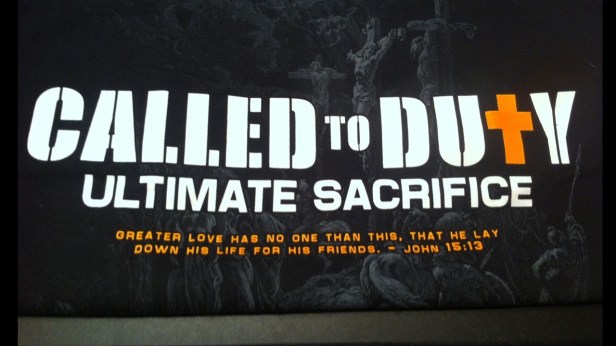
A soldier died for your freedom, but Jesus died for your soul. It’s right that we remember Jesus’ sacrifice for us and it’s right to honour those who sacrificed their lives so that we, and other nations, might live in freedom. We remember so we don’t forget.
5) Remembrance Sunday
Some people believe that Remembrance Sunday is outdated, that it’s a religious observance that should no longer be practised and that it isn’t relevant today. Some even suggest that Remembrance Sunday glorifies war. But that misses the point of Remembrance Sunday altogether.
Remembrance Sunday is a time when we recall those who gave themselves for us and to remember why it was, they did what they did. It’s a time to remember the horror of war and vow ‘never again’. It’s a time to dedicate ourselves anew to living in such a way that we don’t break faith with those who died to bring peace to the world. It’s a time to commit ourselves once again to the struggle against evil – the struggle against the very things that to lead to war in the first place.
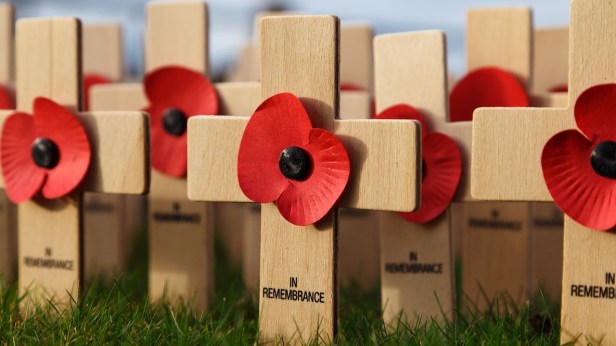
May each one of us determine, with God’s help, to make this Remembrance Sunday a time when we: Remember what we were, Remember what happened and Remember what we should be. Let’s say these words together:
They shall grow not old, as we who are left grow old;
Age shall not weary them, nor the years condemn.
At the going down of the sun and in the morning,
we will remember them.
COPYRIGHT DISCLAIMER: The text contained in this sermon is solely owned by its author, Revd Paul A. Carr. The reproduction, or distribution of this message, or any portion of it, should include the author’s name.
 revPACman