
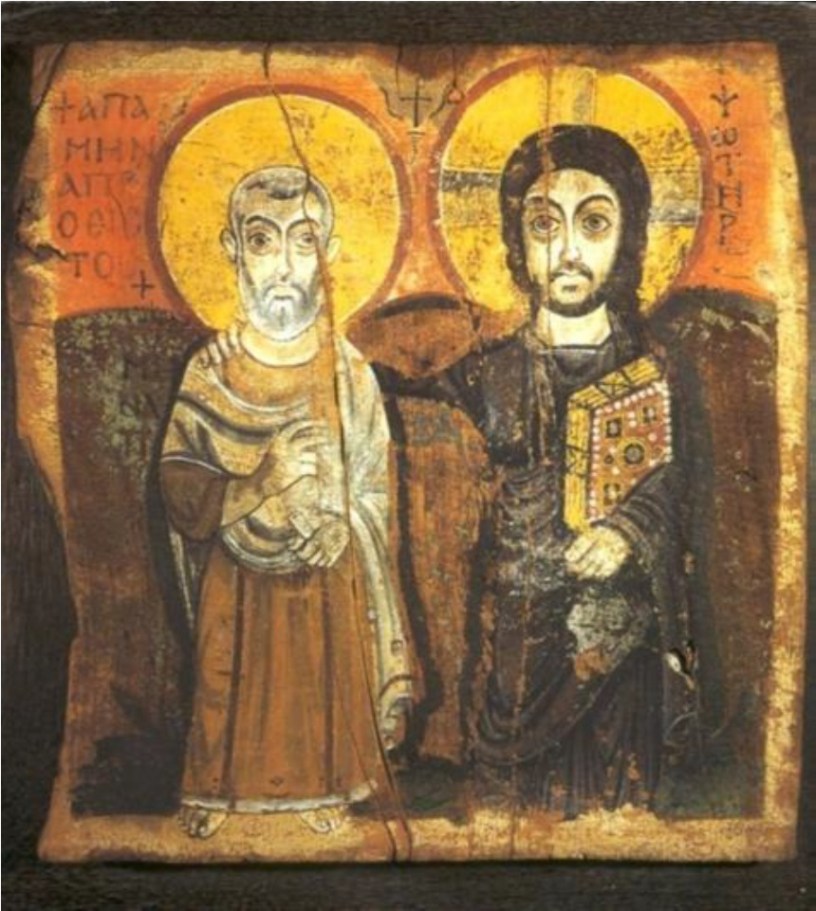
Nowhere is this image of God drawing close to us more profoundly demonstrated than in this, the oldest known Coptic icon, written in the 8th century in Egypt and depicting Christ and Abba (Abbot) Mena (285-309 A.D.) currently hanging in the Louvre in Paris.
The French, however, do not call it ‘Christ and Abba Mena’; they title it ‘Christ and His Friend’. Reflection upon this icon can be used to demonstrate what it is to live the Christian life.
Christ, to the right, is slightly taller than the figure on the left; the inscription ‘Saviour’ is written near him. In a sign of introduction and as a protective gesture, his right hand is placed on the left shoulder of Saint Mena, who can be identified by the inscription placed to the left of his halo, ‘Apa Mena superior.’
In the icon, we notice the unusual position of Christ with his arm around ‘the friend.’ This embrace can demonstrate the change of status we have with Christ. He no longer calls us servants but rather friends.
No longer do I call you servants, for the servant does not know what the master is doing, but I called you friends, for all that I have heard from the Father I have made known to you. (John 15:15)
This icon shows the Lord Jesus Christ holding the Book of the Gospels, symbolizing that He is the Word, the Truth. We are like the friend in the icon, we also have been given something to share, as signified by the small scroll that the friend is holding.
The next detail of this icon to consider is that Christ has no feet. The fact that the friend has feet can be understood as being sent out like the father sent the Son. As Teresa of Avila prayed:
Yours are the feet with which he walks to do good, Yours are the hands, with which he blesses all the world. Yours are the hands, yours are the feet, Yours are the eyes, you are his body. Christ has no body now but yours, No hands, no feet on earth but yours, Yours are the eyes with which he looks compassion on this world. Christ has no body now on earth but yours.
Finally, there is silence found in this icon, as in all icons. Christ and His friend have their mouths closed. The friend, however, is painted with very prominent ears. We are primarily listeners of God. There is a silence in the icon, a prayerful silence where not a word is spoken.
One of the dangers we encounter in our modern technological world is that of constant noise. We are easily bombarded with chatter all day long. It could be through the radio, TV, Internet, or the ceaseless conversation of others. Rarely do we find times of great silence. As a result, when silence is offered to us, we often try to fill that silence immediately. But is this wise? Is it good to occupy our minds day and night with noise?
Though every person will be different, each and every person does need times of regular silence and solitude. Without it, it is hard to hear the Voice of God. God speaks in the silence and He desires to communicate to you through this sacred language. Do not run from silence for, if you do, you will be running from the Voice of God.
Try to take some time each day alone in silence. If you find that it is difficult to do even for five minutes, then this is a sign that there is too much noise in your life. Resolve to have more times of silence this Lent. Turn off the radio in the car, go for a walk, or sit and pray without thinking or speaking, just being quiet in the presence of God. The gift of silent communication with God is a gift that you need and you will learn more from silence than from hours of the noise of the world.
A Prayer
Lord, I desire to seek You in the silence.
I choose to listen to Your quiet promptings of love spoken in this way.
Give me the wisdom and strength I need to dedicate myself to moments of quiet every day.
May these moments bring clarity to my soul and understanding to my life.
Jesus, I trust in You. Amen.
This was written by Revd Mark Derry, of the Church of the Epiphany, Qatar.
 revPACman