
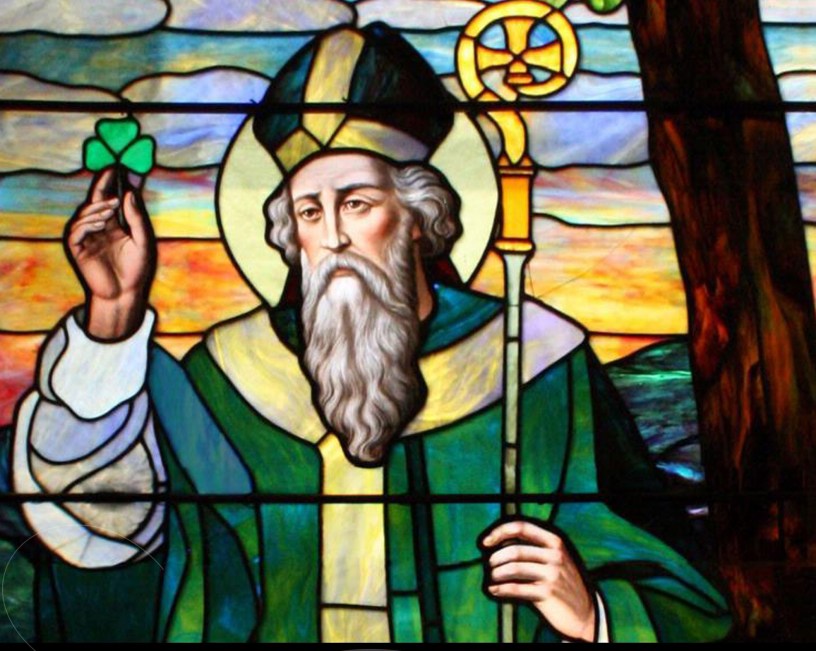
The 17 March celebrates Saint Patrick, the patron Saint of Ireland and is one of the world’s most popular saints. So, to all my Irish friends “Lá Fhéile Pádraig Sona Duit!” And may you wear your Shamrocks with pride and enjoy a pint of the black stuff!
But who was Saint Patrick?
Patrick was a 5th-century Romano-British Christian missionary and Bishop in Ireland. Much of what is known about Saint Patrick comes from the Declaration, which was allegedly written by Patrick himself.
Patrick was born in Britain, in the region of Carlisle. His father was a deacon and his grandfather was a priest in the Christian church, although he was, at best, initially only nominal in his faith.
At the age of 16 he was kidnapped by pirates and forced to work as a shepherd in Ireland. He spent six years there working as a shepherd and that during this time he found God. The Declaration says that God told Patrick to flee to the coast, where a ship would be waiting to take him home.
Details of his escape are sketchy, but it is known that he travelled 200 miles from his place of captivity to a seaport. The adventures and escapades of his journey home honed his reliance upon God, and when he finally returned to his family he felt that he should become a priest, and began a period of training that was to last for several years.
According to tradition, Patrick returned to Ireland to convert the pagan Irish to Christianity. The Declaration says that he spent many years evangelising in the northern half of Ireland and converted thousands.
Patrick’s efforts were eventually turned into an allegory in which he drove “snakes”, heathen practices, out of Ireland, despite the fact that actual snakes were not known to inhabit the region. Tradition holds that he died on 17 March and was buried at Downpatrick. Over the following centuries, many legends grew up around Patrick and he became Ireland’s foremost saint.
Patrick’s life and teachings continue to inspire people of all ages and backgrounds. His message of love, forgiveness, and redemption is as relevant today as it was in his own time. Patrick’s commitment to serving others, even in the face of adversity, is a powerful example for all of us to follow.
Patrick is said to have used the shamrock, a three-leaved plant, to explain the Holy Trinity to the pagan Irish. This story first appears in writing in 1726, though it may be older. In pagan Ireland, three was a significant number and the Irish had many triple deities, which may have aided Patrick in his evangelisation efforts. On Saint Patrick’s Day, it’s customary to wear shamrocks, green clothing or green accessories.
While millions around the world celebrate Saint Patrick’s Day, the sad fact is that Patrick has never been canonized by the Catholic Church and is a saint in name only. There was no formal process for canonization in place when Patrick died. He was proclaimed a saint by popular acclaim, probably with the approval of a bishop. The official process for canonization did not come until about the 12th century.
This well known prayer is attributed to Saint Patrick (though you may only be familiar with some of the words):
The Prayer of Saint Patrick
I arise today
Through the strength of heaven;
Light of the sun,
Splendour of fire,
Speed of lightning,
Swiftness of the wind,
Depth of the sea,
Stability of the earth,
Firmness of the rock.I arise today
Through God’s strength to pilot me;
God’s might to uphold me,
God’s wisdom to guide me,
God’s eye to look before me,
God’s ear to hear me,
God’s word to speak for me,
God’s hand to guard me,
God’s way to lie before me,
God’s shield to protect me,
God’s hosts to save me
Afar and anear,
Alone or in a multitude.Christ shield me today against wounding
Christ with me, Christ before me, Christ behind me,
Christ in me, Christ beneath me, Christ above me,
Christ on my right, Christ on my left,
Christ when I lie down, Christ when I sit down,
Christ in the heart of everyone who thinks of me,
Christ in the mouth of everyone who speaks of me,
Christ in the eye that sees me,
Christ in the ear that hears me.I arise today
Through the mighty strength
Of the Lord of creation.
Amen.(Lorica (or ‘Breastplate’) attributed to Patrick, prob. c.8th century)
And finally, a traditional Irish Blessing:
May your troubles be less,
Your blessings be more,
And nothing but happiness
Come through your door.
Revd Paul A. Carr, various sources and extract from ‘Saints on Earth: A biographical companion to Common Worship’ by John H Darch and Stuart K Burns
And as a bonus, this is a beautiful song called Ireland by an Irish singer/songwriter friend of mine Megan O’Neill.
Interestingly, Megan first performed this publicly at a house gig in Billericay Rectory in February 2020

 revPACman