
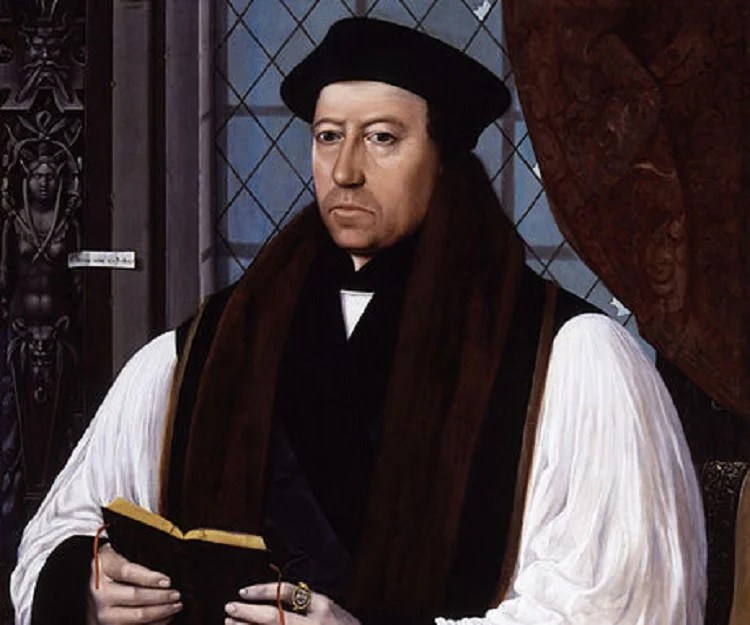
On 21 March the Church of England remembers Thomas Cranmer. Cranmer was the first Protestant Archbishop of Canterbury and a leader of the English Reformation who had a significant impact on the Church of England in it’s liturgy and writings.
But who is Thomas Cranmer?
Born in Aslockton in Nottinghamshire, in1489, Cranmer was educated at Jesus College, Cambridge. He became a Fellow and was ordained in 1523, receiving his doctorate in divinity in 1526. As a Cambridge don Cranmer came to the king’s notice in 1529 when he was investigating ways forward in the matter of the proposed royal divorce.
His rise was rapid. He was appointed Archdeacon of Taunton, made a royal chaplain, and given a post in the household of Sir Thomas Boleyn, father of Anne. In 1530 Cranmer accompanied Boleyn on an embassy to Rome and in1532 he himself became ambassador to the court of the Emperor Charles V. His divergence from traditional orthodoxy was already apparent by his marriage to a niece of the Lutheran theologian Osiander despite the rule of clerical celibacy.
Returning to England to become Archbishop of Canterbury, he was in a dangerous position. Henry VIII was fickle and capricious and Cranmer was fortunate to survive where many did not. Yet Henry seemed to have a genuine affection for his honest but hesitant archbishop, even if he did (apparently in jest) describe him as the ‘greatest heretic in Kent’ in 1543.
Four years later Henry died with Cranmer at his bedside and during the brief reign of Edward VI the archbishop now had an opportunity to put into practice his reform of the English Church.
He edited the Homilies (1547) and wrote those on salvation, good works, faith, and the reading of Scripture. He compiled the two Prayer Books of 1549 and 1552, and wrote the original 42 Articles of Religion (1552).
But the young king’s death brought Cranmer’s phase of the English Reformation to a premature end. He was imprisoned first in the Tower then in the Bocardo prison in Oxford. Under great physical and mental pressure he several times recanted of his deviations from Roman doctrine. But at the last he re-found his courage and repudiated all his recantations before he was burned at the stake on 21 March 1556.
In later years it would become apparent that the seed Cranmer had sown had taken deep root and his 1552 Prayer Book (as amended in 1559 and 1662) clearly demonstrated his gift for both rhythmical fluency and memorable phrase. It was to become a lasting treasure of the English language and Cranmer’s principle of liturgical worship in contemporary English has become a defining element of the Anglican Church.
Cranmer’s death was immortalised in Foxe’s Book of Martyrs and his legacy lives on within the Church of England through the Book of Common Prayer and the Thirty-Nine Articles.
A Prayer for Thomas Cranmer
Father of all mercies,
who through the work of your servant Thomas Cranmer
renewed the worship of your Church
and through his death revealed your strength in human weakness:
by your grace strengthen us to worship you
in spirit and in truth
and so to come to the joys of your everlasting kingdom;
through Jesus Christ our Mediator and Advocate,
who is alive and reigns with you,
in the unity of the Holy Spirit,
one God, now and for ever.
Amen.

Thomas Cranmer, Nicholas Ridley and Hugh Latimer are now known as the “Oxford Martyrs”. A cross on the ground in Broad Street, Oxford, marks the place where they were burned at the stake and a memorial to them was erected in Oxford in the 19th century. The inscription reads:
To the Glory of God, and in grateful commemoration of His servants, Thomas Cranmer, Nicholas Ridley, Hugh Latimer, Prelates of the Church of England, who near this spot yielded their bodies to be burned, bearing witness to the sacred truths which they had affirmed and maintained against the errors of the Church of Rome, and rejoicing that to them it was given not only to believe in Christ, but also to suffer for His sake; this monument was erected by public subscription in the year of our Lord God, MDCCCXLI.
Revd Paul A. Carr & an Extract from Saints on Earth: A biographical companion to Common Worship by John H Darch and Stuart K Burns
 revPACman