
This is a copy of my talk given at Ayia Kyriaki and Saint Stephen’s in the Anglican Church of Paphos on Sunday 21 April 2024. The Bible Readings were Psalm 23 and John 10:11-18. Would you believe this is the first time I’ve ever spoken on Psalm 23 – apart from at funerals!
Prayer
Heavenly Father
I thank You for Your word
By the power of the Holy Spirit
May You speak to my heart
And change my life
In the precious name of Jesus I pray
Amen.
Introduction
It is said that a picture is worth a thousand words. If that is so, then how do we picture God? The answer, of course, is that God presents himself to us using word pictures. And these word pictures open to us aspects of God which would not otherwise be available to us.
And one of the most sublime, captivating and comprehensive pictures we have of God in the Bible, over and over again, is that of Shepherd. And the most famous part of Scripture which portrays God in this way is, of course, Psalm 23. Psalm 23 is one of the best-loved and most well-known sections in the entire Bible – not least because it’s a favourite at funeral services. It is a religious masterpiece of prose.
Charles Spurgeon, who wrote a celebrated six volume commentary of the Psalms entitled ‘The Treasury Of David’ referred to Psalm 23 as the ‘Pearl of the Psalms.’ He wrote
Of this delightful song it may be affirmed that its piety and its poetry … its sweetness and its spirituality are unsurpassed.
David knows what he is talking about here as for the greater part of his early life he was a shepherd, and he draws on that experience to explore what that might mean for God as Shepherd and his people as his flock. Those who live in an urban setting, have a rather romantic view of shepherding. We picture the shepherd sitting under the shade of a leafy tree with his cap tipped over his eyes with his sheep peacefully grazing along some nearby brook only to occasionally lift his cap to see if the sheep are behaving themselves. But nothing could be further from the truth – not in the ancient Near East.
The shepherd worked hard from dawn till dusk. It was a 24/7 job, which is one of the reasons why shepherds were often looked down upon by the religious leaders because their job prevented them from taking part in religious festivals or obeying the Sabbath laws. The shepherd was tough and muscular – he had to be. He was the sheep’s manager, thinker, protector, vet. The sheep’s wellbeing was all down to him.
There was no way a shepherd could be slip shod and caught napping – the sheep were far too valuable to take such a risk. And if that is so with a human shepherd and his flock, how much more is it so with the divine shepherd and his sheep?
1. The Lord our Shepherd SUPPLIES all that we need
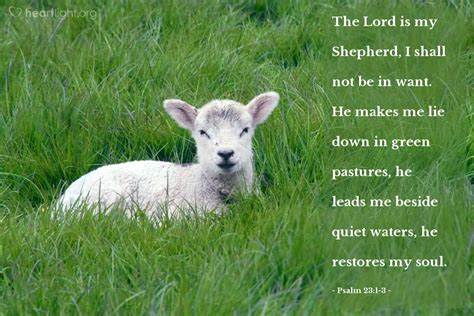
Vs1-2 ‘The LORD is my shepherd; I shall not be in want. He makes me lie down in green pastures, he leads me beside quiet waters, he restores my soul.’
When David says, ‘The LORD’ is my shepherd’ he is using the personal divine name used for God in the Pentateuch (first 5 books of the Bible) which he would have read. The word LORD is actually ‘YHWH’ So instead of saying this is the God who will be whatever he needs to be for you, who is present with you, who cares for you, who rescues you, who makes promises to you and keeps them’, you simply say, ‘YHWH’ – LORD. It encapsulates the whole character of God in one word.
The result of having the LORD as my shepherd is that ‘I will not be in want.’ The sheep will be cared for down to the smallest detail. They will be led to places where they will be well fed, places devoid of poisonous weeds, pastures which are fertile. Note he will lead not push from behind or bully but be out ahead of the sheep taking them beside still waters, so they will not be thirsty, dying from neglect. And when this picture is transferred to God and his people then it is lifted to a much higher plane.
He is not going to leave you in want or need. And when you take a tumble, spiritually speaking, and you are struggling to get up, the Shepherd will be right beside you to set you straight which is what is behind that phrase ‘he restores my soul.’
2. The Lord our Shepherd offers SAFETY
Vs3 ‘He restores my soul; he guides me in paths of righteousness for his name’s sake.’
Not only does the shepherd pick us up when we go astray, he guides us so that we get it right. ‘He guides me in paths of righteousness.’ Or simply ‘the right paths.’ For literal sheep this means that the shepherd will go ahead of the sheep to make sure the track along which they are travelling gets to the new pasture or watering hole. But when applied to God and his people it is the kind of life we were made for. And notice why God does this, it is for ‘his name’s sake.’ What does that mean? It could be because he loves us. It could be that he wants the best for us. It could be that it is all part of his plan. But the ultimate reason why God acts faithfully, lovingly and does not give up is because the sake of his name and his good reputation.
Can a personal name capture such a deep and profound meaning? Well, yes it can. Many people choose the name of their children carefully, especially parents from the African Continent.
My son was born on Christmas Day, and we didn’t want to name him Joseph or Gabriel, so we chose Benjamin (son of my right hand) and Nathan (gift of God.) My daughter was born on Candlemas – when Jesus was presented in the Temple to Anna and Simeon, and we called her Annabel (Graceful beauty) in recognition of this.
But with God. His name is far more important. Everything that God is and stands for is bound up in his name, Yahweh. As we have seen, it is a name which means faithful, provider, holy, righteous and true. So, he has to act in such a way that his name is enhanced and glorified and is seen to stand for what it means.
3. The Lord our Shepherd provides SECURITY
Vs4 ‘Even though I walk through the valley of the shadow of death, I will fear no evil, for you are with me; your rod and staff, they comfort me.’
In ancient Israel valleys were thought of as dangerous places. We tend to think that valleys are pleasant places, whereas the hills are wild and dangerous. But not here. Militarily the valleys gave advantage to Israel’s enemies who had chariots. Here in the valleys the chariots, the iron age equivalent to tanks, could travel with ease and wreak havoc, and so the Israelites built their cities on hills which levelled out the playing field. It was in the valleys that the wild animals like lions and wolves would roam, however, take the sheep a little higher up the mountains, the danger was reduced. So, the valley could literally be the valley of death.
Even though I walk through the dark valleys, the places of threat, the venues of danger, and when it comes to the deepest and darkest valley of them all, death, I will fear no evil because you are with me. You will appreciate that as a minister I have invariably been with people at the point of their death. I have been able to pray with them and for them. I have been able to read words of Scripture to them and hold their hand. But what I have not been able to do is to take them from this world to the next; there is only one who can do that ‘even though I walk through the valley of the shadow of death I will fear no evil for you are with me.’ He is the only one who can be. The LORD is wise enough, and strong enough and powerful enough to get you across and no enemy – including the last enemy – death, can defeat him.
‘… your rod and staff, they comfort me.’ A rod was used to protect their sheep from wild animals. A staff has a crook on the top which was used to rescue the sheep if they got stuck somewhere. It’s a lovely picture of the way God cares for us, protects us and rescues us throughout our lives. So, both in terms of protection and guidance the Christian is secure. And only those who are Christian’s can say that.
4. The Lord our Shepherd is our SHIELD
Vs5 ‘You prepare a table before me in the presence of my enemies. You anoint my head with oil; my cup overflows.
One problem for sheep was the infestation of flies which would get into the mucus membrane of the nostrils where they would lay their eggs, and the larvae would drive the sheep to distraction. So to protect them from this the shepherd would make a mixture of olive oil and medicinal herbs and rub it over the sheep’s head. Again, it is all part of the care and protection a good shepherd would give to his sheep so they could live a healthier better life.
Of course, for David it had a further meaning because as the promised King, his head was anointed with oil by the prophet Samuel. This shepherd boy from the least of the 12 tribes is chosen as King by God above everyone else. And David could never get over such divine generosity to him.
5. The Lord our Shepherd provides SHELTER in this life and the next
Vs6 ‘Surely goodness and love will follow me all the days of my life and I will dwell in the house of the LORD for ever.’
If you are a follower of the Lord Jesus, as your shepherd he is determined to get you home to be with him for ever. He has staked his reputation on it and given his life to make it so.
In John 10, we see that Jesus’ followers: a) knew him as their shepherd; b) they knew his voice; c) they heard them calling them by name; d) they loved him; e) they trusted him; f) they followed him. If Jesus is our good shepherd – why would you try to get through life by going it alone as I know some of you are this morning?
Sheep without a shepherd do not fulfil their true potential.
Here is one who offers you himself to supply you, to secure you and to satisfy you. If we listen to his voice, trust in the plans he has for us, surrender ourselves to his protection and get to know him as he knows us then we can be certain that he we lead us to the most amazing pasture of all.
Is the Lord your shepherd? I pray that he is and that you will offer your life into his care.
Now may the God of peace who brought again from the dead our Lord Jesus, the great shepherd of the sheep, by the blood of the eternal covenant, equip you with everything good that you may do his will, working in us that which is pleasing in his sight, through Jesus Christ, to whom be glory forever and ever. Amen.
Hebrews 13:20-21 ESV
COPYRIGHT DISCLAIMER: The text contained in this sermon is solely owned by its author, Revd Paul A. Carr. The reproduction, or distribution of this message, or any portion of it, should include the author’s name.
 revPACman