
This is a copy of my talk given at Saint Luke’s in the Anglican Church of Paphos on Sunday 28 April 2024. The Bible Reading was John 15:1-8.
Prayer
Heavenly Father
I thank You for Your word
By the power of the Holy Spirit
May You speak to my heart
And change my life
In the precious name of Jesus I pray
Amen.

There’s a story told about Muhammad Ali, the former heavyweight boxing champion of the world. He’s the one who used to say: “I am the greatest”. Not without reason, it has to be said, because he pretty much was. One day he was on an aeroplane when the passengers were told to fasten their seat belts. Seeing that Ali hadn’t done so, one of the stewardesses asked him to fasten his belt. Ali replied, “Superman don’t need no seat belt”. To which the stewardess, brilliantly, responded, “Superman don’t need no plane.”
There’s something shocking about someone making such extravagant claims about themselves – even if it’s part of an act, or done in good humour, or even self-mocking. Yet what Ali claimed for himself was nothing compared to the claims of Jesus of Nazareth. Jesus consistently and repeatedly made claims which put himself, and not only his teaching, at the centre of spiritual reality, defining spiritual reality for us. In Jesus’ words here in John 15 there are four parts: the vine, the gardener, the branches and the fruit. There’s no question as to who they represent.
- The Vine and the Gardener
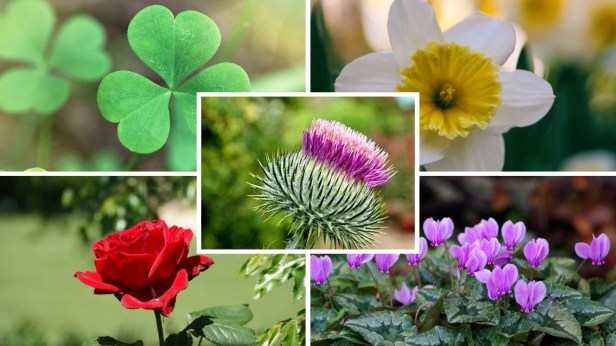
In vs 1, Jesus is saying he’s the one who gives God what he’s been looking for from his people, but not yet found. He’s the true vine. ‘True’ as in real and genuine, as opposed to false or imitation. ‘True’ as in ultimate and final, as opposed to temporary or provisional. The disciples, with their Jewish upbringing, knew the ‘vine’ image refers to the nation of Israel, the people of God. Rather like we might speak of the Shamrock for Ireland, Thistle for Scotland, Daffodil for Wales, Rose for England or a Cyclamen for Cyprus.
But every time God or the prophets spoke of the vine, it was in terms of failure. Because this vine had never produced the fruit God looked for. The fruitless vine, good only for burning, stood for faithless Israel, ready for judgement. So, when Jesus comes as the true vine, he comes as everything that Israel was meant to be but failed to live up to – to be God’s own people, faithful, loyal, obedient, fruitful.
Jesus is making the point that if they, the Jews, want to continue enjoying the status of God’s people, they must belong to him. If he’s the true vine, no other vine can do the job of bearing fruit for God. It’s no longer enough to be a Jew, Jesus is saying, you need to be a Christian. Their heritage, and even their homeland, is no substitute for being in the true vine. We can say the same to ourselves. There’s no substitute for being in the true vine.
There’s much talk these days of spirituality and being spiritual. But don’t Jesus’ words here mean that the only true spirituality is Christianity and that we’re only truly spiritual when we’re a Christian? It also warns us that it’s not enough to belong to a Christian family or a church. If Jesus is the true vine, we only belong to God’s people if we belong to him. He’s the one who gives God what he’s been looking for in terms of spiritual life and fruit.
- The Vine and the Branches
Again, there’s no doubt who’s who here: v5a… Jesus is the vine. His disciples, including Christians today, are the branches. You don’t need to have seen a vine to understand what Jesus is saying. The vine and the branches share the same life. They are part of each other. It’s impossible to think of one without the other. So, Jesus can talk of us remaining in him and of him remaining in us. As the vine gives life to the branches, so Jesus gives life to us. As the vine bears fruit through the branches, so Jesus bears fruit through us, v4-6 …
At this point in John’s Gospel, Jesus is preparing his disciples for life without him. He’ll soon return to his Father via the cross. They’ll be without him, but only physically – because Jesus is telling them how they can still be part of him, remain in him and bear fruit for him, just as branches do with the vine. And that’s the position we’re in as a Christian today. The vine, Jesus, is with the Father, in heaven. The branches, his followers, are still here on earth. How will Jesus bear fruit and do his work in the world today? Through the branches – through those who belong to him. Through you and me.
But if you are anything like me, it’s difficult to achieve the kind of standard that Jesus expects especially when we try to accomplish it in our own strength. The only way we can produce the fruit that Jesus speaks of is if we stay close to Him, allowing Him to shape our lives. To try and be a Christian without Christ is nonsense. If you neglect to read God’s word and don’t make use of the opportunities to hear what it says, how can you expect to enjoy the life that Christ gives? How can you hope to bear fruit for him?

Maybe the Alpha Course will help you to understand why the Bible – as well as Prayer and Church etc. – is important to our Christian lives.
But we need something more than Bible study if we’re to be really fruitful, says Jesus, and it’s not something we’d choose. It’s the Father’s discipline, or the gardener’s pruning, v2 … Christians often go through terrible times: long and painful illness, a distressing bereavement, the break-up of a deep and close relationship. We’re tempted to ask God, “Why is this happening to me?” And understandably so. Perhaps we begin to think that our suffering is a sign of his displeasure, that he’s punishing us for something we’ve done wrong.
This passage doesn’t give all the answers, but it does give an important part of the answer. The gardener prunes the branches until they’re as fruitful as they can possibly be. Our heavenly Father is disciplining us until we’re as fruitful as we can be.
Actually, to be pruned is a compliment. It means there’s life in the branch, something worth nurturing and encouraging. You don’t prune a branch which is dead and lifeless – you cut it off and throw it on the fire. When God disciplines us, it’s because he sees some life in us, something of Christ that is worth nurturing. He sees spiritual life and he does it to produce more spiritual fruit. Hebrews 12:10b-11 … but God disciplines us for our good, in order that we may share in his holiness. No discipline seems pleasant at the time, but painful. Later on, however, it produces a harvest of righteousness and peace for those who have been trained by it.
An old Christian lady who had served Christ all her life was telling her story at a church meeting. A young Christian man in the congregation, awestruck by her godliness, whispered, a bit too loudly, to his neighbour, “I’d give everything to have a testimony like that!” The old lady, whose hearing was still very sharp, overheard and replied, “Young man, everything is what it cost me!”
- The Vine and the Fruit
I’m not the world’s most capable gardener, though we had a garden that was over an acre in our previous house, it took some looking after – we had a sit on mower! I found gardening to be quite therapeutic – and spiritual too. I’ll have to try and so something with the pots on our patio here.
Anyway, we had a Holly Tree at the bottom of the garden, and I observed that it bore red berries every year. It didn’t produce a Daffodil, or a Thistle or a Rose or a Shamrock or a Cyclamen – nor would I expect it to do so.
What fruit does a vine bear? Vine fruit. Grapes, we normally call them. It will not produce apples, or oranges, or pears, however patient we are.
There’s a question we haven’t yet answered in thinking about the vine: What is the fruit which it bears? The vine is there to bear fruit. That’s what makes it the true vine. Fruit bearing is a theme all the way through.
Bearing fruit is what being a disciple is all about and brings glory to God: vs8… But what is the fruit? It’s described in four different ways in the verses which follow. They’re not four different fruits, as if we can choose between them. They’re all the fruit of Christ shown in the lives of those who belong to him. Here they are: vs10, obedience, v11, joy, vs12, love, v16, witness. Perhaps this last one is least obvious. But we must remember that Jesus is preparing his disciples for the time they’ll spend waiting for him to return. He’s already told them, 14v30: the prince of this world is coming.
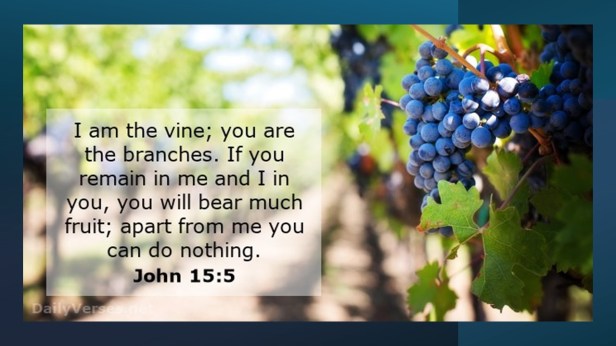
Are you a fruit bearing Christian? There’s no other kind. If I’m a Christian, I will bear fruit. But you may say, surely, we’re saved, we’re Christians because of what Christ has done for us, not because of what we do for him? Yes, that’s true. And Jesus makes that very point in vs3. We only belong to him because of his word spoken to us and dwelling in our lives. But, at the same time, the only evidence that we do belong to him and share the life he gives is that we bear his fruit.
A preacher was once challenged by a man after his sermon: “Don’t you agree that a Christian may fall very far and yet be saved?” The preacher replied, “I think it would be a very dangerous experiment.”
Have you ever seen one of those portrait paintings where the eyes have been so skilfully painted that they appear to be watching you wherever you go? That, no matter where you go in the room, they’re looking straight at you. Similarly, we can’t get away from Jesus. We have to reckon with him. He’s the one who gives God what he’s been waiting for from his people. He’s the one who gives life to his people and bears fruit through them. He’s the one who determines the character of the fruit in their lives. With him, we have everything. Without him, we have nothing. vs5
COPYRIGHT DISCLAIMER: The text contained in this sermon is solely owned by its author, Revd Paul A. Carr. The reproduction, or distribution of this message, or any portion of it, should include the author’s name.
 revPACman