
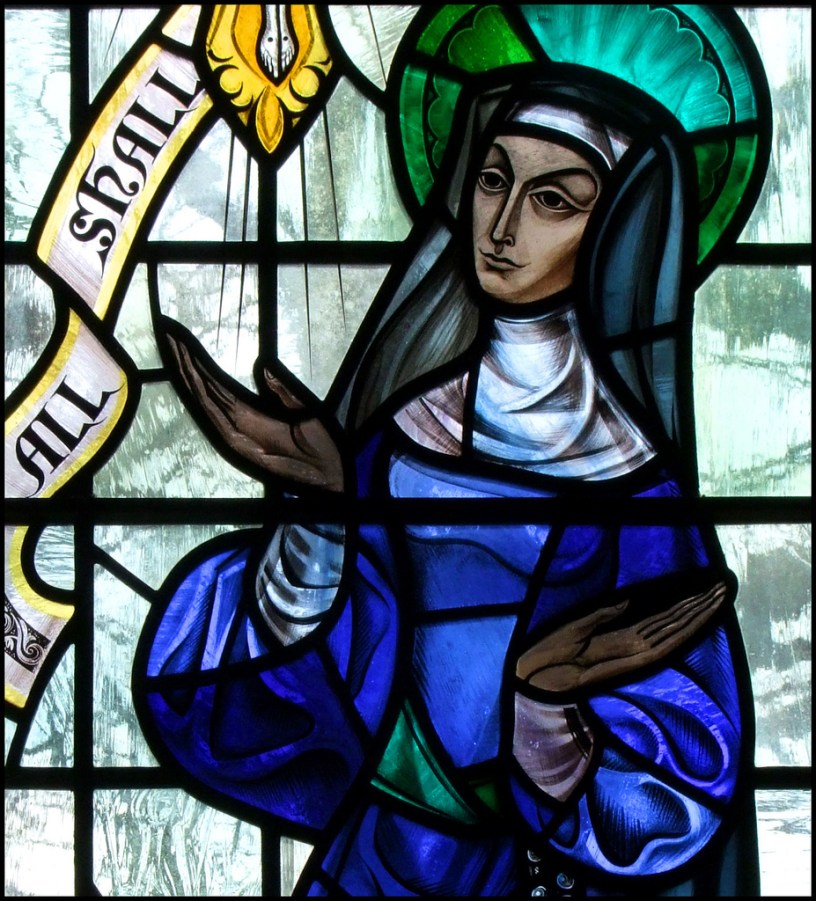
On 8 May the Church remembers Julian of Norwich a spiritual writer and mystic. She is known as the patron saint of cats and is known for her ‘Revelations of Divine Love’ and her most famous saying:
All shall be well and all shall be well and all manner of things shall be well.
But who was Julian of Norwich?
Julian was born in 1342 and her life is something of a mystery. It has been argued that she had been married and widowed before becoming a recluse. What is known for certain is that at the age of 30 Julian fell ill, and just when she thought she had reached the point of death her pain vanished and she received 16 visitations.
Julian wrote these down in what came to be known as the ‘short text’, before meditating on them and producing her ‘long text’ 20 years later.
Julian focuses upon spirituality and creation. She stresses that all things have their being through the love of God. She believes that we were loved from eternity. The high point of her spirituality is the cross and she shows a desire to enter into the sufferings of Christ. She is convinced that humanity was separated from God by sin, and is redeemed and reunited with God through Christ. Julian places stress upon Christ as mother, as divine wisdom, but she does so with a distinctly Trinitarian understanding.
One of the notable features of Julian is that her theology determines her experience, rather than the other way round. Thus seeing Christ’s suffering allows Julian to see the meaning of this life generally, and of her own suffering especially.
For Julian the image of God as mother speaks more powerfully than anything else of the outgoing love of the Trinity for creation. Julian was writing at the point in history when theology and spirituality were being slowly but surely prised apart. Her vision of God is formed out of both an intellectual approach and a response of love.
Her writings have influenced many throughout the centuries, and are the result of reflection on the questions of life in the light of an immediate spiritual experience.
Thus I saw and understood that our faith is our light in the night; which light is God, our endless day. Julian, Long Text 83
When the soul is tempest tossed, troubled and cut off by worries, then is the time to pray, so as to make the soul willing and responsive towards God. But there is no kind of prayer that can make God more responsive to the soul, for God is always constant in love. And so I saw that, whenever we feel the need to pray, our good Lord follows us, helping our desire.
A Prayer for Julian of Norwich
Most holy God, the ground of our beseeching,
who through your servant Julian
revealed the wonders of your love:
grant that as we are created in your nature
and restored by your grace,
our wills may be so made one with yours
that we may come to see you face to face
and gaze on you for ever;
through Jesus Christ your Son our Lord,
who is alive and reigns with you,
in the unity of the Holy Spirit,
one God, now and for ever.
AMEN.
Revd Paul Carr & Extract from Saints on Earth: A biographical companion to Common Worship by John H Darch and Stuart K Burns
 revPACman