
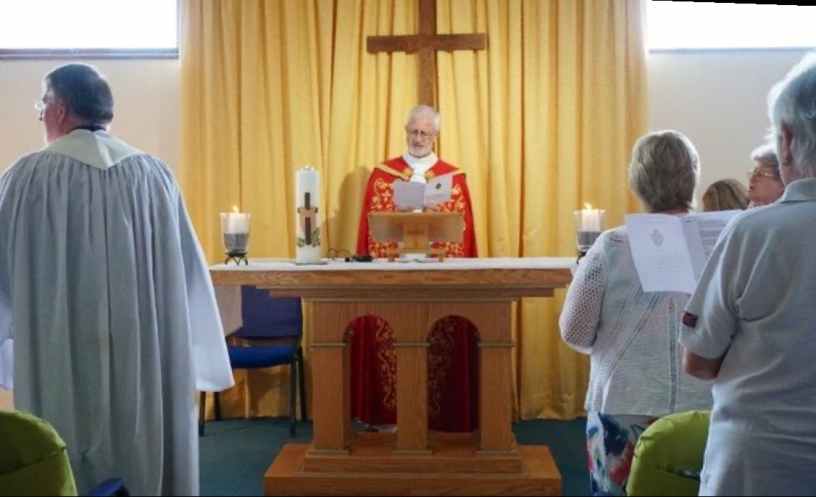
This is a copy of the talk given by the Archdeacon of Cyprus, Ven Christopher Futcher, at my induction service at Saint Stephen’s, Tala, in the Anglican Church of Paphos on Saturday 26 April 2024. The Bible Readings were Acts 13.44-end, Psalm 98.1-5 and John 14.7-14.
There is no getting away from it, Easter celebrated a few weeks ago and through this whole season, is experienced as a huge disruption.
Starting, of course, with the raising of Jesus from the dead: the dead friend who appears to the grieving woman in the garden, the leader and companion who is suddenly among the disciples in a closed room, the unrecognised companion on the road.
It is hard for us to appreciate the emotional, mental and spiritual adjustments that are demanded by these disruptive appearances.
In the gospel reading Philip, earlier, but in an almost timeless way, asks the question that all will want to ask when encountering or hearing about this man. We’ve heard your words, we’ve seen what you are doing, but just show us the Father – give us the proof that you really are as close to him as you say you are.
The reply is for us all, for the church, for enquirers about faith. You must change your focus, allow yourself to see that the Father is in Jesus, and Jesus is in the Father. Recognise that the dependency of Jesus on the Father is a both a transparency and a unity. If you know one, you know the other, nothing of the Father remains hidden, because Philip’s question still assumes that the Father is other than the Son, separate and beyond. Seeing the Father or turning to the Father, does not mean going beyond Jesus.
Philip must change his focus, as must they all and when they do the disciples will be a renewed humanity, capable of zealously proclaiming the loving and redeeming presence of God in Christ. The disciples will be able to proclaim these events as having taken place in specific time and particular places, God acting in human history.
Just as Philip is attested to have done in the Acts of the Apostles, when he preached the gospel in Samaria and encountered the Ethiopian Eunuch on the road from Jerusalem down to Gaza. Let these place names, biblical and modern, stay with us. This did not happen just anywhere, but in specific places.
In the Easter season this paired reading of John’s Gospel and the Acts of the Apostles makes so clear that the Church is an Easter people. Our fundamental identity as people of faith is here. As we receive these events as good news, having taken place at a specific time and in particular places, God acting in human history for the sake of the humanity he loves.
Most of us accept some changes in our lives, the ones we choose, like life with a partner, but there are others … I recently had to upgrade my mobile phone. There is a bit of the new toy sensation, but mostly anxiety about data transfer and becoming familiar with some differences. I know that I will use mainly those functions with which I am already familiar. I know it can do far more than that, far more than I am used to, but the old one had become comfortable. I think that Easter faith is like that. Most of us settle and do not explore deeply the unrestricted scope of our personal relationship with the Father through the Son.
The call of Jesus in the reply to Philip calls us to go beyond, to go further, in accepting the change that has taken place in our world and our lives. A new life that comes from the essential nature of Christ, dwelling with and within those who love him.
In the Acts reading Paul and Barnabas are in the city of Antioch, deep into modern Turkey, after their visit and journey through Cyprus.
They are attracting large crowds and speaking boldly. It is interesting to see how often in the preaching of the Apostles in the Roman world social cohesion was disturbed. In Ephesus it was the traders of goods related to the cult of Diana, in Antioch, it seems to have been the settled status of the resident Jewish population. Influence was used against them. Populism and the manipulation of crowds through fear of change is nothing new. Blame someone foe a change, identify them as an enemy, unite people against them, as a way of achieving an action.
Here in Antioch influential people incited the population to have Paul and Barnabas driven out of the town. It is one of those key moments in the Bible to describe how Christ came to be preached to the Gentiles. It needs to be handled with care so that it does not become a stepping stone towards a Christian anti-semitism.
It serves also as an indication that we cannot escape this turmoil of disturbance in our world, because the Easter Gospel is always about change, therefore disturbing, therefore not always going to be acceptable.
Paul and Barnabas embraced change in the focus of their preaching, but it was change that was faithful to the mission of God’s people. It came through disruption, but was a new way of doing work described long ago by the prophet Isaiah – a command to be a light to the Gentiles.
About 20 years ago I spent a week on a boat doing a sailing course. 4 of us with a tutor. One of the other participants was a man from Germany. He worked in the car industry in the development of headlight technology, but he was also an academic and later sent me a copy of his book on the business speciality of disruption. The argument being that often disruption is needed to initiate creativity, and therefore business managers need to develop skills specific to handling disruption, because managing change even causing change is good for business.
It is interesting to look back over the history of Christianity, noting moments when change was handled creatively and without division. Sadly there have been schisms and divisions, but also the creation of the Franciscan order within the Roman Catholic Church responding to the new focus on poverty and simplicity by St Francis. Another example would be the acceptance of huge changes in church music, a great acceptance of creativity and one of the features of a working ecumenism in the Church.
Change for the Easter people comes through spiritual refocussing and the effect of external factors: it is creative.
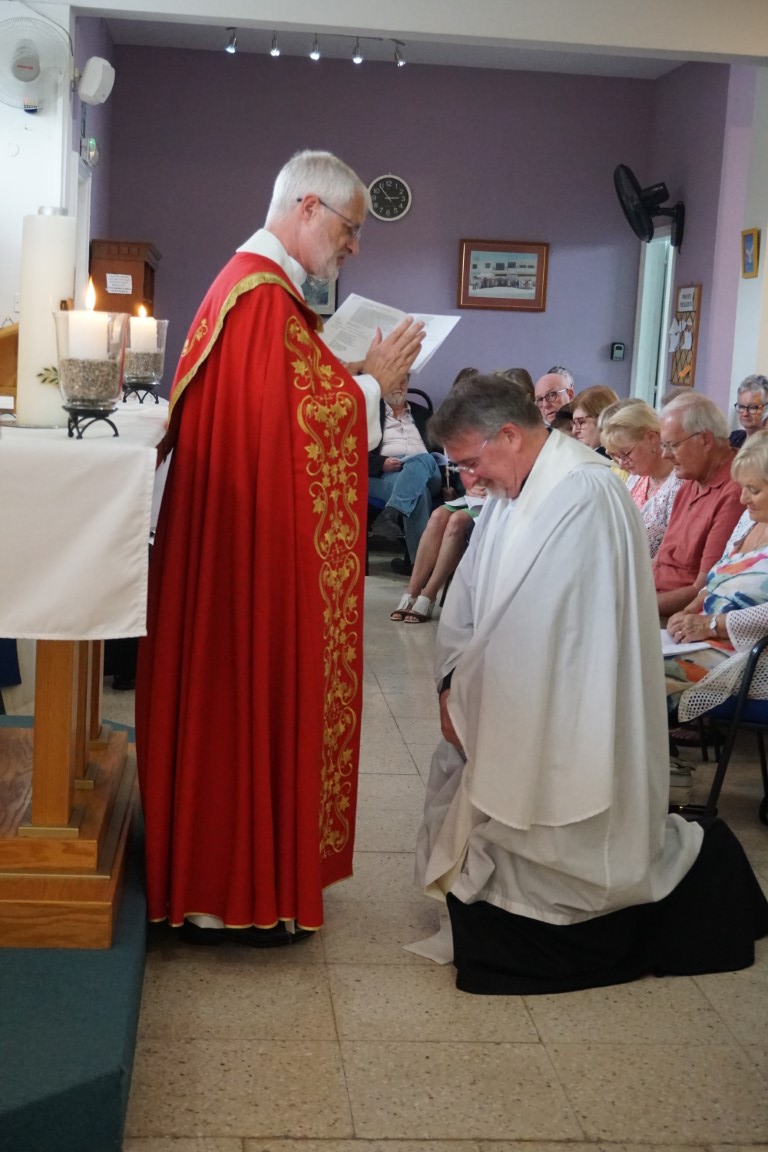
These readings provide a context today for this Welcome Service for Paul, and his wife Paula.
And coming a few months after their arrival, as with any change of a person, we are already experiencing that cycle of creativity through change in the Anglican Parish of Paphos and in the Diocese. There will be more of this for us all as we welcome our new Bishop, Sean, in just a few weeks time.
Already Bishop-elect Sean is asking me, why do we do it like that, how did this come about, and I am trying to find answers that are rational and also clarifying who needs to be consulted and included in resolving on changes.
It is a time to celebrate and welcome new people – Paul and Paula here in Paphos, in two weeks Deborah in Limassol, in four weeks Bishop Sean in the whole diocese.
We are an Easter people, shaped by Christ and his transparent unity with the Father, and we are bold in proclaiming that in him is God who brings light for the world.
 revPACman