
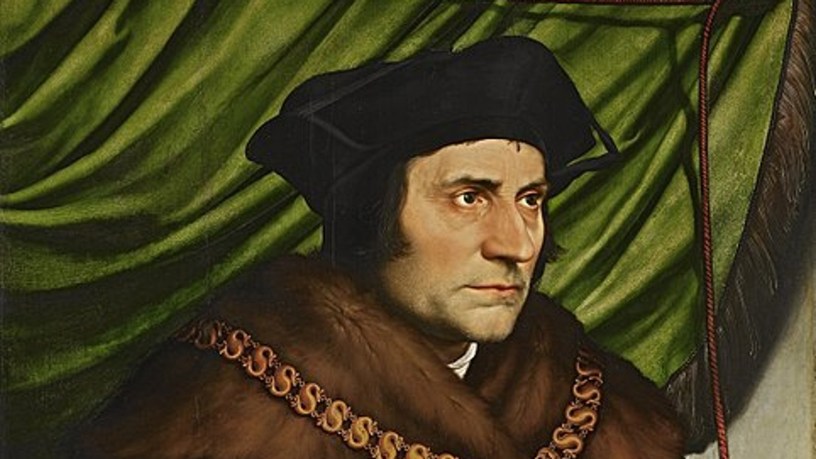
On 6 July the Church remembers Saint Thomas More. He was known for opposing the divorce of King Henry VIII.
But who was Saint Thomas More?
Thomas More (1478–1535) The accounts of Thomas More’s happy home life at Chelsea, recorded after his death by his son-in-law Will Roper, the growth in More’s popularity following his canonization by Pope Pius XI in 1935 and Robert Bolt’s 1960 play A Man for All Seasons, with its widely popular film version, have left a delightful but anachronistic picture of an enlightened twentieth-century family man trapped in the political bear garden that was Tudor England.
The real Thomas More was born in London in 1478, the son of a judge, and educated at Oxford and Lincoln’s Inn. Called to the Bar in 1501, elected to Parliament in 1504 and appointed under-sheriff of London in 1510, the young More was left a widower with four small children. He subsequently married Alice Middleton, a widow, to provide his children with a mother.
An articulate Renaissance humanist, More’s best known work was Utopia (1516), a satirical account of life on the fictitious island of Utopia where conditions there are contrasted favourably with those of contemporary English society. Encountering the growing force of the Reformation, More had no sympathy with either the Reformers or their beliefs. He endorsed the burning of heretics and conducted an acrimonious pamphlet war with William Tyndale.
More came to the attention of Henry VIII and the two men became friends, the king greatly valuing More’s company, conversation and advice. More’s rise in the royal favour was indicated by his becoming a member of the Privy Council in 1518 and being knighted in 1521.
Two years later he became Speaker of the House of Commons and in 1529 Lord Chancellor, the first layman to hold the post. His fortunes changed, however, when he refused to support Henry’s divorce from Catherine of Aragon, his religious principles making him unwilling to support any defiance of the Pope.
He resigned from the Chancellorship in 1532 and withdrew from public life at great personal financial cost. But a private life did not exempt More from the requirements of the 1534 Act of Succession and he refused to take the accompanying oath since it would have involved a rejection of papal authority.
After a trial at Westminster Hall, More was condemned to death and was beheaded on Tower Hill on 6 July 1535, declaring himself on the scaffold to be ‘the King’s good servant, but God’s first’.
THE LAST PRAYER OF ST. THOMAS MORE (composed in the Tower of London)
Give me the grace, Good Lord.
To set the world at naught. To set the mind firmly on You and not to hang upon the words of men’s mouths.To be content to be solitary. Not to long for worldly pleasures. Little by little utterly to cast off the world and rid my mind of all its business.
Not to long to hear of earthly things, but that the hearing of worldly fancies may be displeasing to me.
Gladly to be thinking of God, piteously to call for His help. To lean into the comfort of God. Busily to labour to love Him.
To know my own vileness and wretchedness. To humble myself under the mighty hand of God.
To bewail my sins and, for the purging of them, patiently to suffer adversity.
Gladly to bear my purgatory here. To be joyful in tribulations. To walk the narrow way that leads to life.
To have the last thing in remembrance. To have ever before my eyes my death that is ever at hand.
To make death no stranger to me. To foresee and consider the everlasting fire of Hell.
To pray for pardon before the judge comes.
To have continually in mind the passion that Christ suffered for me. For His benefits unceasingly to give Him thanks.
To buy the time again that I have lost.
To abstain from vain conversations.
To shun foolish mirth and gladness.
To cut off unnecessary recreations.
Of worldly substance, friends, liberty, life and all, to set the loss at naught, for the winning of Christ.To think my worst enemies my best friends, for the brethren of Joseph could never have done him so much good with their love and favor as they did him with their malice and hatred.
These minds are more to be desired of every man than all the treasures of all the princes and kings, Christian and heathen, were it gathered and laid together all in one heap. Amen.
Revd Paul A. Carr & an extract from Saints on Earth: A biographical companion to Common Worship by John H Darch and Stuart K Burns
 revPACman