
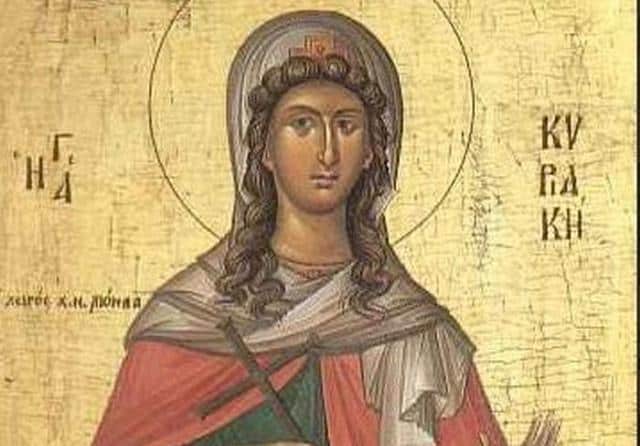
Agia Kyriaki in Kato Paphos, is one of the churches in the parish of the Anglican Church of Paphos
On July 7 the Greek Orthodox Church commemorates the Feast Day of Agia Kyriaki the Great Martyr.
But who was Agia Kyriaki?
Agia Kyriaki was the only child of Dorotheus and Eusebia. Since she was born on a Sunday (Kyriaki, in Greek), she was named Kyriaki.
One day a wealthy magistrate wished to betroth Kyriaki to his son. Not only was she young and beautiful, but her parents were wealthy, and the magistrate wished to control that wealth. The magistrate went to her parents to request her hand, but Saint Kyriaki told him that she wished to remain a virgin, for she had dedicated herself to Christ.
The magistrate was angered by her words, so he went to the emperor Diocletian to denounce the saint and her parents as Christians who mocked the idols, and refused to offer sacrifice to them.
Diocletian sent soldiers to arrest the family and have them brought before him. He asked them why they would not honour the gods which he himself honoured. They told him that these were false gods and that Christ was the one true God.
Dorotheus was beaten until the soldiers grew tired and were unable to continue. Since neither flattery nor torment had any effect, Diocletian sent Dorotheus and Eusebia to Melitene on the eastern border between Cappadocia and Armenia. Then he sent Saint Kyriaki to be interrogated by his son-in-law and co-ruler Maximian at Nicomedia.
Maximian urged her not to throw her life away, promising her wealth and marriage to one of Diocletian’s relatives if she would worship the pagan gods. Saint Kyriaki replied that she would never renounce Christ, nor did she desire worldly riches. Enraged by her bold answer, Maximian had her flogged. The soldiers who administered this punishment became tired, and had to be replaced three times.
Shamed by his failure to overcome a young woman, Maximian sent Saint Kyriaki to Hilarion, the eparch of Bithynia, at Chalcedon. He told Hilarion to either convert Kyriaki to paganism, or send her back to him.
Making the same promises and threats that Diocletian and Maximian had made before, Hilarion was no more successful than they were. Saint Kyriaki challenged him to do his worst, because Christ would help her to triumph. The saint was suspended by her hair for several hours, while soldiers burned her body with torches. Not only did she endure all this, she also seemed to become more courageous under torture. Finally, she was taken down and put into a prison cell.
That night Christ appeared to her and healed her wounds. When Hilarion saw her the next day, he declared that she had been healed by the gods because they pitied her. Then Hilarion urged her to go to the temple to give thanks to the gods. She told him that she had been healed by Christ, but agreed to go to the temple. The eparch rejoiced, thinking that he had defeated her.
In the temple, Saint Kyriaki prayed that God would destroy the soulless idols. Suddenly, there was a great earthquake which toppled the idols, shattering them to pieces. Everyone fled the temple in fear, leaving Hilarion behind. Instead of recognizing the power of Christ, the eparch blasphemed the true God as the destroyer of his pagan gods. He was struck by a bolt of lightning and died on the spot.
Saint Kyriaki was tortured again by Apollonius, who succeeded Hilarion as eparch. When she was cast into a fire, the flames were extinguished. When she was thrown to wild beasts, they became tame and gentle. Therefore, Apollonius sentenced her to death by the sword. She was permitted time to pray, so she asked God to receive her soul, and to remember those who honoured her martyrdom.
Just as Saint Kyriaki ended her prayer, angels took her soul before the soldiers could strike off her head. Pious Christians took her relics and buried them in a place of honour.
Even today, women ask Saint Kyriaki to pray to God, so they can remain firm and courageous in the struggle of everyday life and stay in the path of love of the Risen Christ despite any obstacles.
A troparion (hymn) dedicated to Saint Kyriaki is sung in the fifth Byzantine tone:
O virgin martyr Kyriaki,
You were a worthy sacrifice
When you offered your pure soul to God;
Wherefore Christ has glorified you,
And through you pours forth graces abundantly on all the faithful,
For He is the merciful Loving God!
Revd Paul A. Carr, various sources and Greek City Times
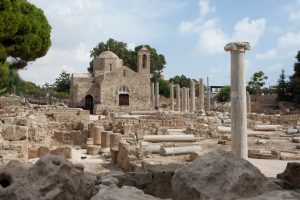
A Brief History of Ayia Kyriaki Chrysopolitissa
St. Paul and St. Barnabas visited Cyprus in 45 AD (Acts 13 verses 5-12) and converted the Roman proconsul Sergius Paulus. He became the first Christian ruler and Cyprus the first Christian country. Tradition has it that St. Paul was scourged in Paphos at the pillar near this church. This church is, therefore, often known as “The Church by St. Paul’s Pillar”.
The church of Ayia Kyriaki Chrysopolitissa was built around 1540 AD as a Latin Church on the site of a small church which was destroyed in 365 AD by an earthquake.
The Orthodox Bishop of Paphos entrusted Ayia Kyriaki to the Latin Catholic Community (LCC) in 1986 and two years later the Latin Catholic Church invited, among others, the Anglican community to use Ayia Kyriaki for the divine worship. – service times can be found HERE.
 revPACman