
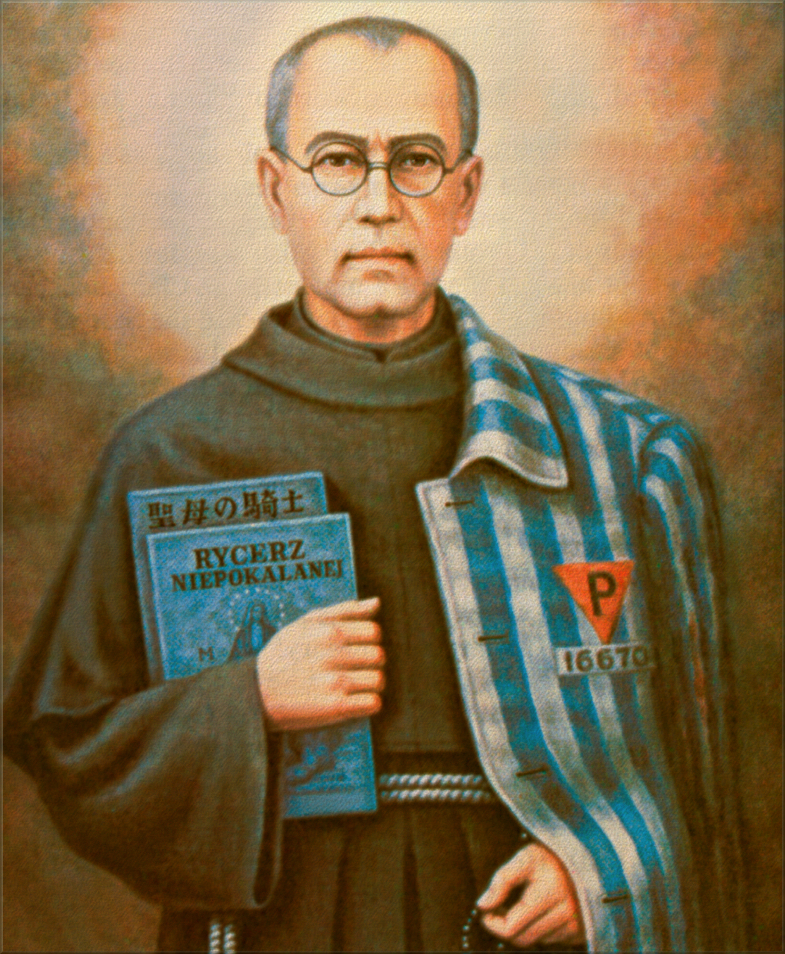
On 14 August the Church remembers Maximilian Kolbe (1894 – 1941) a Polish Catholic Priest and Franciscan, who was put to death in a Nazi concentration camp because of his faith.
But who was Maximilian Kolbe?
Maximilian was born Raymond Kolbe to a pious Catholic family near Lodz in Poland in 1894. In 1906 he experienced a vision of the Virgin Mary, which he described in his own words:
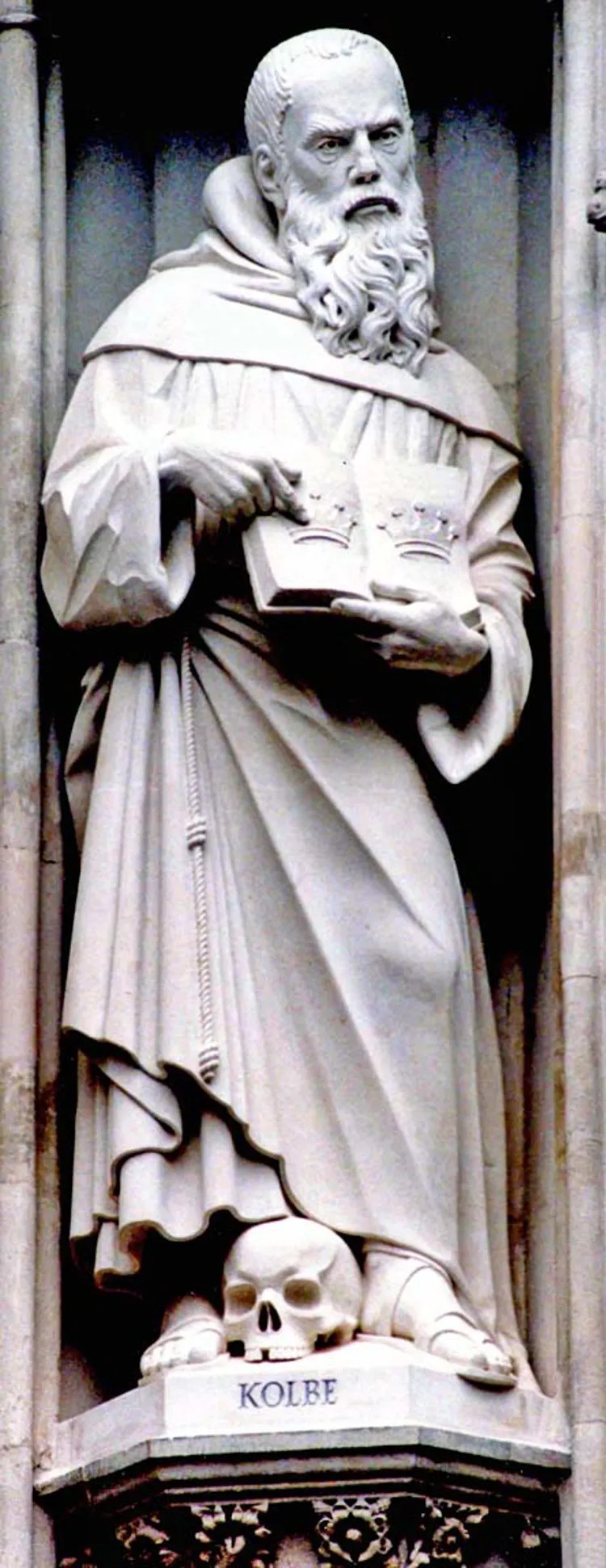
I asked the Mother of God what was to become of me. Then she came to me holding two crowns, one white, the other red. She asked if I was willing to accept either of these crowns. The white one meant that I should persevere in purity, and the red that I should become a martyr. I said that I would accept them both.
In 1910 he entered the seminary of the Conventual Franciscan Order at Lwow and in due course was sent to study in Rome where he was ordained priest in 1918. In 1917 he and six other young men had founded the ‘Militia of the Immaculata’ – a movement to encourage Marian devotion. When he returned to Poland in 1918 to teach in the Cracow seminary, he continued to develop this enterprise. In 1927, despite his indifferent health, he established a community near Warsaw called Niepokalanow, the ‘City of the Immaculata’.
By 1939 it had expanded from 18 friars to 650, making it the largest Catholic religious house in the world at that time. But though in one sense a very conservative organization, in confronting the many changes in modern society, especially its secularization, the friars utilized the most modern technology including printing. This enabled them to publish countless catechetical and devotional tracts, a daily newspaper with a circulation of 230,000 and a monthly magazine with a circulation of over one million.
Maximilian started a short-wave radio station and even planned a film studio. In 1930 he and four companions went to Japan where, despite daunting linguistic and financial difficulties, they established a magazine and a friary at Nagasaki. He envisioned further expansion overseas but by 1936 his health had so deteriorated that his superiors ordered him back to Poland.
Following the German invasion of September 1939 the friars were initially imprisoned but were then unexpectedly released and so were able to work among refugees and casualties of war. But as a Polish patriot who never feared to be outspoken in his contempt for the Nazis, Maximilian was not remain free for long. He was arrested and with countless others made the fateful journey by cattle truck to the death camp at Auschwitz. There he continued to minister to inmates awaiting death.
Death came for him when he volunteered to take the place of another prisoner who had been condemned to die a slow death in a starvation bunker. Maximilian took his place, but eventually his Nazi captors ended his life with a fatal injection on 14 August 1941 – the eve of the Feast of the Assumption – aged 47 yrs. * A fuller account can be read below.
The deed and courage of Maximillian Kolbe spread around the Auschwitz prisoners, offering a rare glimpse of light and human dignity in the face of extreme cruelty. After the war, his reputation grew and he became symbolic of courageous dignity.
Kolbe was beatified as Confessor of the Faith in 1971. He was canonised as a martyr by Pope John Paul II (who himself lived through the German occupation of Poland) in 1981.
Pope John Paul II decided that Kolbe should be recognised as a martyr because the systematic hatred of the Nazi regime was inherently an act of hatred against religious faith, meaning Kolbe’s death equated to martyrdom. At his canonisation, in 1982 Pope John Paul II said: Maximilian did not die but gave his life … for his brother.
A Prayer
Most loving Father,
whose Son Jesus Christ came to give his life as a ransom for many:
Grant to us the grace, as you granted to your servant Maximilian Kolbe,
to be always ready to come to the aid of those in need or distress, not counting the cost;
that we may follow in the footsteps of your Son Jesus Christ our Lord;
who is alive and reigns with you and the Holy Spirit, one God, now and for ever.
Amen.
Saint Maximilian Kolbe is one of the ten Modern Martyrs of the 20th century unveiled above the west door of Westminster Abbey in 1988. The statue was carved by Andrew Tanser.
Revd Paul A. Carr and Extract from Saints on Earth: A biographical companion to Common Worship by John H Darch and Stuart K Burns
* On May 28, 1941, Kolbe was transferred to the concentration camp at Auschwitz. During his time there, he would share his meagre rations of food with those around him.
One day a man from Kolbe’s block escaped. All of the men from that block were brought out into the hot sun and made to stand there all day with no food or water. At the end of the day, the man who’d escaped wasn’t found and so the Nazi commandant told the prisoners that ten men would be selected to die – in the starvation cell – in place of the one who had escaped.
One of those ten selected was a polish sergeant (Francis Gajowniczek). He begged to be spared because he was worried that his family would not be able to survive without him. As he was pleading with the commandant, Kolbe silently stepped forward. The commandant turned to him and said asked, “What does this Polish pig want?”
Kolbe pointed to the polish sergeant and said, “I am a Catholic priest from Poland; I would like to take his place, because he has a wife and children.” The commandant stood silent in disbelief for a moment. He then allowed the sergeant to go back to his place in the ranks and Kolbe took his place in the starvation bunker.
Each day the guards used to remove the bodies of those who had died. However, instead being greeted by the usual sounds of screaming, all they would hear was the sounds of Kolbe and the others in the bunker singing hymns and praying.
When Kolbe could no longer speak due to hunger and lack of energy, he would whisper his prayers. At the end of two weeks, the cell had to be cleared out for more prisoners. Only four prisoners were left alive, and Kolbe was one of them.
The guards came in and gave each a lethal injection and on August 14, 1941, Kolbe paid the ultimate price for following his Master.
 revPACman