
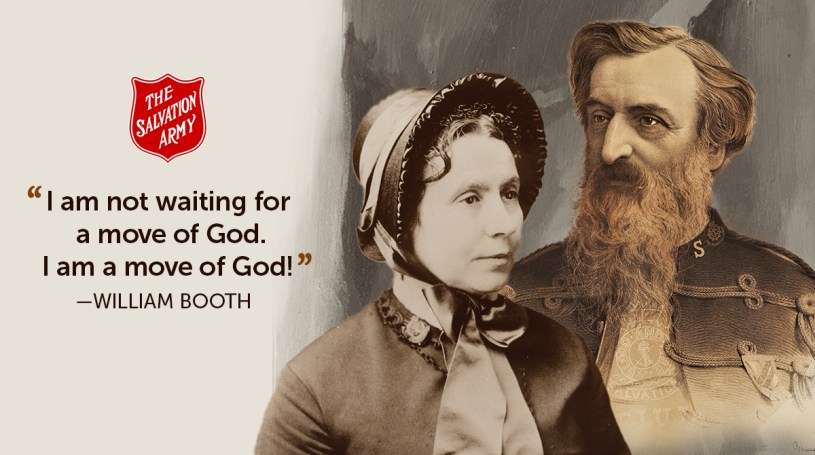
On 20 August the Church remembers William and Catherine Booth, founders of the Salvation Army.
But who were William and Catherine Booth?
Born in Nottingham in 1829 and educated privately, William Booth was an apprentice pawnbroker when he experienced a religious conversion at the age of 15. He moved to London and in 1851 joined the Wesleyan Reform Union. Three years later he transferred to the more radical Methodist New Connexion, which accepted him as a ministerial candidate and an itinerant evangelist and preacher.
In 1855 Booth married Catherine Mumford, born at Ashbourne in Derbyshire, also in 1829, the daughter of a Wesleyan lay preacher. She had been expelled from the Brixton Wesleyan Church for ‘excessive zeal’!
Despite being in constant pain Catherine bore four children and later started and ran the women’s work of the Salvation Army. She ensured that from the first women had a place in the Army’s leadership. A gifted teacher in her own right, she became affectionately known as the ‘Mother of the Salvation Army’ until her death from cancer in 1890.
After separating from the Methodist New Connexion in 1861, William Booth continued his ministry independently. In 1865 the Booths founded the Christian Mission at Whitechapel in East London to propagate the Christian faith and to furnish spiritual and material aid to those in need.
Much later, in 1878, at the height of ‘jingoism’ when Britain nearly went to war with Russia over Constantinople, the mission, which for some time had informally been using military ranks and terminology, officially changed its name to the ‘Salvation Army’.
Members of the Army, equipped with uniforms and flags, drums and cornets, were often greeted with riotous demonstrations when they first appeared on the streets. Some suffered assault and some were arrested for breach of the peace.
Having famously asked his son the question, ‘Why should the devil have all the best tunes?’, William encouraged Salvationists to set their hymns and songs to the ‘pop’ tunes of the day:
The Army is coming – amen, amen!
To conquer this city for Jesus – amen!
We’ll shout ‘Hallelujah’ and praise his dear name,
Who redeemed us to God through the blood of the Lamb.
The sound of its footsteps is rolling along;
The kingdom of Satan triumphant so long,
Is shaking and tott’ring, and downward shall fall
For Jesus the Saviour shall reign over all.
The Army’s work of evangelism and social action rapidly progressed, and branches were established in all parts of the world. William Booth wrote several books, the best known of which was In Darkest England and the Way Out (1890). In 1912 he was ‘promoted to glory’ and his son, William Bramwell Booth, succeeded him as general.
On May 9th, 1912, in William Booth’s final speech to thousands of Salvation Army friends, he said these amazing words:
‘While women weep as they do now, I’ll fight;
while little children go hungry as they do now, I’ll fight;
while men go to prison, in and out, in and out, as they do now, I’ll fight;
while there is a drunkard left, while there is a poor lost girl upon the streets, while there remains one dark soul without the light of God I’ll fight – I’ll fight to the very end!’
Revd Paul A. Carr and extract from Saints on Earth: A biographical companion to Common Worship by John H Darch and Stuart K Burns
 revPACman