
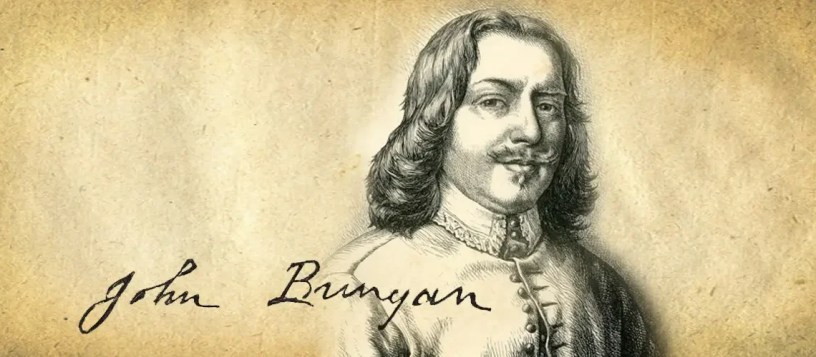
On 30 August the Church remembers John Bunyan (1688) spiritual writer, best known for his book The Pilgrim’s Progress.
But who was John Bunyan?
John Bunyan was born in 1628 at Elstow, near Bedford, the son of a brazier or tinker. He served an apprenticeship at his father’s trade, and during the Civil War served for a time in the Parliamentary army.
In about 1648 he married Margaret Bentley, and as a result of her Christian witness he attempted to reform his life. After several years of striving to reform and despairing of his efforts he came to both a living faith and an assurance of salvation. He joined the Independent congregation in Bedford and later began a preaching ministry there.
After his wife’s death, Bunyan remarried and became a popular preacher, speaking to larger audiences and at the same time coming into conflict with the local clergy who resented uneducated and unordained preachers.
After the Restoration of Charles II in 1660, the Church of England reasserted its authority and action was taken against unlicensed preachers. Bunyan, who refused to stop his preaching ministry, spent most of the next twelve years in Bedford jail (although during a part of this time he was allowed a degree of freedom and was able to support his family by making shoelaces).
With little to read other than the Bible and John Foxe’s Book of Martyrs, Bunyan began to write religious tracts and pamphlets and, most importantly, his spiritual autobiography, Grace Abounding to the Chief of Sinners (1666). Bunyan was released in 1672, but by 1675 he was back in prison serving a six-month sentence for unlicensed preaching.
It was during this time that time he probably wrote a large part of his major work, The Pilgrim’s Progress, a prose allegory of the pilgrimage of a soul in search of salvation, which was published in 1678. The main character, Christian, with his companions, first Faithful then Hopeful, journeys from the City of Destruction to the Heavenly City, encountering en route such hazards as the Slough of Despond, the Hill Difficulty, Doubting Castle, By-Path Meadow and Vanity Fair.
The instant popularity of The Pilgrim’s Progress can be deduced from the fact that ten editions were printed during the remaining ten years of Bunyan’s life. It eventually became the most widely read book in the English language after the Bible and it greatly influenced later English writers.
Noted for its simple, biblical style, The Pilgrim’s Progress is now generally considered one of the finest allegories in all of English literature – not just among spiritual writings – and has been translated into many languages.
A Prayer
God of peace,
who called your servant John Bunyan
to be valiant for truth:
grant that as strangers and pilgrims
we may at the last rejoice with all Christian people
in your heavenly city;
through Jesus Christ your Son our Lord,
who is alive and reigns with you,
in the unity of the Holy Spirit,
one God, now and for ever.
Amen.
Revd Paul A. Carr & Extract from Saints on Earth: A biographical companion to Common Worship by John H Darch and Stuart K Burns
 revPACman