
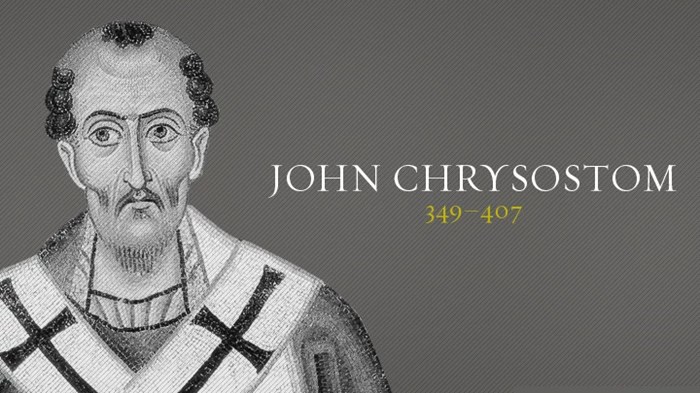
On 13 September the Church remembers John Chrysostom, bishop and teacher of the faith and known as the Patron Saint of preachers.
But who was John Chrysostom?
The literal translation of ‘Chrysostom’ is ‘Golden-Mouth’. Such was the power, eloquence and skill in John’s preaching that during his time as priest in Antioch people began to call him by this nickname which was both descriptive and well deserved.
His sermons were full of biblical exposition and practical application. He combined this with a flair for words and a fierce commitment to practical Christianity. His lifestyle matched his words. John’s early ascetic life meant that he was as spiritually sensitive as he was linguistically eloquent.
Born in Syria in the middle of the fourth century, John started to live the ascetic life after his baptism. His desire for authentic Christianity led him into the desert, where he placed himself under the authority of an old Syrian monk for four years, before moving on to live in isolation in a cave for a further two. Ill health finally forced him back into the city, and he was ordained priest in 386.
During the twelve years he spent at Antioch he made great use of the skills of public speaking that he had learnt as a youth, and was given special responsibility for preaching. His sermons were directed towards the instruction and moral reformation of a nominally Christian society. He was appointed a special assistant to the bishop, with responsibility for the poor of the city.
In 398 John was chosen to be the Bishop of Constantinople. There is no reason to suppose that he did not welcome the move to a city which was the seat of power of the Eastern Emperor and which surpassed Rome in terms of authority and prestige. John was quietly whisked away from Antioch without his or his people being told of his election as Bishop of Constantinople to avoid popular demonstrations.
In Constantinople Chrysostom inherited an undisciplined clergy living in luxury. The disparity between the huge fortunes of the ruling class and the needs of the poor was often emphasized in his preaching. He instigated many practical works to redress the balance, which meant that in turn he was both loved and hated by the citizens of the city.
The Emperor’s wife Eudoxia took a particular dislike to his highlighting of the moral and practical aspects of Christianity. The Empress, incensed at John’s preaching, erected a statue of herself outside the Church of Hagia Sophia to provoke Chrysostom. Charges were brought against him, alleging that he had called the Empress a ‘Jezebel’. Other charges were concocted and brought against him but John refused to defend himself or tone down his preaching. The Empress had him exiled, only to recall him a short time later when the city was hit by a earthquake.
John never moderated his position, preaching against excess and continuing to rein in the worst excesses of the Church. He was exiled in 404, again at Eudoxia’s instigation, and this time sent to Pontus. He was made to walk the journey, and given no rest, and he died en route.
Chrysostom’s flair for words is evident in his writing on prayer: By prayer, I understand not that which is found only in the mouth, but that which springs up from the bottom of the heart. Indeed, just as trees with the deepest roots are not broken or uprooted by a violent storm … so too, prayers that come from the depths of the heart, rooted there, ascend to heaven with confidence. They are not turned aside under attack from any distracting thought at all (On the Incomprehensibility of God, Fifth Discourse).
A Prayer
God of truth and love,
who gave to your servant John Chrysostom
eloquence to declare your righteousness in the great congregation
and courage to bear reproach for the honour of your name:
mercifully grant to those who minister your word
such excellence in preaching,
that all people may share with them
in the glory that shall be revealed;
through Jesus Christ your Son our Lord,
who is alive and reigns with you,
in the unity of the Holy Spirit,
one God, now and for ever.
Amen.
Revd Paul A. Carr and Extract from Saints on Earth: A biographical companion to Common Worship by John H Darch and Stuart K Burns
 revPACman