
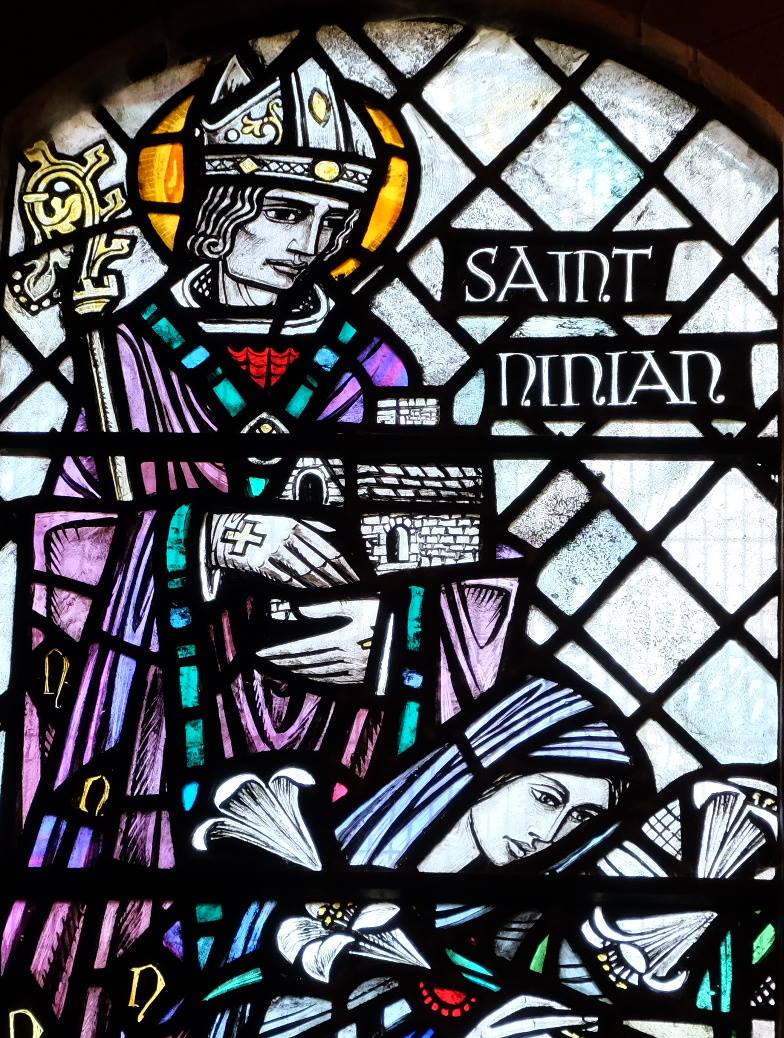
On 16 September the Church remembers Ninian, bishop and apostle of the Picts, c. 432.
But who was Saint Ninian?
Although a Briton by birth, Ninian had received his education in Rome, before returning to the Isles, and settling in Galloway. Ninian evangelized the district beyond Hadrian’s wall reaching up into the region of the Picts (Forfar, Perth and Sterling). He also built the first known stone church in Britain in 397 in Galloway and established a monastery in the area of Whithorn.
Ninian was influential in the establishment and success of Whithorn as a base for study and spirituality for Irish and Welsh monks. As such he played a great part in the gradual move north of the Christian faith in the fifth century.
Bede records Ninian as being the Apostle to the Picts: ‘The southern Picts … accepted the true faith through the preaching of Bishop Ninian, a most revered and holy man of British race’. While there is speculation as to how much influence Ninian had in the far north of this region, there is a consensus that he was involved in a mission to the Picts in some way. More credibility is placed upon his work in the Galloway region. There is a recognition that much of the success of Columba in establishing Christianity in the northern regions of Britain was down to the earlier work of Ninian.
He was buried in Whithorn, and his resting place quickly became a place of pilgrimage.
A Prayer
Almighty and everlasting God,
who called your servant Ninian to preach the gospel
to the people of northern Britain:
raise up in this and every land
heralds and evangelists of your kingdom,
that your Church may make known the immeasurable riches
of your Son our Saviour Jesus Christ,
who is alive and reigns with you,
in the unity of the Holy Spirit,
one God, now and for ever.
Amen.
Extract from Saints on Earth: A biographical companion to Common Worship by John H Darch and Stuart K Burns
 revPACman