
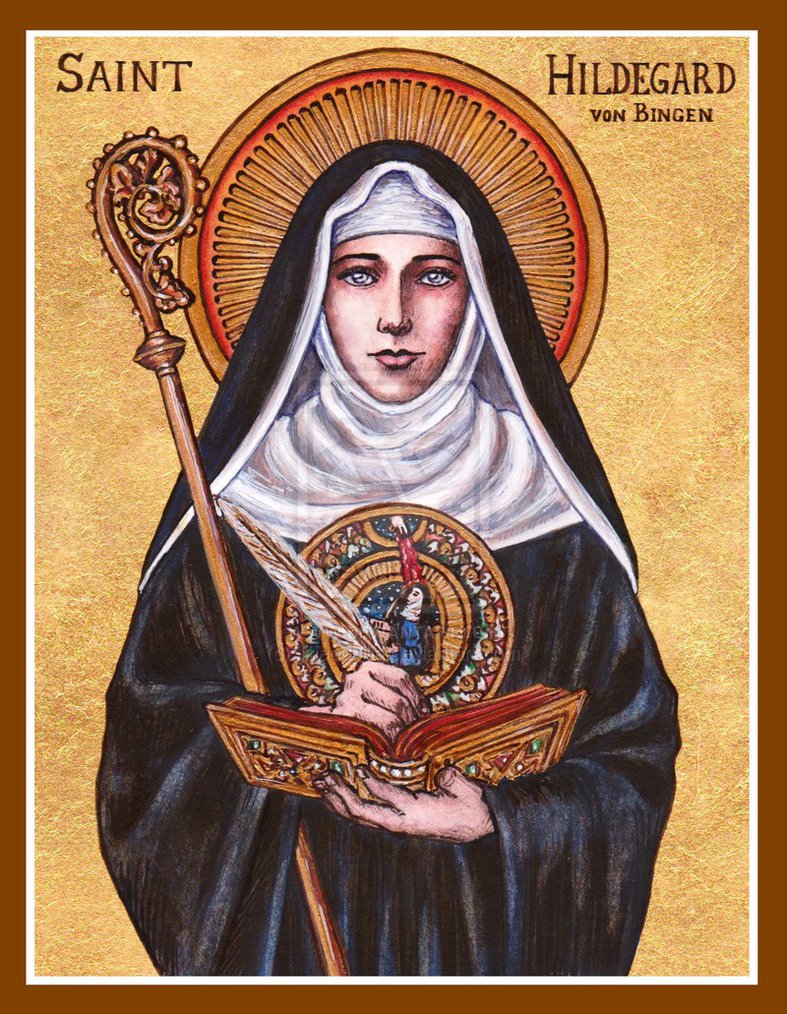
On 17 September, the church remembers Hildegard, abbess, visionary, mystic, scholar, musician, botanist, nun and teacher (1098 – 1179).
But who was Hildegard von Bingen?
Hildegard was the tenth child to be born to a noble family in the Nahe valley, in the Rhineland. As was customary with the tenth child, she was dedicated at birth to the church, a common practice in those days.
From early childhood, Hildegard was the recipient of supernatural visions and experiences. At the age of eight she was put by her parents into the care of Jutta, a female recluse who lived close to a Benedictine Monastery at Diessenberg. Seven years after, at the age of 15, Hildegard took vows and became a nun in the monastic community that had gathered around Jutta. On Jutta’s death in 1136, Hildegard herself became the abbess.
As well as a visionary and mystic, Hildegard was a remarkable woman who excelled in many areas. She was not a nun removed from the world and enveloped by mystery. She was versatile and energetic, producing varied works and affecting others wherever she went.
Hildegard was a prolific communicator and corresponded with many people, including royalty. More than three hundred of her letters survive to this day. She saw herself as standing in the prophetic tradition and was not afraid to castigate or reprimand. She wrote musical compositions including hymns, chants and songs. Her theological works include commentaries on creeds and Gospels, and on the Rule of St Benedict. Hildegard’s medical handbooks and books about nature are remarkable for their content and conclusions. She also wrote a play.
Between 1141 and 1151 Hildegard began to receive visions and, with the approval of the Archbishop of Mainz, recorded some them. The collection of her visions is called her Scivias and contained 26 visions. Hildegard writes on the nature of man, and the Last Judgement. Scivias includes a collection of dramatic songs.
The community grew too large for their premises and moved to Rupertsberg, near Bingen. From this base Hildegard travelled throughout Rhineland and founded a daughter house at Eibingen.
Hildegard was concerned that the writings about her visions be approved. Pope Eugenius gave her the necessary permission and, as her writings spread, so did her fame. The mystical quality of her writings, and the nature of her music have led to Hildegard being appropriated by many people, not all of whom recognize the theological and spiritual base to her life.
One could probably sum Hildegard up as a mystic, scholar, musician, and botanist, a nun and a teacher with a unique perspective of the world and the origin of the surrounding universe and how man is interwoven with everything.
Hildegard was, above all else, a woman devoted to God, whose visions and writings sprang out of a desire for him. O how precious is the maidenhood of this virgin, she of the shut door whose womb the holy Godhead filled with His fire so that a flower bloomed in her and the son of God from that secret place went forth like the dawn. Thus the sweet seed, who was that Son, through the shut door of her womb unlocked paradise. And the Son of God from that secret place went forth like the dawn. (Responsory 63)
A Prayer
Most glorious and holy God,
whose servant Hildegard, strong in the faith,
was caught up in the vision of your heavenly courts:
by the breath of your Spirit
open our eyes to glimpse your glory
and our lips to sing your praises with all the angels;
through Jesus Christ your Son our Lord,
who is alive and reigns with you,
in the unity of the Holy Spirit,
one God, now and for ever.
Amen.
Revd Paul A. Carr and extract from ‘Saints on Earth: A biographical companion to Common Worship’ by John H Darch and Stuart K Burns
 revPACman