
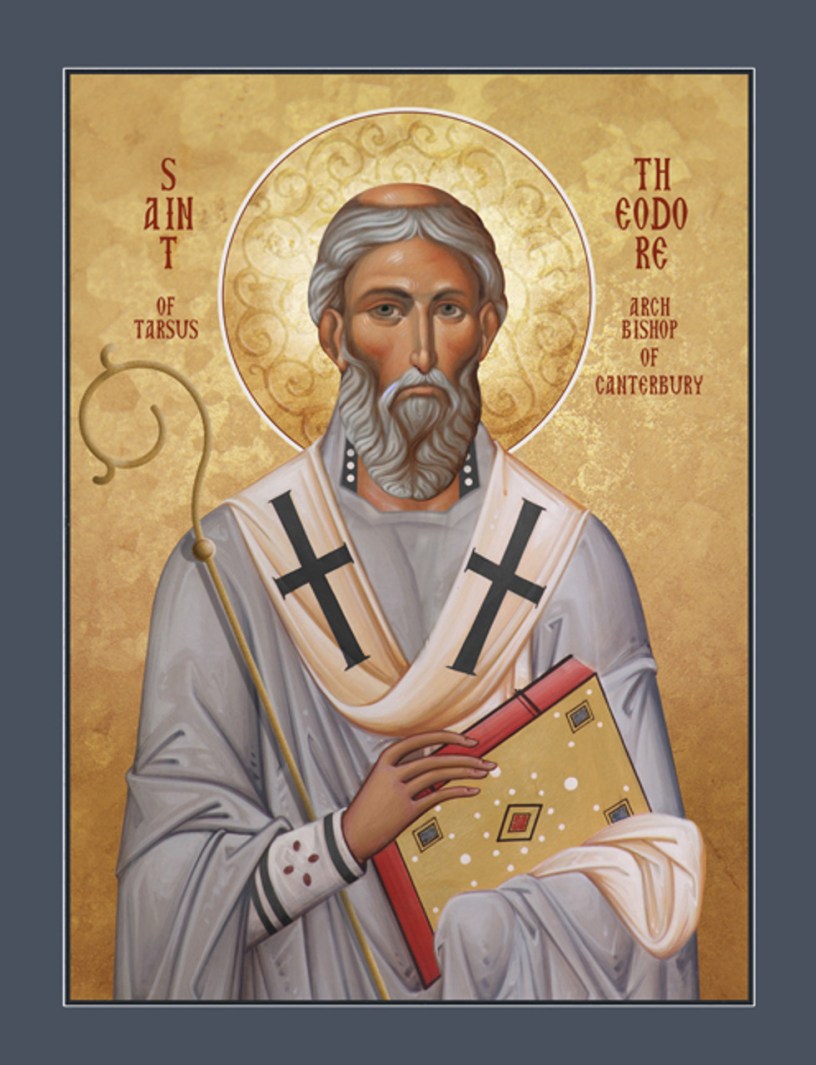
On 19 September the church remembers Theodore, monk, Archbishop, 690.
But who was Saint Theodore?
Theodore was Archbishop of Canterbury at a time of crisis for the Roman Church in England. In 664 Archbishop Deusdedit died and, as a severe plague had greatly reduced the number of bishops and high-ranking clergy in Britain, finding a successor proved to be a hard task. Three years after the death of Deusdedit, Wighard was chosen to be archbishop, but he too died of the plague on the journey to Rome for his consecration.
By this time the Pope was concerned about the delay and chose Hadrian, an African monk, as the next Archbishop of Canterbury. Hadrian refused the position, feeling that he was not worthy of the task, and recommended Theodore, a Greek monk living in a Roman monastery. Theodore, just like the Apostle Paul (Saul of Tarsus) was of Greek descent and grew up in Tarsus, but fled to Constantinople after the Persian Empire conquered Tarsus.
Although Theodore was not ordained the people reluctantly agreed. Theodore was immediately ordained deacon, and when he had grown his hair long enough (four months later) was ordained priest and consecrated bishop.
Both Theodore and Hadrian travelled to Britain in the company of Benedict Biscop. It was a long and arduous journey during which Theodore learnt the English tongue. They arrived in Britain in May 669. On arrival they found a Church lacking in leadership, although relatively healthy at root level. Theodore appointed three bishops immediately, and set off on a tour of the Church. He called a synod at Hertford in 672, and issued canons designed to establish principles of administration and order. The date of the celebration of Easter was affirmed, and bishops were required to confine their activities to their own dioceses.
This measure was aimed at limiting the activities of the Celtic Bishops, who were able to wander wherever they willed, having a more pliable jurisdiction. Theodore established a yearly meeting of the whole Church, and moved to increase the number of bishoprics throughout the land. He sought to bring unity to a fragmented Church.
A major area of contention for Theodore came in the Northumbrian region, the area most loyal to the Celtic traditions, and the areas least open to the decisions made at the Synod of Whitby (664). Theodore had several disagreements with Wilfrid, Bishop of Ripon (a vast area), which included Wilfrid’s expulsion (677) and reinstatement at a lower level of authority and influence.
Theodore introduced into Northumbria the Roman diocesan system of church government whilst allowing the Northumbrian Church freedom to blend both Celtic and Roman principles. In doing so he confirmed the decisions taken at Whitby whilst retaining the characteristics of both Roman and Celtic traditions within the same united body. Theodore’s actions shaped the Church for ages to come, and began to sow the seeds of a common identity of the Church in Britain.
Although remembered as the principal force behind the common Church in Britain, Theodore was also known as a gifted teacher and theologian. He taught science, astronomy and law as well as Latin and Greek at the school he founded in Canterbury. An astute politician and a visionary leader, Theodore oversaw one of the most fruitful periods of the Church in Britain.
The process of integration of the various elements of the Church was completed after Theodore’s death. The monastic community on Iona conformed in 716. Wales was the last bastion of Celtic independence, finally submitting to the authority of Rome in 768.
A Prayer
Almighty God,
who called your servant Theodore of Tarsus from Rome to the see of Canterbury,
and gave him gifts of grace and wisdom to establish unity where there had been division,
and order where there had been chaos:
Create in your church, by the operation of the Holy Spirit,
such godly union and concord that it may proclaim,
both by word and example, the Gospel of the Prince of Peace;
who lives and reigns with you and the Holy Spirit,
one God, for ever and ever.
Amen.
Revd Paul A. Carr and extract from ‘Saints on Earth: A biographical companion to Common Worship’ by John H Darch and Stuart K Burns
 revPACman