
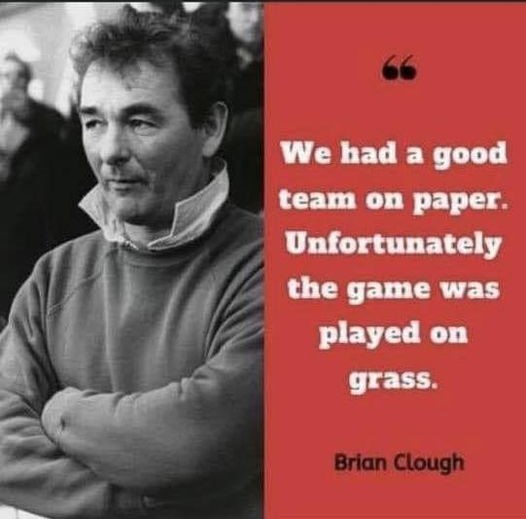
On 20 September 2004, legendary striker and coach Brian Clough sadly passed away at the age of 69.
Brian Howard Clough was born on Thursday 21 March 1935 in Grove Hill, Middlesbrough. He was the sixth of nine children. When talking of his childhood he said he “adored it in all its aspects. If anyone should be grateful for their upbringing, for their mam and dad, I’m that person. I was the kid who came from a little part of paradise.” On his upbringing in Middlesbrough, Clough claimed that it was “not the most well-appointed place in the world, but to me it was heaven”. “Everything I have done, everything I’ve achieved, everything that I can think of that has directed and affected my life – apart from the drink – stemmed from my childhood. Maybe it was the constant sight of Mam, with eight children to look after, working from morning until night, working harder than you or I have ever worked.”
Clough failed his Eleven-plus examination and attended Marton Grove Secondary Modern School. He later admitted in his autobiography, Walking on Water, that he had neglected his lessons in favour of sport, although at school he became Head Boy. He also said that cricket, rather than football, was his first love as a youngster, and that he would have rather scored a test century at Lord’s than a hat-trick at Wembley. He left school in 1950 without any qualifications, to work at ICI and did his national service in the RAF Regiment between 1953 and 1955.
Cloughie started his career at his hometown club, Middlesbrough. Surprisingly, even with his bucket load of goals they never really amounted to much success come the end of the season, with Boro never making it out of the Second Division during his time there. After struggling for promotion with Boro, and a highest league position of 5th, ’Big Ead’ decided to take his talents to Wearside which cost us £55,000.
He scored goals for fun, averaging a goal almost a game with a staggering 204 goals in 222 games. He was never short of confidence and why should he have been? Everything he touched seemed to find its way in. Footage of his time in football may be hard to come by but here’s a snippet of what he was like. There was only ever one thing on his mind and it was to shoot at any given opportunity. Simple, but efficient.
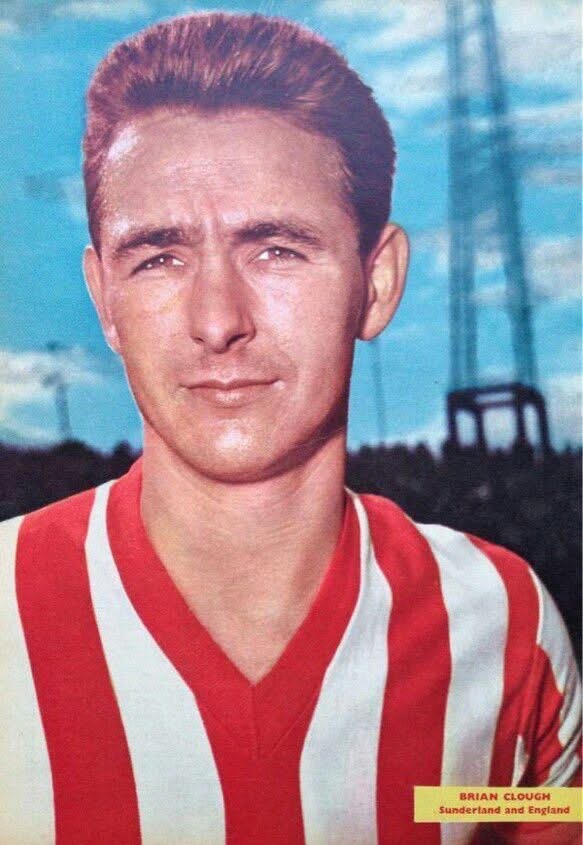
Cloughie settled in straight away, resuming his scoring habits with 34 goals in his first season as we made our push for promotion. We finished third in the league and one point off promotion, but only the top two teams went up back then.
The season after was deja vu for Sunderland, teetering on the edge of promotion. For Cloughie it was the beginning of the end for his playing days, after a collision with Bury’s Goalkeeper on boxing day, 1962. The coming together of the two players resulted in a torn MCL and ACL which ruled him out indefinitely for the remainder of the season. If we had him playing for us for the whole of the season there was little to no doubt we’d have spent the next season in the top flight of English football.
His injury took about a year and half to recover from. Without him we actually managed to achieve promotion in the season following his injury. He bravely came back after his injury but like many players at that time, the damage had taken its toll on him and he only wore the red and white shirt three more times before he hung his boots up.
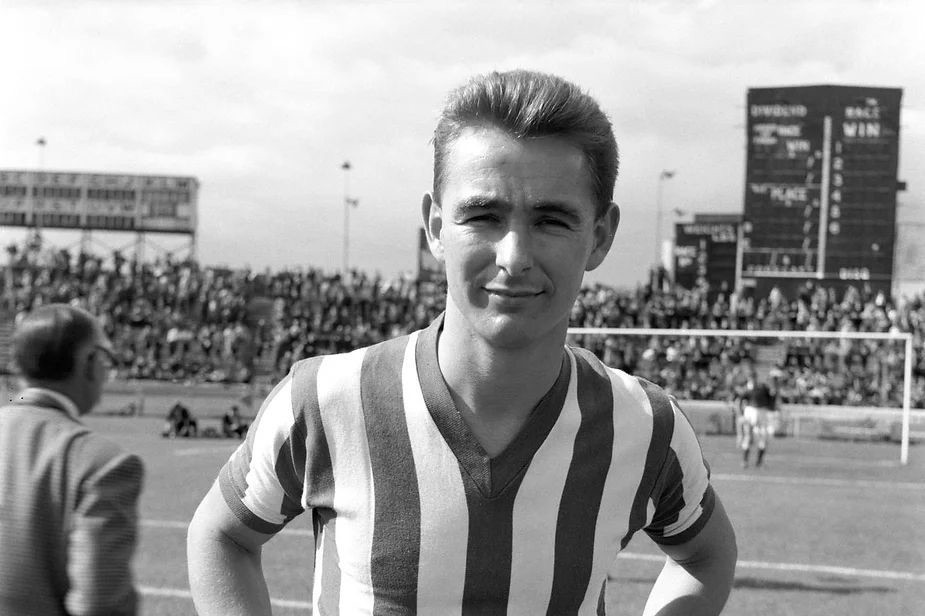
Retiring in football at the age of 29 is sad for any player, but for a player of his talent it hurt that little bit more. Of course if he wasn’t a Sunderland player he would have played till his 40’s without any injuries. Just our luck.
From a Sunderland point of view the injury was a nightmare, but for the footballing world in general it was more of a blessing than it was a curse as this became the birth of one of the greatest managers English football has ever seen. As well as one of the loudest.
For the silverware he lacked as a player, he made up for tenfold as a manager. His first trophy as a gaffer came with Derby after he won the Second Division title. He followed up that success by winning the First Division in only his second season in the league.
He had short stints at Leeds and Brighton before joining the club where he ultimately left his mark on English football. He joined Nottingham Forest and was in charge of the club for almost a millennium of games, managing 994 matches in total.
Whilst at Forest he became footballing royalty after winning two European Cups (Champions League) back to back. Something that we could quite confidently say will never happen again in those circumstances, from a Division Two team to conquering Europe in just a few years- as well as winning the First Division in his first season in the league. He kept up his trend of winning back to back trophies as he won the League Cup in the 77/78 season, and the season after. Then a few years later he went back and did it again, winning the competition in the 88/89 and 89/90 Campaigns.
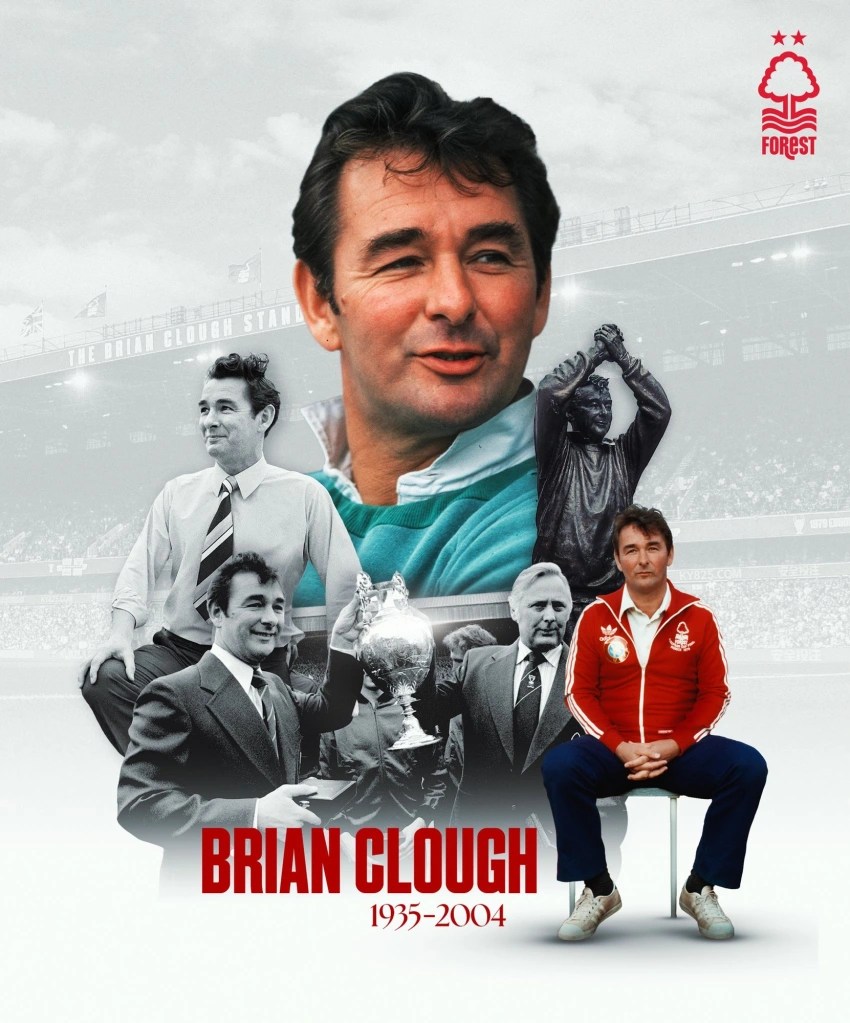
Unfortunately for us, the outspoken leader never came back to Wearside as a coach. This is despite Cloughie claiming “I would have crawled up the M1 on my hands and knees over broken glass to be manager of Sunderland.” Though he did leave his mark on the club with his incredible goal scoring ability and brash attitude. One thing that will always remains true, he is sorely missed by all.
The happiest time I ever spent in a football club, including when I was manager of league champions was when I played for Sunderland.
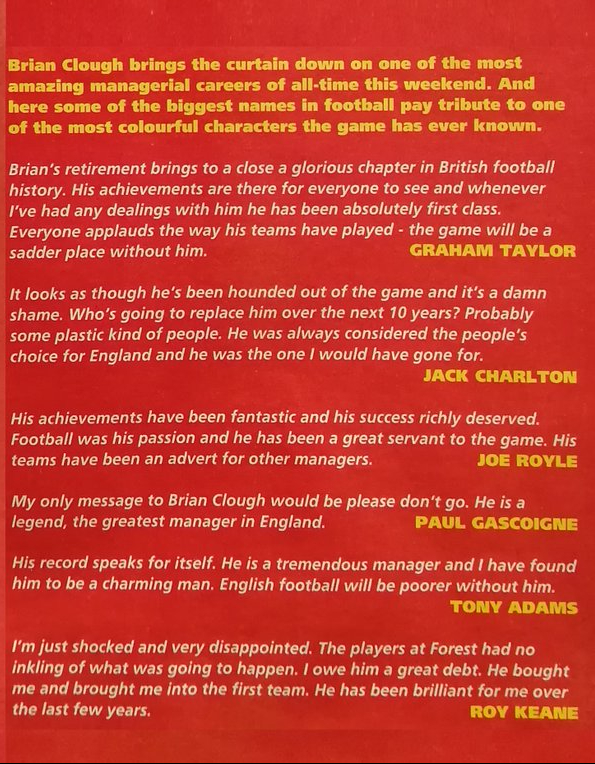
Ahead of his final match before retirement in May 1993, Shoot magazine spoke to some prominent football people of the time. Here’s what they had to say about the great man.
Clough’s story was one of greatness, but behind the charisma and the outrageousness, it is also one of tragedy and Johnathan Wilson writes about it here in ‘Unherd’ The Tragic Life Of Brian Clough
Daniel Taylor has written an excellent article in The Athletic Online Magazine featured in the New York Times!
RIP Cloughie.
revpacman and various sources including those at the end of the article as well as A Love Supreme and Roker report via X/Twitter
 revPACman