
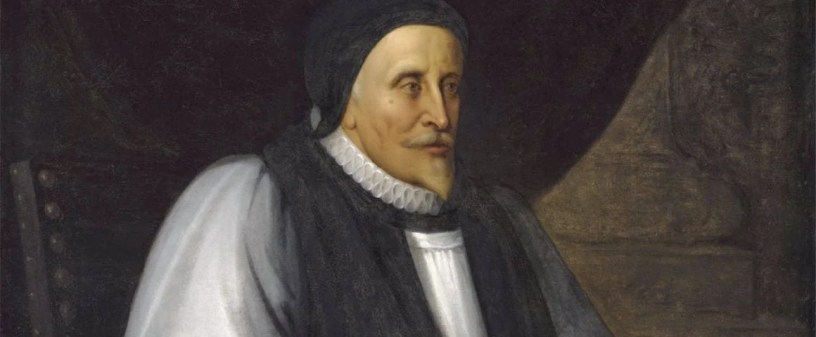
On 25 September the church remembers Lancelot Andrewes, bishop, spiritual writer (1555 – 1626).
But who was Lancelot Andrewes?
Lancelot Andrewes was born near to the Tower of London in 1555 and educated at Merchant Taylors’ School and Pembroke Hall, Cambridge, where he was elected Fellow in 1575. He was ordained in 1580. In 1589 he became Vicar of St Giles, Cripplegate, where he soon developed a reputation as a preacher, before returning to Cambridge as Master of Pembroke Hall. In 1601 he became Dean of Westminster and four years later was consecrated Bishop of Chichester.
One of the most learned men of his time, he was present at the 1604 Hampton Court conference out of which emerged the new translation of the Bible which became known as the Authorized (or King James) Version. Andrewes himself worked on the first part of the Old Testament.
In an age of Calvinist theology and largely Low Church ceremonial, Andrews was an articulate exponent of a more sacramental pre-Tractarian form of High Church Anglicanism, giving respectability and academic underpinning to a movement that was later to be associated with Archbishop Laud.
But, unlike Laud, Andrewes was not himself a controversial or combative figure. He was essentially a scholar and it was upon sound learning and a desire that Anglican worship should be based on ordered ceremonial that he adopted and developed practices in worship to complement his belief in the Real Presence and to honour the incarnate Christ.
His ceremonial practices were largely a personal matter in his private chapel and where others adopted them it was by Andrewes’ example not by his persuasion. He was an outstanding theologian of the High Church movement in the Church of England, writing from a uniquely Anglican point of view about the Church, the sacraments and episcopacy. He counted Richard Hooker and George Herbert among his friends.
A Morning Prayer of Lancelot Andrewes
O Thou who sendest forth the light,
createst the morning,
and makest the sun to rise on the good and the evil:
Enlighten the blindess of our minds with the knowledge of thy truth;
lift up the light of thy countenance upon us,
that in thy light we may see light, and, at the last,
in the light of grace the light of glory;
through Jesus Christ our Lord.
Amen.
But in his own day he was best known as a preacher. He preached regularly at the court of James I and many of his sermons were published. Over three hundred years later T.S. Eliot took some words from Andrewes’ 1622 Christmas sermon (‘A cold coming they had of it …’) for the opening five lines of his poem The Journey of the Magi.
T.S. Eliot: The Journey of the Magi
Andrewes was translated from Chichester to Ely in 1609 and in the same year he was appointed a privy councillor. He was further translated to Winchester in 1619. He died at Winchester Palace in 1626 and is buried in Southwark Cathedral.
A Prayer
Lord God,
who gave to Lancelot Andrewes many gifts of your Holy Spirit,
making him a man of prayer and a pastor of your people:
perfect in us that which is lacking in your gifts,
of faith, to increase it,
of hope, to establish it,
of love, to kindle it,
that we may live in the light of your grace and glory;
through Jesus Christ your Son our Lord,
who is alive and reigns with you,
in the unity of the Holy Spirit,
Amen.
Revd Paul A. Carr and extract from ‘Saints on Earth: A biographical companion to Common Worship’ by John H Darch and Stuart K Burns
 revPACman