
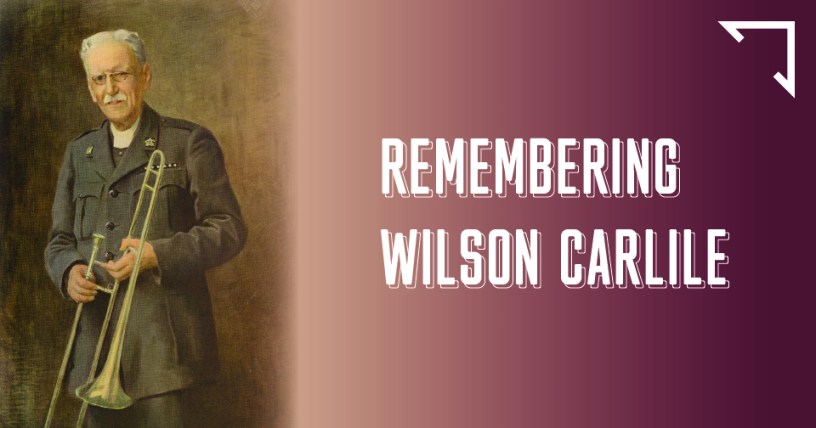
On 26 September the church remembers Wilson Carlile, priest and founder of the Church Army, 1847 – 1942.
But who was Wilson Carlile?
Wilson Carlile was born in Brixton, London in 1847 and had a patchy education owing to the chronic back trouble from which he suffered all his life. But he excelled at languages and music. He was highly successful in business until recession and serious illness combined to end his career at the age of 31. A breakdown followed which was in turn followed by his conversion. He later commented:
I have seen the crucified and risen Lord as truly as if He had made Himself visible to my bodily sight. That is for me the conclusive evidence of His existence. He touched my heart, and old desires and hopes left it. In their place came the new thought that I might serve Him and His poor and suffering brethren.
Initially he offered his services to the Americans Moody and Sankey, at that time holding a mission in London. He accompanied Sankey on the harmonium, learned a great deal about methods of evangelism and was inspired to become an evangelist himself. Consequently he was confirmed into the Church of England and then entered the London College of Divinity to train for his ordination in 1880.
He served his curacy at St Mary Abbots in Kensington but the lack of contact between the Church and the working classes was a cause of real concern to him and he began outdoor preaching in order to reach those who would not come to church.
Carlile left Kensington in order to work in a slum mission, and from 1882 began the process of uniting local Anglican parish missions into a national organization, which in keeping with the popular use of military terminology in church life at that time took the title ‘Church Army’. A training college for men was founded in 1884 followed by one for women three years later. After some initial hesitancy the Church of England incorporated the Church Army into its structures and in due course the office of Evangelist was founded for Church Army officers and sisters.
The Church Army’s work included evangelism and social and moral welfare work and this was supplemented by work among the troops during the First World War. Carlile was careful to ensure that the Church Army always worked within official church structures. He remained honorary chief secretary until his retirement in 1926, having been made a prebendary of St Paul’s Cathedral in 1906. He died in 1942, sixty years after he founded Church Army. His memorial tablet at St Paul’s, includes these words,
‘A man greatly beloved who loved and served all – especially those thought most unlovable. GO AFTER THAT WHICH IS LOST.’
As we remember Wilson Carlile and his commitment to loving service and to showing love to all, even the most unlovable, I am inspired to renew my efforts in love, even in loving those I find the most unlovable. I invite you to consider doing the same.
A Prayer
God of boundless energy and light:
We thank you for the courage and passion of Wilson Carlile
who, after the example of your Son,
sought new ways to open your Church to diverse leaders
as beacons of the Gospel of Christ.
Quicken our hearts to give bold witness to Jesus Christ;
who with you and the Holy Spirit, lives and reigns,
one God, now and for ever. Amen.
Revd Paul A. Carr and extract from ‘Saints on Earth: A biographical companion to Common Worship’ by John H Darch and Stuart K Burns
 revPACman