
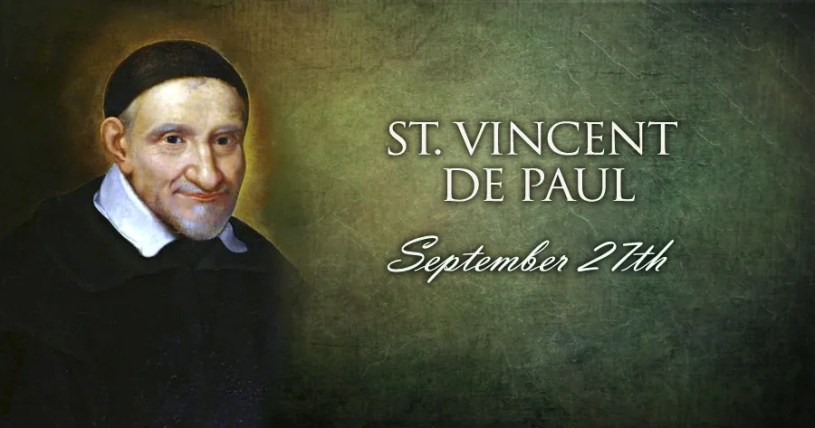
On 27 September the church remembers Vincent de Paul, the French, 17th century priest known as the patron of Catholic charities for his apostolic work among the poor and marginalized and founder of the Lazarists, 1580 – 1660.
But who was Vincent de Paul?
Born the son of peasant farmer at Pouy in the Landes, south-west France around 1580, Vincent was educated by the Franciscans and at the universities of Dax and Toulouse. While travelling by sea from Marseille to Narbonne in 1606 he was seized by Turkish pirates and sold into slavery. His ordeal of captivity lasted until 1607, during which time the priest converted his owner to the Christian faith and escaped with him from Tunisia. Afterward, he spent time studying in Rome, and – in a striking reversal of fortune – served as an educator and spiritual guide to members of an upper-class French family.
Ordained in 1600, he spent ten years in uneventful parish ministry but eventually he underwent a marked change of attitude to the poor and the suffering. In Paris, Vincent visited prisoners condemned to be galley slaves and, appointed by Louis XIII as royal almoner of the galleys (in effect, chaplain to the galley slaves), he continued this ministry, both pastoral and evangelistic, at Marseille and Bordeaux.
In 1617 he founded the first Confraternity of Charity, made up of wealthy women working among the sick and poor near Lyons. For a number of years he was the personal chaplain to the wealthy Gondi family who encouraged and supported Vincent in his charitable and mission work. With their support he founded the Congregation of the Mission – an institute of priests initially organized for rural mission.
A community of the Congregation was formally established at the Collège des Bons-Enfants in Paris in 1626, where Vincent served as Principal. The alternative name ‘Lazarist Fathers’ was given to the group when it established headquarters at the former priory of St Lazare, in 1632. Vincent not only headed the order but also founded with others several charitable organizations, notably the Daughters of Charity, in 1633. This was notable in being the first non-enclosed community of women which was devoted to caring for the sick and the poor.
From 1628 the Congregation of the Mission organized several seminaries for the training of priests as a result of work done by Vincent with young men about to be ordained. He was also concerned with relief work during the religious wars in France. His implacable opposition to the Jansenists (a group considered heretical within the Roman Catholic Church) was believed to have been responsible for its suppression, yet paradoxically in an age of religious conflict he was unusually courteous towards Protestants, insisting that they be treated as brothers, with respect and love.
Vincent died in Paris on 27 September 1660. It was said that ‘the poor of Paris lost their best friend and humanity a benefactor unsurpassed in modern times’. Pope Clement XII canonized him in 1737. In 1835, the French scholar Blessed Frederic Ozanam took him as the inspiration and namesake for the Society of Saint Vincent de Paul, a lay Catholic organization working for the relief of the poor.
Prayer
Merciful God,
whose servant Vincent de Paul,
by his ministry of preaching and pastoral care,
brought your love to the sick and the poor:
give to all your people a heart of compassion
that by word and action they may serve you
in serving others in their need;
through Jesus Christ your Son our Lord,
who is alive and reigns with you,
in the unity of the Holy Spirit,
one God, now and for ever.
Amen.
Revd Paul A. Carr and extract from ‘Saints on Earth: A biographical companion to Common Worship’ by John H Darch and Stuart K Burns
 revPACman