
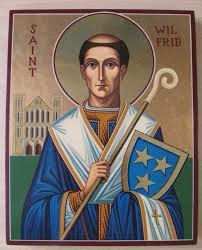
On 12 October the church remembers Wilfrid bishop, missionary and patron Saint of Ripon, 709.
But who was Wilfrid?
Wilfrid was a Northumbrian nobleman, and an early disciple of the Celtic Church. Though a man of intense spiritual energy and commitment, he never relinquished his immense wealth nor the position in society given to him by birth.
Wilfrid’s adolescent years were spent at Lindisfarne, most probably for educational reasons, and in 653 he joined Benedict Biscop on one of his frequent journeys to Rome. There he was greatly influenced by Gallic Christianity which was similar to the Celtic tradition, and he eventually sought to instil some of these principles into the Northumbrian Church.
On his return from Rome, Wilfrid was somewhat dubiously ordained by Agilbert, a dispossessed bishop of the West-Saxons. He was a spokesman for the Roman Church at the Synod of Whitby in 664, and soon after that he was appointed as Bishop of Northumbria.
Although the Church after Whitby was held to be united, Wilfrid considered ordinations performed by bishops from Scotland to be uncanonical, and so he journeyed to Gaul to be installed. He stayed there for two years, far longer than was necessary, and on his return found that Oswy, King of Northumbria, had grown tired of waiting, and had installed Chad in his place. Wilfrid finally took up the position of Bishop of Northumbria when Archbishop Theodore insisted on it, three years later.
Wilfrid’s career was then the subject of much turbulence and disagreement. In total he was deprived of his see three times, twice appealing to Rome for reinstatement. He disagreed with the Northumbrian kings, and fell foul of Theodore, the Archbishop of Canterbury who was modernizing the government of the Church. When he died his once vast diocese had been reduced by the archbishop to that of his monastery at Hexham.
Wilfrid was a man of many colours and allegiances. Greatly influenced by the idea of papal support, he had an intense and colourful image as a bishop, more regal than ecclesiastical. He laid claim to having introduced the Rule of St Benedict to Northumbria, and had a papal charter giving his monasteries independence from outside interference. He encouraged female participation in the Church, protected the Northumbrian Queen Etheldreda in her dispute with her husband over her virginity – at one point helping her to escape.
His travels to Rome included missionary preaching (in Frisia in 679) and he greatly influenced the kingdom of Sussex for the gospel. His final reinstatement to the position of Bishop of Ripon and Hexham was followed by three days of feasting.
Wilfrid was a nobleman who retained his wealth, leaving much to his family at his death, and bequeathing two shares to the abbots of Ripon and Hexham that they might be able to ‘purchase the friendship of kings and bishops’. His colourful character allowed Wilfrid to gain a foothold for the gospel in areas that were otherwise inaccessible, and his spiritual energy should not be underestimated.
A Prayer
Almighty God,
who called our forebears to the light of the gospel
by the preaching of your servant Wilfrid:
help us, who keep his life and labour in remembrance,
to glorify your name by following the example of his zeal and perseverance;
through Jesus Christ our Lord. Amen.
Extract from Saints on Earth: A biographical companion to Common Worship by John H Darch and Stuart K Burns
 revPACman