
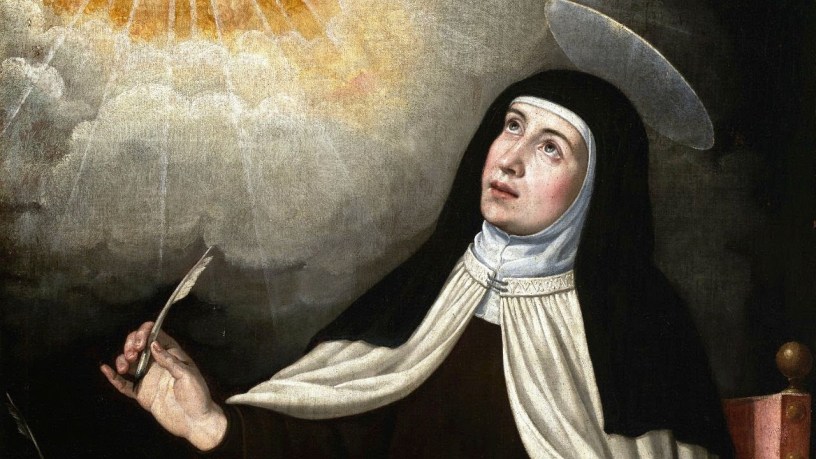
On 15 October the church remembers Teresa of Avila, teacher of the faith and Patron Saint of Headache sufferers and Spanish Catholic Writers, 1515-1582.
But who was Teresa of Avila?
Born at Avila in 1515 to an old Spanish family of partly Jewish ancestry and educated in an Augustinian convent, Teresa entered the local Carmelite Convent of the Incarnation in 1535. There she fell seriously ill, was in a coma for a while, and partially paralysed for three years. The illness made her lax and lukewarm in her prayers and devotions.
However, her prayer life eventually deepened and she began to have visions and a vivid sense of the presence of God. At times she felt sharp pains that she claimed were caused by the tip of an angel’s lance piercing her heart.
In 1555, after increasingly rigorous religious exercises, she underwent a profound spiritual awakening, experiencing visions of Christ and a state of spiritual ecstasy. She was thus converted to a life of extreme devotion. But her new seriousness about her faith did not fit with the relaxed attitude of the Carmelites, where the nuns retained their own property and freely accessed the world outside their convents.
So in 1560 Teresa took it upon herself to reform the Carmelite order which had, in her view, departed from the order’s original intention and become far too lax. Her proposed reforms included strict enclosure of the nuns within the convent, where they would be required to engage in prayer and study, and required to go barefoot (‘discalced’) as a symbol of their poverty, humility and simplicity.
Not unnaturally, her proposed reforms were not popular amongst most Carmelites and it took papal intervention on her behalf for her to establish, in 1562, the Convent of St Joseph at Avila, the first community of reformed, or Discalced, Carmelite nuns. In 1567 she was authorized to establish similar religious houses for men and in this she was aided by John of the Cross, the Spanish mystic.
Though she was constantly harassed by those hostile to her intentions, Teresa helped to establish 16 foundations for women and 14 for men. Two years before her death the Discalced Carmelites received papal recognition as an independent order. Teresa died in Alba de Tormes in 1582.
As well as being a monastic reformer Teresa was also a unique spiritual writer, the first to describe states of prayer between meditation and ecstasy. In her life of Christian service Teresa gave the lie to the viewpoint that the contemplative life and practical action are incompatible, and urged her followers to ‘accustom yourself continually to make many acts of love, for they enkindle and melt the soul’.
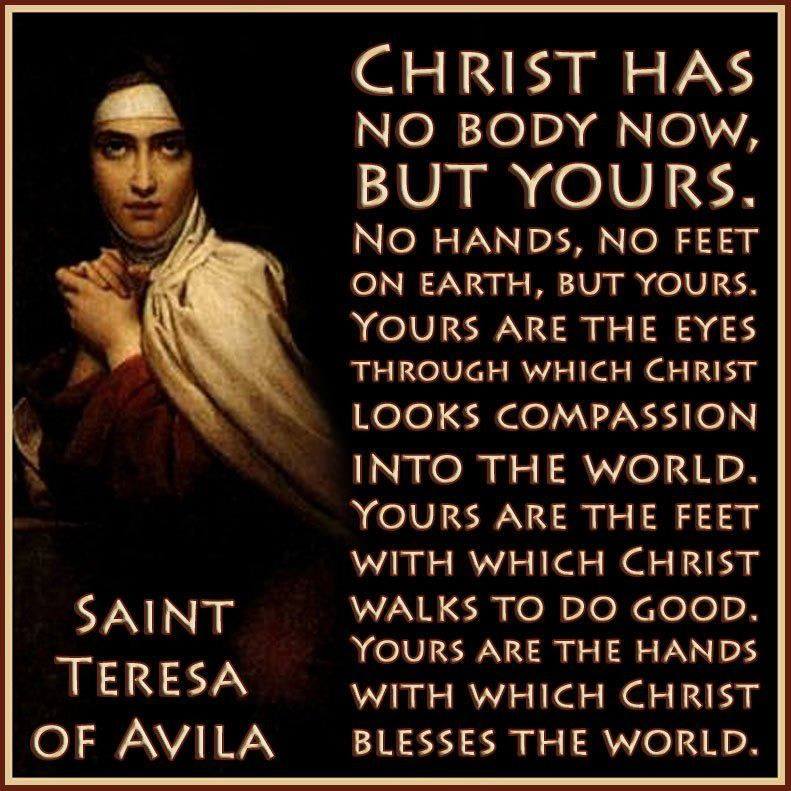
St. Teresa is the patron saint of Headache sufferers. Her symbol is a heart, an arrow, and a book. She was canonized in 1622. In 1970 she was declared a Doctor of the Church for her writing and teaching on prayer, one of two women to be honoured in this way.
A Prayer
Merciful God,
who by your Spirit raised up your servant Teresa of Avila
to reveal to your Church the way of perfection:
grant that her teaching
may awaken in us a longing for holiness,
until we attain to the perfect union of love
in Jesus Christ your Son our Lord,
who is alive and reigns with you,
in the unity of the Holy Spirit,
one God, now and for ever.
Amen.
Revd Paul A. Carr and extract from ‘Saints on Earth: A biographical companion to Common Worship’ by John H Darch and Stuart K Burns.
 revPACman