
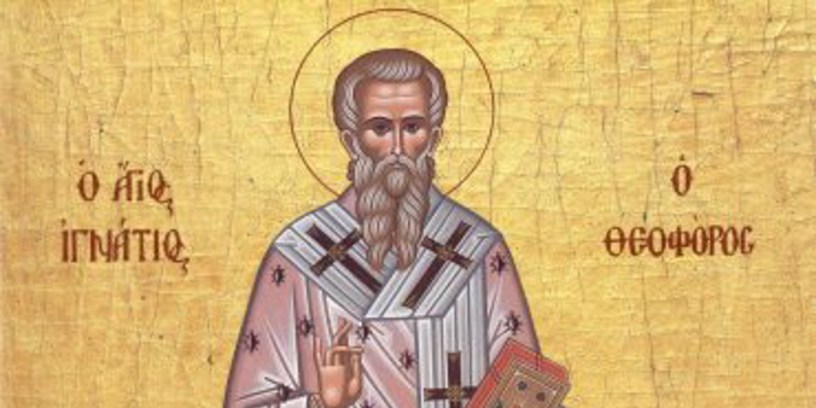
On 17 October the church remembers Ignatius of Antioch, also known as Ignatius Theophorus, bishop, martyr, c. 107.
But who was Ignatius of Antioch?
Ignatius, was born in Syria, and converted to Christianity and eventually became the second bishop of Antioch. He was sentenced during the Roman Emperor Trajan’s reign to be devoured by wild beasts. Trajan decided that Christians, although guilty of ‘anti-state behaviour’, were not to be sought out for arrest, but rather should be arrested and tried only if they were obvious in their faith and refused to reject Christ when asked.
Ignatius was arrested in Syria and transported to Rome for his punishment. On this long and arduous journey Ignatius travelled through Asia Minor, and stopped at Phrygia and Smyrna. As news spread of his arrest and journey he received visits by prominent Christians, including Polycarp. He wrote letters to the Churches of each area he passed through, and also wrote to the Christians in Rome informing them of his impending arrival.
Ignatius was convinced of the need for unity in the Church, and he encouraged this whenever he could. He saw this unity as ideally illustrated in relationships between bishops of the Church. He emphasized the need for constant community worship and celebration of the Eucharist.
Ignatius is well known for the seven letters he wrote on the long journey from Antioch to Rome. Five of these letters are to churches in Asia Minor; they urge the Christians there to remain faithful to God and to obey their superiors. He warns them against heretical doctrines, providing them with the solid truths of the Christian faith.
The sixth letter was to Polycarp, bishop of Smyrna, who was later martyred for the faith. The final letter begs the Christians in Rome not to try to stop his martyrdom. “The only thing I ask of you is to allow me to offer the libation of my blood to God. I am the wheat of the Lord; may I be ground by the teeth of the beasts to become the immaculate bread of Christ.”
His letters reveal him to be a man completely devoted to Christ and passionate for unity. Ignatius was also keen to receive martyrdom, and in his letters he emphasized that on no account was anyone to attempt to prevent his death. For him, martyrdom was the ultimate imitation of Christ, and a gift from God. Although there is no account of his martyrdom it is widely assumed that he died upon the completion of his journey at Rome in the Circus Maximus.
A Prayer
Feed us, O Lord, with the living bread
and make us drink deep of the cup of salvation
that, following the teaching of your bishop Ignatius
and rejoicing in the faith
with which he embraced a martyr’s death,
we may be nourished for that eternal life
for which he longed;
through Jesus Christ your Son our Lord,
who is alive and reigns with you,
in the unity of the Holy Spirit,
one God, now and for ever.
Amen.
Revd Paul A. Carr and extract from ‘Saints on Earth: A biographical companion to Common Worship’ by John H Darch and Stuart K Burns
 revPACman