
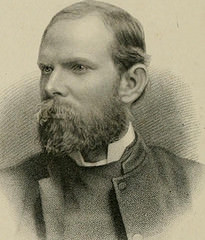
On 29 October the church remembers James Hannington, bishop, martyr, 1847 – 1885.
But who was James Hannington?
James Hannington was born at Hurstpierpoint in Sussex in 1847. After leaving school in Brighton he worked in business, then in the army. In 1868 he entered St Mary Hall at Oxford to train for the Anglican ministry. Ordained in 1874, he served curacies at Martinhoe in Devon (where he had a conversion experience) and at Darley Abbey near Derby. In 1875 he returned to Hurstpierpoint as minister of St George’s Chapel.
In 1882, influenced by the news of the deaths of missionaries in Buganda (part of modern-day Uganda), Hannington offered to serve with the Church Missionary Society. Though the Kabaka (king), Mutesa, welcomed Christian missions, Buganda was landlocked and a long trek from the coast was required in order to get there. This was to be Hannington’s undoing on two occasions.
On his first tour of duty in East Africa in 1882–3 he was overcome by fever and dysentery on the trek westwards and had to be carried back to the coast, twice being given up for dead. On his return the CMS Medical Board ruled that he should never return to the region. Yet in 1884 when a separate diocese was created for Eastern Equatorial Africa, this ruling was reversed and Hannington, fully recovered in health, was consecrated bishop by Archbishop Benson at Lambeth. He arrived in Africa early the following year and began visiting his clergy in the coastal settlements. One commented, ‘he was beloved by every missionary. There never was a bishop who could be so firm, and, at the same time, so kind and considerate.’
Yet the time came in July 1885 when Hannington prepared to visit his flock inland in Buganda. The old Kabaka, Mutesa, had died the previous October. His son Mwanga was no friend of European missionaries and Hannington had already received word of the suffering of both missionaries and converts at Mwanga’s court.
So, wishing to be with them as soon as possible the courageous and impetuous Hannington ignored advice from all quarters and travelled the quickest route, which unfortunately was the invasion route traditionally taken by Buganda’s enemies. German imperialists had been unsettling the Bugandans, who seemed unable to distinguish between different nationalities of white men. On entering the border region, the bishop’s party was detained by the local chief who asked Mwanga for instructions as to the fate of his prisoner. October 21, 1885, they took him prisoner. They allowed him a little freedom early in his captivity and he walked out to look at the Nile.
His journal tells what happened next: “…suddenly about twenty ruffians set upon us. They violently threw me to the ground, and proceeded to strip me of all valuables. Thinking they were robbers I shouted for help, when they forced me up and hurried me away, as I thought, to throw me down a precipice close at hand. I shouted again in spite of one threatening to kill me with a club. Twice I nearly broke away from them, and then grew faint with struggling and was dragged by the legs over the ground. I said, ‘Lord, I put myself in Thy hands, I look to Thee alone.’ Then another struggle and I got to my feet and was then dashed along. More than once I was violently brought into contact with banana trees, some trying in their haste to force me one way, others the other, and the exertion and struggling strained me in the most agonizing manner. In spite of all, and feeling I was being dragged away to be murdered at a distance, I sang ‘Safe in the Arms of Jesus‘ and laughed at the very agony of my situation. My clothes were torn to pieces so that I was exposed; wet through with being dragged on the ground; strained in every limb, and for a whole hour expecting instant death, hurried along, dragged, pushed at five miles an hour, until we came to a hut…”
After exhibiting him as a trophy for a week, the order came, Hannington and his party were speared to death on 29 October 1885. We know most of this detail because one of the Ugandans kept Hannington’s journal and sold it to a later expedition.Hannington’s last words are reported to have been:
Tell the king that I die for Uganda. I have bought this road with my life.
Though by no means the first Christian martyr in Uganda (George Shergold Smith and Thomas O’Neill of the original CMS Nyanza mission party were martyred in 1877) nor, sadly, the last, Hannington was Uganda’s most high-profile martyr until Archbishop Janani Luwum in 1977.
A Prayer
Most merciful God,
who strengthened your Church by the steadfast courage
of your martyr James Hannington:
grant that we also,
thankfully remembering his victory of faith,
may overcome what is evil
and glorify your holy name;
through Jesus Christ your Son our Lord,
who is alive and reigns with you,
in the unity of the Holy Spirit,
one God, now and for ever.
Amen.
Revd Paul A. Carr and extract from ‘Saints on Earth: A biographical companion to Common Worship’ by John H Darch and Stuart K Burns
 revPACman