
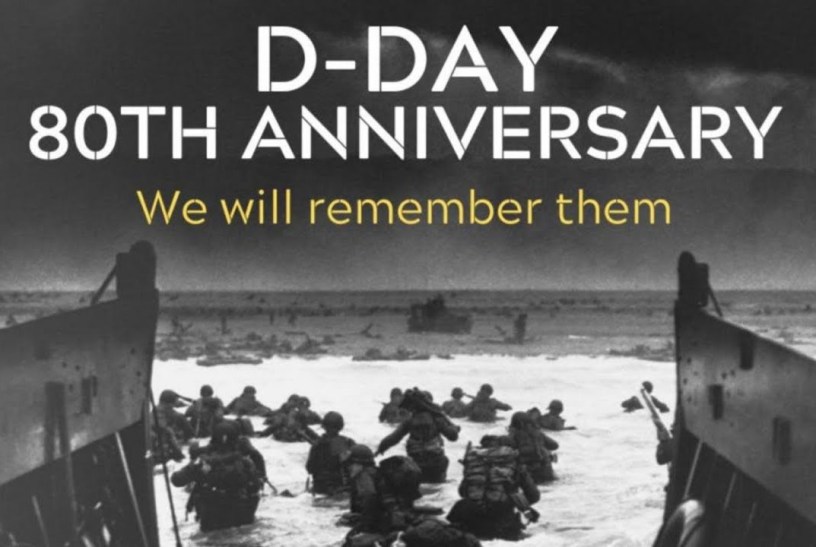
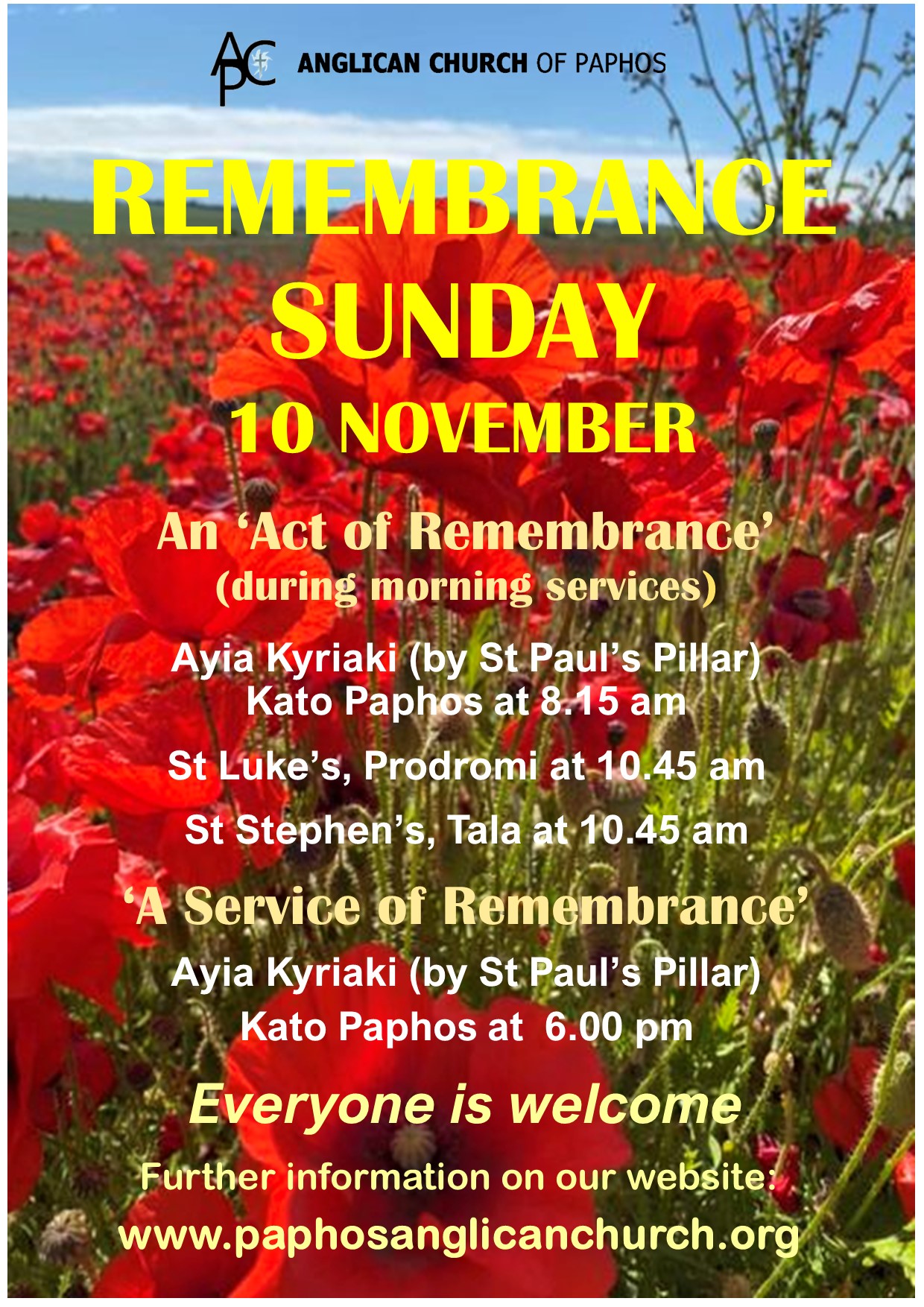
This is a copy of my talk given at Ayia Kyriaki (x2) and Saint Stephen’s in the Anglican Church of Paphos on 10 November 2024 – Remembrance Sunday.
Introduction
2024 commemorates the 80th Anniversary of The Battle of Normandy, also known as D-Day, began on 6 June 1944, and resulted in the Allied liberation of Western Europe from Nazi Germany’s control.
Codenamed Operation Overlord, the battle began when some 156,000 Allied soldiers, transported by 7,000 naval vessels, went ashore on five beaches along a 50 mile stretch of a heavily fortified French coastline. They were protected by thousands of aircraft who carried out more than 14,000 sorties, bombing targets and dropping some 24,000 airborne personnel behind enemy lines.
The invasion was one of the largest amphibious military assaults in history. And the code names of the Normandy beach sections: Omaha, Utah, Juno, Gold and Sword remain etched in our minds and the annals of 20th century warfare.

By the end of that first day, over 130,000 personnel representing 13 nations had come ashore. That success came at a terrible cost. All told, the allies suffered 10,000 casualties in the skies, seas and on the beaches of Normandy on 6th June alone.
But D-Day was only the beginning. For the next three months of ‘Operation Overlord’, the fighting would rage in the towns and villages of Northern France. It was a fight for liberation that would involve more than two million allied personnel, with 72,000 making the ultimate sacrifice.
By late August 1944, they had breached Hitler’s famed ‘Atlantic Wall’ and northern France had been liberated and they had gained a foothold in ‘Fortress Europe’. Hard fought, and costly, the Battle of Normandy was a decisive victory which paved the way to end the Second World War in Europe.
Even as there are very few living D-Day veterans, and the date recedes into the past, the event still stands, in the eyes of history, and those who were there, as one of the most heroic and dramatic battles of WW2. However, I’m very pleased to say that I met Harry Fenwick, a 101 year old veteran on D-Day this year when I led an Act of Remembrance on Mandria Beach with the Paphos Branch of the Royal British Legion (I’m their Padre/Chaplain).
UPDATE. I was privileged to sit next to Harry at for breakfast for the RBL Act of Remembrance on Armistice Day – and what an amazing man he is, what a story he has to tell and what a life he’s lived.


Whilst none of us were present on D-Day, we know with some certainty what took place through the many recollections of veterans and films made about the landings. None more so than Steven Spielberg’s film ‘Saving Private Ryan.’ Just as when we think of the Exodus and the Crossing of the Red Sea, we think of Cecile B DeMille and Charlton Heston. When we think of D-Day, it’s ‘Saving Private Ryan’ and Tom Hanks. Though Saving Private Ryan was fictional, it was inspired by the true story of Frederick Niland, who was recalled home from Europe after his brothers were killed in action.
There are four things I want you to think about this Remembrance Sunday:
1.The Bravery of the Allied Soldiers
I always wonder how men today – myself included – would react to a war situation like the Normandy invasion. Would we be racing to shore despite the hail of bullets, or would we be cowering in the landing craft? Similarly, how we would have survived (or not) in the forests running from the Nazis, when parachuted in to the wrong drop zone, living in fear of instant death, surviving on food meant for animals or food stolen from someone’s kitchen.
The truth is we don’t know which we would have been, and we certainly don’t know whether we could come close to matching the courage and determination of the Allied troops at Normandy. At the very least, we must admire what they did. It may not be an exaggeration to say that their courage saved the free world. They should have our admiration and respect and appreciation – especially in this 80th anniversary year and especially on this Remembrance Sunday.
2. The Human Spirit
Thinking about D Day and Remembrance Sunday, I’m struck by the complicated reality that is the human spirit. On 6 June the media was full of reports on the observance of the anniversary in France, and interviews with some survivors, many of whom talk with great sadness, almost despondency about how they survived, and their colleagues didn’t.
How were they not one of the thousands of soldiers killed during the assault? How had they come through without a scratch? This isn’t an unusual reaction. I’ve heard old soldiers speak about this myself.
One veteran interviewed on D-Day had this to say: You think you’re dead or going to die. I’ve wondered all my life … why did I survive? You think about all those dead kids. How did I get out of this myself, and not a scratch?
Isn’t that amazing – feeling guilty for not being a casualty of war.
This interview with D-Day Veteran Harry Billinge on BBC Breakfast on 8 November 2019 is very moving. It’s 11 mins long but watch it all if you can. Especially when he begins to talk about his Christian faith.
I’m not brave – I’m lucky.
3. Greater Love
In John 15, Jesus said: “Greater love has no-one than this, that he lay down his life for his friends.” On this Remembrance Sunday it’s right to honour those who sacrificed their lives on our behalf. And whilst it’s right to remember those who sacrificed their lives so that we might live in freedom, we must understand that mankind can only do that on an individual basis for their family, or collectively, a nation.
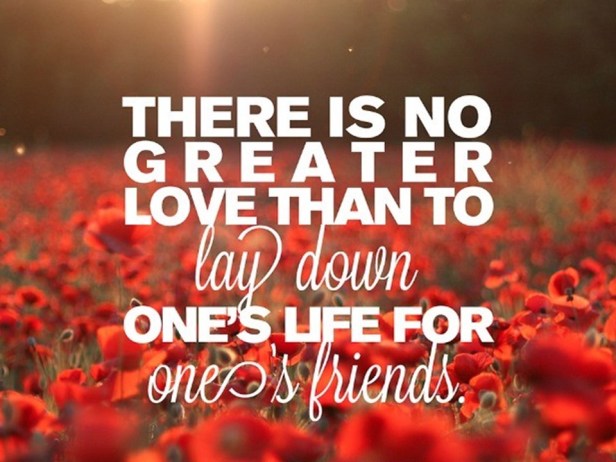
Jesus, however, made the ultimate sacrifice for the whole of the world in order that the past wrongs in our lives can be forgiven and that we can have a fresh start in life. We have been saved from a greater danger through the death of Jesus on the cross.
4. Why it’s Right to Remember
Remembrance Sunday is a time when we ought to remember, with gratitude and thankfulness, those men and women who gave, and continue to give, their lives in the ultimate sacrifice for our freedom. It is a day which should never be forgotten and one we have a responsibility to support and pass onto the next generation.
Does this mean that we are supporting war? I don’t think it is. Remembrance Sunday is a time when we recall those who gave their lives for us and remember why it was, they did what they did. It’s a time to remember the horror of war, especially world war, and to vow never again. It’s a time to dedicate ourselves anew to living in such a way that we don’t break faith with those who have died, and continue to die, to bring peace to the world.
But Remembrance Sunday isn’t a day to remember the past, it’s a timely reminder of today’s heroes, those who continue to serve in conflicts and peace-keeping missions across the globe in order to safeguard the freedom of others that we take so much for granted.
Did you know that more than half of all British Forces are currently in ‘harm’s way’ as the Americans would say? There are currently over 20,000 British troops deployed in Eastern Europe and over 2,000 deployed in the Middle East.
It’s sobering to be reminded that WW1 saw a soldier dying every 15 seconds.

10 million in total lost their lives (888,246 British soldiers) plus 7 million civilians and an unbelievable 23 million wounded. During WW2, 22 million military personnel lost their lives, but even more incredible than that is the fact that 28 million civilians lost their lives as well. And di you know 179 Army Chaplains lost their lives in WW1 and 134 in WW2. I always lay a cross in their memory today.
It’s also tragic to be reminded that more than 500 million people have died, or been injured, as a result of war since 1914. The bloodiest century in the history of the world.
There’s no doubt that these are sobering statistics for us all. But it’s because of this unacceptable loss of life that it’s right that we remember those who fought for our freedom and its right that we honour their sacrifice today.
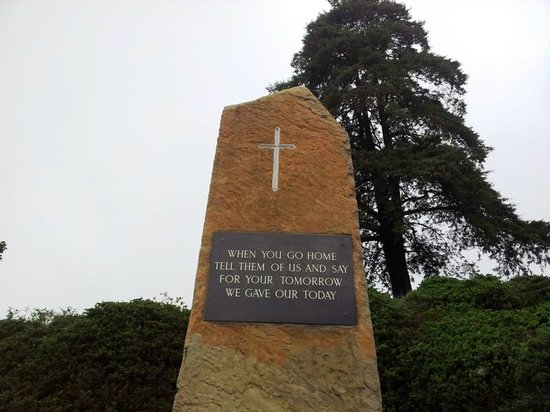
2024 also commemorated the 80th Anniversary of the Battle of Kohima, which took place in three stanes from 4 April to 22 June 1944. And as the Kohima Epitaph rightly reminds us:
When you go home, tell them of us and say, for your tomorrow we gave our today.
Some people believe that Remembrance Sunday is outdated and that, as a religious observation, it should no longer be practised, that the time for remembering wars long since passed isn’t relevant anymore and that we should just get on with living our lives in the present.
But that misses the point of Remembrance Sunday altogether because it suggests that honouring the memory of those who died is honouring the kind of actions they found themselves having to make in the midst of a struggle that, in the end, none of them really wanted to be a part of – but believed they must be – if others were to dwell in the freedom and in the peace that God wants us all to have.
There’s no doubt we live in troubled and anxious times with all that is taking place in Israel, Palestine, Lebanon, Syria, Iran and Ukraine. How different the world would be if we leaders of nations were to live with the morals and values of the Lord Jesus. As Jesus said in John 14:27
Peace I leave with you, my peace I give to you. I do not give to you as the world gives, do not let your hearts be troubled and do not be afraid.
Jesus promises peace in this world and the world to come. And if your hearts are troubled and you are afraid, then know that Jesus is only a prayer away.
A Prayer For Remembrance Sunday
Almighty Father,
whose will is to restore all things in your beloved Son, the King of all:
govern the hearts and minds of those in authority,
and bring the families of the nations,
divided and torn apart by the ravages of sin,
to be subject to his just and gentle rule;
who is alive and reigns with you, in the unity of the Holy Spirit,
one God, now and for ever.
Amen.
COPYRIGHT DISCLAIMER The text contained in this sermon is solely owned by its author, Revd Paul A. Carr. The reproduction, or distribution of this message, or any portion of it, should include the author’s name.
 revPACman