
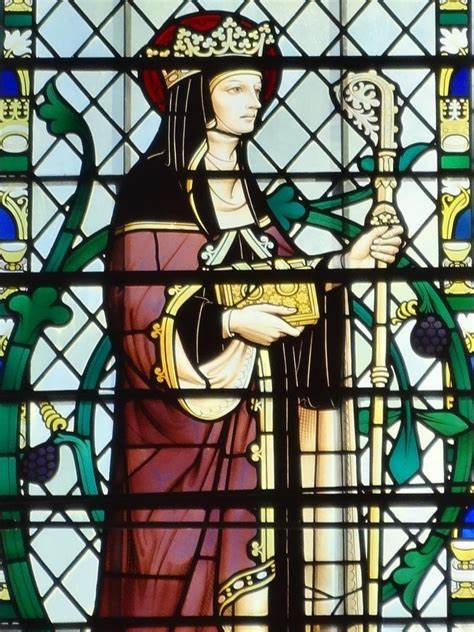
On 19 November, the church remembers Hilda, Apostle of Charity, teacher, administrator and advisor, spiritual director, reformer, abbess, 614-680. Hilda is also known as one of the patron saints of learning and culture, including poetry.
But who was Hilda of Whitby?
Hilda was a princess within the Deiran (Northumbrian) dynasty, with connections to the East Anglia royal family. She was baptized by Paulinus, Bishop of York.
Hilda’s sister became Queen of the East Angles. This region was greatly influenced by the Gallic Church, and this spurred Hilda to travel to Chelles, near Paris, with the aim of taking her monastic vows. However, before Hilda reached Gaul she was recalled by Aidan (Bishop of Lindisfarne) to Northumbria. After living a solitary life for a short period of time, she was made abbess of a religious house at Hartlepool in 649.
In 657 Hilda founded a religious community at Streasnaeshalch, later named Whitby by the Danes. Whitby came to have a significant role in the development of the faith in England. Whitby was a double monastery (a community of both men and women, but governed by a single head) and was a royal establishment. No fewer than five bishops were trained there, and the community became famous for its learning.
Whitby was the location for the celebrated Synod of 664, and Hilda was hostess for the gathering. The Synod was called in 664 to decide upon the date of Easter, which was a point of contention between the Celtic and Roman Churches in Britain. At this Synod, Hilda argued for the defence of Celtic church customs, and although the argument was eventually lost, she accepted the decisions of the Synod with grace, and worked to unite the Church throughout the land.
The existence of a written form of Hilda’s life, and her position as abbess of a double community show the importance of women at this stage of English Christian history. She was a woman of note and influence, asked for counsel by rulers, kings and ordinary people. Bede writes, “All who knew her called her mother because of her outstanding devotion and grace”.
The veneration of Hilda from an early period is attested by the inclusion of her name in the calendar of Saint Willibrord, written at the beginning of the 8th century. According to one tradition, her relics were translated to Glastonbury by King Edmund; another tradition holds that Saint Edmund brought her relics to Gloucester.
She is reputed to have encouraged Caedmon to write Christian poems – the first Christian poetry to be composed in English. Now we must laud the heaven-kingdom’s keeper, the Ordainers might and his mind’s intent, the work of the Father of Glory: in that he, the Lord everlasting, appointed of each wonderous thing the beginning; he holy Creator, at the first created heaven for a roof to the children of men; he, mankind’s Keeper, Lord everlasting, almighty Ruler, afterwards fashioned for mortals the middle earth, the world. Caedmon’s Hymn, 7th century
A Prayer
Eternal God,
who made the abbess Hilda to shine like a jewel in our land
and through her holiness and leadership
blessed your Church with new life and unity:
help us, like her, to yearn for the gospel of Christ
and to reconcile those who are divided;
through him who is alive and reigns with you,
in the unity of the Holy Spirit,
one God, now and for ever.
Amen.
Revd Paul A. Carr and extract from ‘Saints on Earth: A biographical companion to Common Worship’ by John H Darch and Stuart K Burns
 revPACman