
God’s Command to Worship
Wherever there are people something or other will be worshipped. If people don’t worship God they’ll worship a god of another kind. In some parts of the world that may be a rock or a tree or the sun. In fact, you could say that society is a worshipping culture and people worship at the altar of: money; possessions; employment; family and celebrity, to name but a few. It seems that there’s an inherent need within us to give honour and adoration to something beyond ourselves.
In Revelation 4:11 we read: You are worthy, our Lord and God, to receive glory and honour and power, for you created all things and by your will they were created and have their being. God is worthy of our worship because he is our creator and sustainer of our faith. God doesn’t command us to worship Him because He needs our worship – though it’s true that worship is pleasing to Him and that He inhabits the praises of his people. God commands us to worship Him because we need what worship can do in our lives. Worship does something to us – it makes us complete and we can only find satisfaction when we are doing those things for which we were created.
A Definition of Worship
The woman at the well didn’t fully understand. She thought that worship was all about going to the right place and doing the right thing. She wasn’t alone, of course. Most of the Jews had also fallen into that same way of thinking. Even today, many people believe that turning up on a Sunday is worship – but it’s about much more than that.
True worship, as we read in Mark 12:30-31 is to: Love the Lord your God with all your heart and with all your soul and with all your mind and with all your strength. The second is this: Love your neighbour as yourself. And this echoes the theme of 1 John 3:16-24. Loving God with all our heart, soul and mind, simply means to worship with all that we are, with what makes up the very centre of our being. It’s about giving as much as we can to God and giving all that we have to Him, and to those around us, in love.
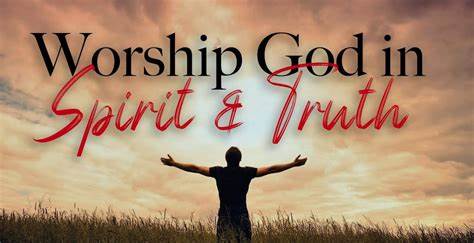
Sometimes Jesus’ disciples need to be shocked into an understanding of Christian truths and this is definitely the case in the story of the woman at the well in John 4. Here, Jesus uses an adulteress to teach some fundamental truths about worship. Remember Jesus’ words in John 4:21-24: … a time is coming when you will worship the Father neither on this mountain nor in Jerusalem. … a time is coming … when (we) will worship the Father in spirit and truth, for they are the kind of worshipers the Father seeks. God is spirit, and his worshipers must worship in spirit and in truth.
Worship in Spirit and in Truth
We know God doesn’t consist of a physical body like us, so worshipping Father, Son and Holy Spirit must involve something more than a physical act. Jesus was explaining that true worship was no longer going to take place in a building but in the hearts of His people. 1 Corinthians 3:16: Don’t you know that you yourselves are God’s temple and that God’s Spirit lives in you?
We also need to understand who God is if we are to experience true worship, because true worship is based on knowledge of God. We can’t be worshipping God in Truth if our lifestyle, what we say and do and our attitude is contrary to what the Bible teaches. Jesus teaches that worship must engage our heart and minds. A marriage of intellect (Truth) and emotions (Spirit) which is both healthy and complimentary – that’s the kind of worshipper that God is seeking, vs23.
Worship as a Christian Community
Many of us will recognise the importance and value of worshipping together but if you are anything like the members in the churches where I’ve served – you won’t always agree about the form and character it should take. If I was to ask each of you to give me a definition of worship I’m sure you’d all have a different answer simply because we all have our own particular preferences.
Some people enjoy a more traditional form of worship. Others appreciate more contemporary forms of worship. Some are suspicious of ‘new’ songs – even new liturgy. But I do believe they bring a new freshness, intimacy and vitality to our worship.
Likewise, some of the great old hymns/liturgy are rich in teaching and devotion and have sustained believers for many years and such a legacy is something to be cherished – but not at the exclusion of something contemporary – I actually re-introduced the Book of Common Prayer into my last parish and value/appreciate the traditional forms of Anglican worship. But we have a responsibility, I believe, in an increasingly secular society, to do what we can to connect with the post-modern, post Christian world in which we live and that is about language, style and content. All this is a challenge to us, especially when church membership is declining year on year.
I recognise, of course, that there is more to Sunday worship than songs, liturgy and contemporary language. It involves a whole host of other things: Prayer; the reading of God’s word; Preaching; Holy Communion; Tithing; Giving; Listening; Fellowship; Fasting; Lifestyle; Evangelism; Mission and so on.
The most important issue which needs to be at the heart of our thoughts about worship, both as an individual and as a Christian community, is not what pleases us in worship, but what most honours God – which, in reality, may have little to do with our own preferences. Have you ever considered the fact that what may be termed ‘helpful’ to you may, in fact, be unacceptable to God? Might we find ourselves, just like those religious leaders in Acts 4:11 rejecting the very things that brings us life? Like them, might our aim in worship be simply please ourselves and not God?
Of course, there are some gestures of ritual and priestly ministrations, but worship is, fundamentally, faith expressing itself in obedience and adoration. It’s personal/intimate fellowship with God in a way that is relevant to every area of our life. In seeking after a true worshipping spirit, we shouldn’t be preoccupied with perpetuating a certain tradition, but rather desiring to worship in a way that touches hearts; changes lives and is pleasing, and honouring, to Him and reaches out to those who are not yet Christians.
The truth is that worship has little to do with style but everything to do with our heart.
Some Characteristics of Living Worship
I’ve already mentioned that we engage in worship, not so much for God’s benefit but for our own. But what, you might ask, are some of the characteristics of worship in Spirit and Truth? I call it Living Worship – because that’s what it is. Here are a few suggestions:
Living Worship means putting God first Above anything, and everything, else in our lives.
Living Worship is Trinitarian We worship Father, Son and Holy Spirit and embraces a supernatural characteristic.
Living Worship creates a spirit of thankfulness It is obedience to God’s command to worship in response to the salvation we have received through Jesus. Psalm 100:4 encourages us to: Enter His gates with thanksgiving and His courts with praise. One of the signs of a thankful heart is that we give thanks to God for the many blessings we receive from Him day to day and for the opportunities that are before us.
Living Worship brings us into God’s presence Living Worship moves the focus from ourselves and our circumstances to Him. We become aware of His glory and greatness, His majesty and power.
Living Worship gives us His perspective on our situation How many times has someone asked how you are and you reply: All right … under the circumstances. Living Worship should enable us to see over our circumstances, not be weighed down by them. Living Worship gives us God’s perspective on our situation which is exactly what we need.
Living Worship is living out our faith in our everyday lives Living Worship is not something that is confined to church meetings – is a twenty four hours a day, seven days a week lifestyle.
Living Worship is not dependent on buildings and circumstances Nor does it require liturgy, incense, candles, robes, canticles etc. Living worship is not even dependent on other people – we worship wherever we find ourselves; Work; Garden; Market; Pub; Hobby Group; Cafe. Whatever and wherever the circumstances in which we find ourselves.
Living Worship changes us Living Worship is not cold and formal. One of the principle elements of Living Worship is the joy that ought to be present because our hearts have been touched by the love of God. Living Worship changes our attitudes and thinking, it transforms our character and makes us a people of hope and of faith.
COPYRIGHT DISCLAIMER The text contained in this article is solely owned by its author, Revd Paul A. Carr. The reproduction, or distribution of this message, or any portion of it, should include the author’s name.
 revPACman