
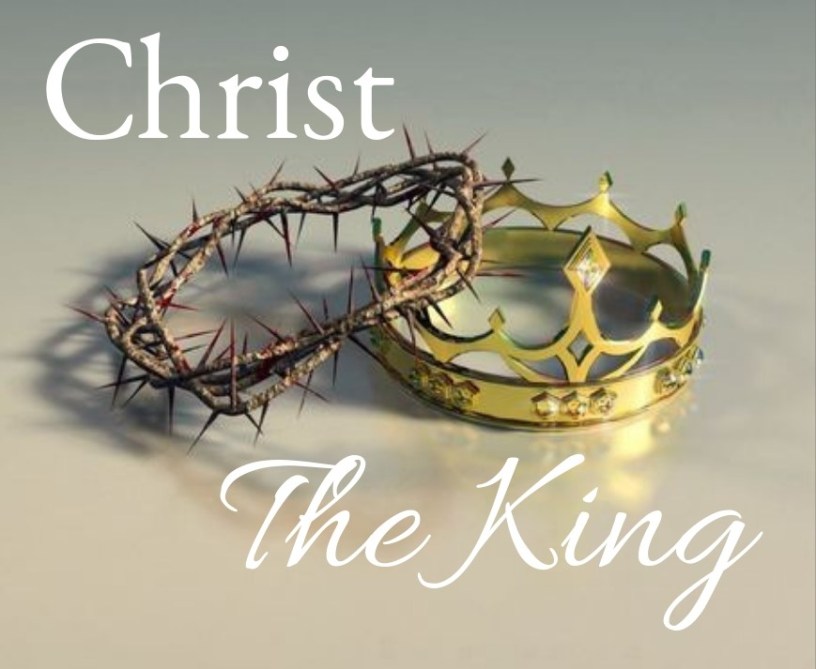
This is a copy of my talk given at Ayia Kyriaki and Saint Luke’s in the Anglican Church of Paphos on Sunday 24 November 2024 and Via Zoom for Saint Paul’s Anglican Church, Kuwait on Friday 22 November 2024. The Bible reading was John 18:33-37. NB. A shorter version of this sermon was preached in Paphos due to time constraints!
Prayer
Heavenly Father,
I thank You for Your word.
By the power of Your Holy Spirit,
May You speak to my heart,
And change my life.
In the precious name of Jesus I pray.
Amen.
Introduction
The origins of ‘Christ the King’ Sunday could be a sermon all by itself. It begins in the 1920s, which was a very interesting time for our world. We had only just emerged from the war ‘to end all wars’, nationalism was on the increase and the signs were everywhere that it was hurtling towards another (which it was). We were in the grip of a worldwide economic depression and desperately looking for answers.
Some outspoken leaders believed that they had answers to those questions. One was the Italian leader, Mussolini, who had just celebrated his third year in office. Another was a young rabble-rouser by the name of Adolf Hitler, who had been out of jail for a year by that stage, and whose Nazi party was rapidly growing in popularity across Germany.
But in 1925, Pope Pius XI directed all churches to set aside one Sunday to declare that: Jesus Christ is King. It wasn’t embraced by the Anglican Communion until 1970. when it was placed at the Sunday before Advent. How we couldn’t imagine the Church liturgical calendar without this feast day.
But this Sunday was set aside, not for the US president, not the British Prime Minister, not the warlords of ISIS, not the Premier of China. But Jesus as Lord and King. Nations rise and fall, and kingdoms come and go, but Jesus is always Lord, and his role as King remains. All other kingdoms will turn to dust.
And when we think about Christ as King, we may be reminded of Handel’s Messiah and its magnificent Alleluia chorus: King of Kings, Lord of Lords, And He shall reign for ever and ever!
Some see Advent as a time for a spiritual shake-up – and thinking about the end times often does that for many people. Thomas Cranmer obviously thought so when he wrote the prayer/collect for today – it’s one of those great prayers of the Church:
Stir up, we beseech thee, O Lord,
the wills of thy faithful people, that they,
plenteously bringing forth the fruit of good works,
may of thee be plenteously rewarded,
through Jesus Christ our Lord.
Since Victorian times, ‘Stir Up Sunday’ is associated with the tradition of making the Christmas pudding – an essential part of most traditional Christmas dinners. If you haven’t started yet, today is the perfect day to start!
1. The Last Word
The study of the end times is known as eschatology. It’s a theological word that has its roots in two Greek words eschatos, meaning last and logos meaning word. And so, when we use the term eschatology, it literally means the last word.
Have you ever been in a heated argument with someone and couldn’t let the matter drop? I can’t say I’ve been in that situation myself!! A time when you just had to continue making your point. Why? Because you had to have the last word. To have the last word is to be the final authority. Ask any coach, teacher, manager, politician, or parent and they will tell you that having the last word is the most important one.
That is ultimately what today is all about. When the church declares that Christ is King, we are declaring that Christ has the last word. He is the final authority and power in the universe. Christ is King!
2. Two Kingdoms
In John 18:33-17, we see two kingdom’s locked in combat, each competing with the other to have the last word. Jesus claims to be a king. Pontius Pilate is a Governor in the mightiest empire on earth.
Jesus and Pilate represent two very different ways of looking at power and authority in this world. Jesus represents one kind of kingdom. Pilate represents another. In today’s Gospel we see these two kingdoms colliding.
Two kingdoms, two ways of life, two kinds of power, two kinds of authority, continually pushing and tugging against one another, each trying to have the last word. One lives by the power of the sword. The other lives by the power of love.
One is driven to accumulate wealth. And there can never be enough. The other announces, “Blessed are the poor.” Everyone is wealthy.
One believes that the weak must serve the strong. The biggest guns and the most money matters. The other believes that the strong get to serve the weak. That the last shall be first and the first shall be last.
One demands that everyone must get what they deserve. Justice is all that matters. The other dares to give people what they don’t deserve: mercy and forgiveness.
One believes that everyone has got to prove themselves. There are no shortcuts. There are always strings attached, obligations to be fulfilled, conditions to be met. The other dares to believe that everyone is a child of God and can dare to call him “Abba Father.”
Two different kingdoms, two different ways of life, two different perspectives on what matters, two different voices claiming to have the last word. In the final analysis, only can have the last word – the other would be exposed as a pretender to the throne.
3. The Last Word: Pilate?
When this scene in the praetorium came to an end, the answer seemed clear. Pilate was king. He sentenced Jesus to death by crucifixion. He would have the last word. And because Pilate had the last word, everything that Jesus represented, his claims for himself and for God, would be exposed as a deception.
It was just not true – this talk of love, mercy, and forgiveness. If God was to have a last word, it was to be spoken by kings like Pilate. And that last word certainly was not mercy!
And as Jesus hung there on the cross, Pilate added further insult to injury by posting over Jesus’ head a sign of mockery: Jesus of Nazareth, King of the Jews. What a king! What a pretender, this Jesus of Nazareth. Pilate and all that he represented in this world had the last word.
And so, in the remainder of chapter 18 and Jesus’ trial before Pilate, the trial takes on an unusual shape. Even though officially Jesus is on trial before Pilate, in John’s way of telling, the roles actually get reversed. Pilate is put on the defensive.
Pilate has to justify himself. Pilate gets so unnerved and bewildered that finally he asks in desperation, “What is truth?” Everything that he had assumed to be true no longer seems so true in the presence of Jesus. Finally, with a sense of desperation, Pilate gives up and hands Jesus over for crucifixion.
But we know that the story didn’t end there. Three days later Jesus was raised from the dead. Pilate did not have the last word. That sign posted over his head on the cross in mockery was actually right. Jesus is indeed King. Jesus does have the last word. Jesus is God’s last word to the world. And it is a word of mercy and forgiveness. Because Jesus has the last word, life changes. It can no longer be business as usual.
4. The Last Word: Jesus!
Jesus is the one who is really in control. He is determined to have the last word. And he has the last word when – as King! – he compels Pilate to hand him over to crucifixion where he can finally be enthroned on the cross!
Because Christ is King, because Jesus does indeed have the last word, everything that Jesus claimed concerning God and human life and truth and good and evil was true! God can be trusted. Sinners are forgiven. The meek and the poor and the persecuted for Jesus’ sake receive blessings. Eternal life is now already ours because Jesus is King.
Because Jesus has the last word, Christian’s can express a kind of community life that just isn’t seen in any other place. Because Jesus has the last word, the last word among us is mercy and forgiveness. We are slow to judge and quick to forgive. We are generous instead of miserly. We welcome all into our midst with no strings attached.
Because Jesus has the last word, we are yeast in the loaf, a light in the darkness, the salt of the earth. In other words, we can make a difference in this world. All too often we think that we can only do God’s work by working in the institutional church, but the most important work that we do is out there in the world, Monday through to Saturday. In our jobs and hobby groups, in our families and neighbourhoods, where we can dare to go against the grain.
Jesus has the last word – not the boss or the neighbour or the latest popularity contest. Because he has the last word, we can tell the truth when everyone else can only lie. Because he has the last word, we can strive to do our best when everyone else is just trying to get by. Because he has the last word, we can go out of our way to help someone, even when it might cost us.
5. Who Is Christ the King?
Few people realize that the hymn “Crown Him with Many Crowns” boasts twelve verses. Twelve! Of course, most hymnals reduce it to six. But these six verses give us six qualities of Jesus as King:
- The Lamb of God, Revelation 5:6
- The Son of God and Son of Man, John 1:1,14
- The King of Love, Romans 5:8
- The King of Life, John 11:25
- The King of Peace, Ephesians 2:14
- The King of Heaven, Acts 1:9
But let me tell you a little more about Christ the King (with thanks to the BibleDude and Revd Dr S.M. Lockridge).
He was there in the beginning when the Triune God spoke all of creation into existence and called it good.
He walked with Adam and Eve in the Garden.
He was the Redeemer who brought the Israelites out of Egypt.
He was the Rock in the wilderness who provided life-giving water.
He’s the one who walked in the fiery furnace with Shadrach, Meshach, and Abednego in one of the greatest moments of deliverance of the faithful ever recorded.
He was the King in Isaiah’s temple vision when he described the glory of God.
He was born of a virgin in a humble manger.
The Spirit of God descended like a dove at his baptism with the Father proclaiming, “This is my Son, the Beloved, with whom I am well pleased.”
He put the devil in his place while fasting in the wilderness for 40 days.
He called a bunch of ragamuffins to follow him as his disciples.
He went to a wedding and turned water into wine.
He preached to the people about the good news of the kingdom of God.
He cured people afflicted with disease and pain, demons, blindness and paralysis.
He is close to the hungry, the poor, and the sick.
He has a heart for the widows and orphans.
He broke cultural barriers by talking with the Samaritan woman at the well.
He stilled the storm when the boat was being swamped by the waves.
He raised people from the dead.
He walked on water.
He calls us who are weary and heavy laden, promising rest and complete restoration.
He called out the religious elite who cared more about their own comfort and wealth than ministering the heart of God.
He showed us that His rule is not by power and might, but by caring for those who need Him.
He’s the Great Shepherd who left the 99 to rescue the one.
He taught his disciples how to lead by washing their feet.
He prayed in the garden, “Let this cup pass from me; yet not my will, but yours be done.”
He took the whipping and abuse and mocking of the Roman soldiers, and said, “Father forgive them, they know not what they do.”
He died a criminal’s death on the cross, taking with Him the sins of the world.
He defeated death by rising from the grave.
He ascended into heaven and is seated at the right hand of the Father.
He looked at me, when I was broken and unworthy, and called me to a life of hope and a purpose.
He is there with you when you’re struggling with life.
He’s there when you’re broken-hearted, bringing deep healing exactly where you need it.
He’s the one who will wipe away every tear from our eyes.
He’s coming back to restore all things.
That’s my King!
Do you know Him?
Conclusion
Many times in the Bible, and throughout Church history, people have sought to deny the Kingship of Jesus. And this was, and is, a key theological issue.
- If Jesus is not the divine Lord, and is not the very image of God, then we cannot know God.
- If Jesus is not the sovereign Lord who rules the universe. then we can have no confidence and security in the face of the tough times of life.
- And if Jesus is not the divine sovereign Lord who died for our sin on the cross, then we can have no forgiveness.
Christ the King Sunday asks us a most timely and timeless question: Who has the last word in your lives? Who is truly king? Pilate, representing the kings and rulers of this world, or Christ?
COPYRIGHT DISCLAIMER The text contained in this sermon (except where stated) is solely owned by its author, Revd Paul A. Carr. The reproduction, or distribution of this message, or any portion of it, should include the author’s name.
 revPACman