
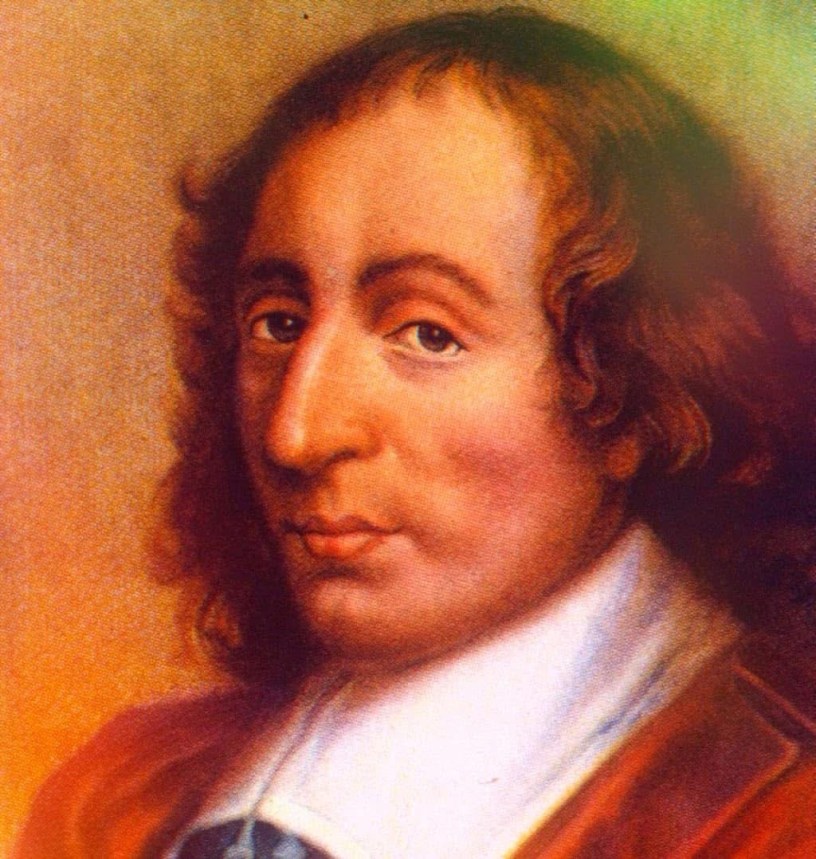
On 25 November 1654, Blaise Pascal – one of the greatest mathematicians, physicists and engineers of all time, inventor of the calculator and designer of the Parisian bus route – experienced his ‘Night of Fire’; a profound spiritual encounter that totally transformed his life.
By any measure Pascal was a genius polymath. It was while he was still in his teens that he invented the first mechanical calculator – a precursor to modern computers. He also created at least two entirely new fields of mathematical research and his Law of Probability is still used by economists today. Pascal’s name has been lent to a unit of pressure and a programming language. And yes, he even developed the first bus route for Paris!
But the defining moment of Pascal’s brilliant life came between 10.30 and 12.30 at night, on 23 November 1654. We know about his ‘Night of Fire’ only from words he himself wrote and sewed into his jacket, eventually discovered by a curious servant after the great man’s death. These are his words:
Fire.
God of Abraham,
God of Isaac, God of Jacob,
not of philosophers and scholars.
Certainty, certainty,
heartfelt joy, peace.
God of Jesus Christ.
That mysterious encounter changed Pascal’s life. Thereafter he turned his intellect towards theology and philosophy. His book Pensées, which is widely considered a masterpiece of prose, argues that the reason for prayer is God’s desire “to impart to his creatures the dignity of causality.” It also includes Pascal’s famous ‘wager’: that it makes more sense to live as though God exists because if you are wrong your loss will be merely finite, but if you are right your gain will be immeasurable.
Ultimately this brilliant intellect was not a rationalist but a mystic who argued that ‘People almost invariably arrive at their beliefs not on the basis of proof but on the basis of what they find attractive’ (De l’art de persuader).
—
Extracted from “How to Pray: A Simple Guide for Normal People”
 revPACman