
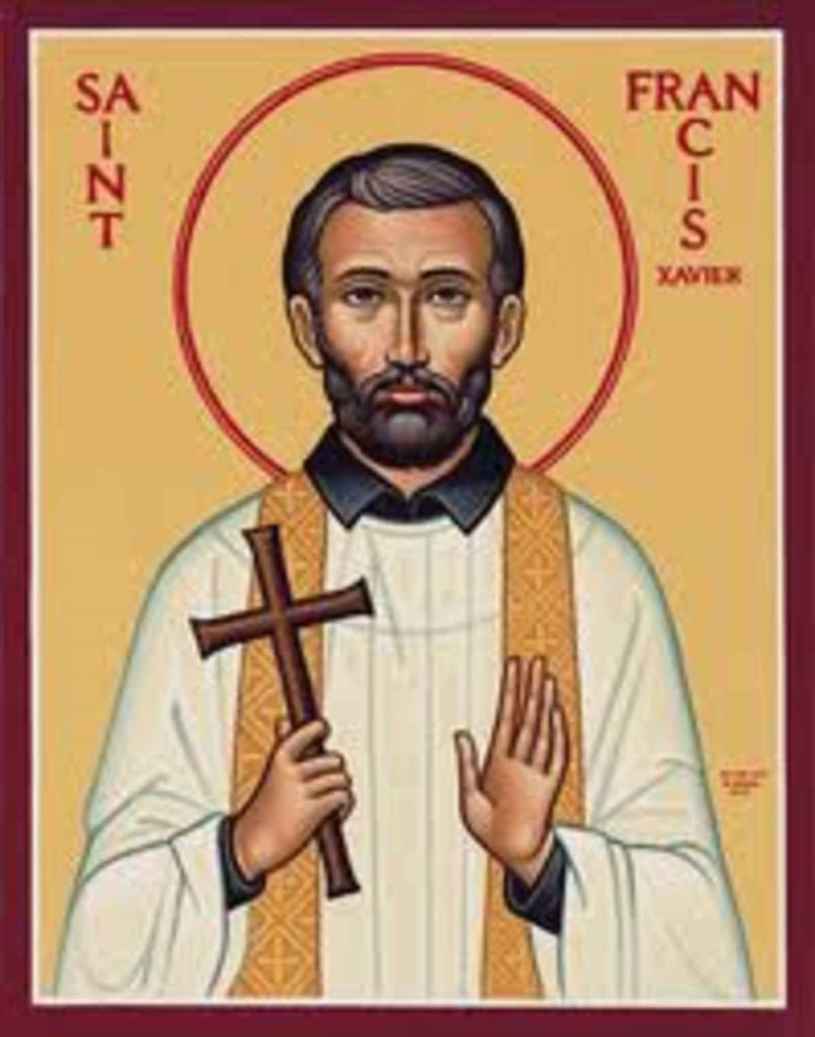
On 3 December the Church remembers Saint Francis Xavier, missionary, and Patron Saint of African missions, foreign missions, navigators, parish missions, plague epidemics, propagation of the faith. 1506-1552.
But who was Francis Xavier?
Born in the Castle of Xavier near Sanguesa, in Spain in 1506, Francis Xavier was the son of an aristocratic Basque family. He was educated at the University of Paris, where he met Ignatius Loyola. Xavier was one of the group of six who joined with Ignatius Loyola in 1534. He was ordained priest in Venice in 1537 and when the Society of Jesus was founded in 1540 Xavier was its first secretary.
At the invitation of the King of Portugal to evangelize the East Indies, Xavier made his way to the Portuguese enclave of Goa in India, which became his base. After preaching with great success in Goa for five months, he moved south through India to Ceylon (now Sri Lanka), where he is said to have made tens of thousands of converts.
In 1545 Xavier left India for Malacca from where he travelled down the Malay Peninsula and on to the Molucca Islands, founding Christian communities as he travelled and preached.
He was the first to note a problem that was to bedevil the work of missionaries in the following centuries as well as in his own: the oppression, exploitation and un-Christian lifestyles of Europeans were among the biggest obstacles that the missionaries had to overcome and made their task (especially when indigenous people assumed that all white people were Christians) so very much harder.
After a trip to Goa, he sailed for Japan and landed at Kagoshima in 1549. He studied the Japanese language for a year and then preached in many of the principal cities for two-and-a-half years. By 1551, when he left Japan, he had established a vigorous Christian community that was to remain faithful in time of persecution.
His next target was China. To gain entrance to that country, then closed to foreigners, he persuaded the Portuguese authorities to send an embassy, of which he would be a member, to the Chinese Emperor. The embassy left Goa in 1552 but got no farther than Malacca. Xavier continued alone, arriving at Sancian, a small island near Macau, in August 1552. There he died on 3 December that same year, after repeated vain attempts to reach the mainland. His body was returned to Goa for burial.
Francis Xavier died at the early age of 46, yet in his short life he proved to be one of the most effective missionaries of all time. Though the official Jesuit figure of 700,000 conversions at Xavier’s hands is no doubt an exaggeration, it gives some idea of the sheer scale of his work. And if Xavier’s achievements are a tribute to his total commitment to mission work they also indicate the success of his strategy, in which he sought in each area he visited to target those groups (children in South India, local rulers in Japan, etc.) most likely to be receptive to the gospel, to give it a foothold in the indigenous culture and to propagate it within their communities.
There are now millions of Christians in the Orient who can trace their Christian evangelization back to Francis Xavier. He is regarded as the greatest missionary since Saint Paul.
A Prayer
God our Father,
who by the preaching of your servant Francis
brought many peoples of Asia to yourself:
give his zeal for the Faith to all who believe in you,
that your Church may rejoice in continued growth;
through Jesus Christ your Son our Lord
who is alive and reigns with you
in the unity of the Holy Spirit,
one God, now and for ever.
Amen.
Francis Xavier and Saint Ignatius of Loyola were canonized on the same day in 1622.
Revd Paul A. Carr and extract from ‘Saints on Earth: A biographical companion to Common Worship’ by John H Darch and Stuart K Burns
 revPACman