
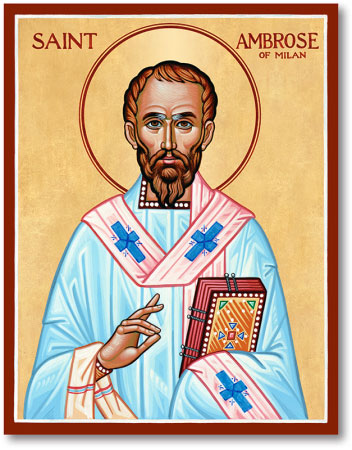
On 7 December the church remembers Saint Ambrose of Milan, bishop, teacher of the faith, and Patron Saint of Beekeepers, beggars and learners, 339/340 – 397.
But who was Saint Ambrose?
Born in Trier 339/340 and brought up in a Christian family, Ambrose was recommended as bishop in 374. Although he was a Christian he had not yet been baptized. After he accepted the position Ambrose received baptism, ordination and consecration as bishop within a single week. His election as bishop is a testimony to his ability in government and his personal integrity.
The Church in Milan was torn between two opposing theologies concerning the nature of Christ. The Arian party denied the full divinity of Christ, whilst the anti-Arian (or orthodox) party affirmed it. The two parties could not agree on a candidate for bishop and the argument spilled over into civil unrest. Ambrose was the only candidate both parties could agree on.
In the debate Ambrose initially followed the decrees of the Emperor who was an Arian supporter. However he soon started to act for the defence of orthodoxy and pursued an anti-Arian agenda in his appointments and social affairs. One famous anti-Arian event occurred in 386 when the Arian party requested a church building in which to conduct their worship.
Although agreed by the Emperor, the request was refused by Ambrose and he underlined the refusal by occupying the requested building with his whole congregation. The occupation lasted from Palm Sunday to Easter Day, and the time was passed by the singing of songs. It was the origin of Ambrosian chant in which hymns drew content from the religious events rather than just Scripture. A prolific hymn writer, Ambrose became known as the founder of liturgical hymnody in the Western Church.
Ambrose had many disagreements with the Emperor Theodosius. Although a Christian, Theodosius had difficulty ruling his empire in a Christian manner, often blindly following the advice of his largely pagan court and occasionally over-reacting in a violent manner to quell public unrest. In 390 Ambrose’s power over Theodosius was demonstrated.
The people of Thessalonica murdered one of Theodosius’ senior officers. The Emperor had the citizens invited to the Circus and then sent in soldiers to massacre them. Records note that in three hours 6,000 citizens lost their lives. Ambrose’s response was to withdraw the Eucharist from the Emperor, until he had performed public penance. Ambrose constantly challenged him over his behaviour and his policies, and pushed the boundaries of church influence deeper and deeper into the role of the State. In all this, Ambrose’s main weapon was the withholding of the Eucharist from the Emperor and through this threat Ambrose claimed for the Church the right of veto over the decisions of the State.
Ambrose was a staunch defender of the Church in a time of theological unrest and debate. He was unwilling to compromise the Church’s position in society. He was also willing to act for the State, making several peace missions, and intervening in civil unrest on more than one occasion. Ambrose demanded integrity in leadership from the governing class, and from the Emperor in particular. He stated quite plainly that ‘the Emperor is in the Church, not over it’. He died two years after Theodosius, on Good Friday 397.
Ambrose’s ‘Hymn for the time of Advent’ shows how he could combine doctrine and song to produce images of theological beauty: Redeemer of the nations come, That we may taste the virgin’s fruit And every age in wonder gaze On such a birth, worthy of God! No earthly father’s seed played here, But mystic Breath touched holy virgin womb: The Word of God took human form And human flesh blossomed divine. Hymn for the Time of Advent
A Prayer
God of hosts,
who called Ambrose from the governor’s throne
to be a bishop in your Church
and an intrepid champion of your faithful people:
mercifully grant that, as he did not fear to rebuke rulers,
so we, with like courage, may contend for the faith we have received;
through Jesus Christ our Lord.
Amen.
Revd Paul A. Carr and extract from ‘Saints on Earth: A biographical companion to Common Worship’ by John H Darch and Stuart K Burns
 revPACman