
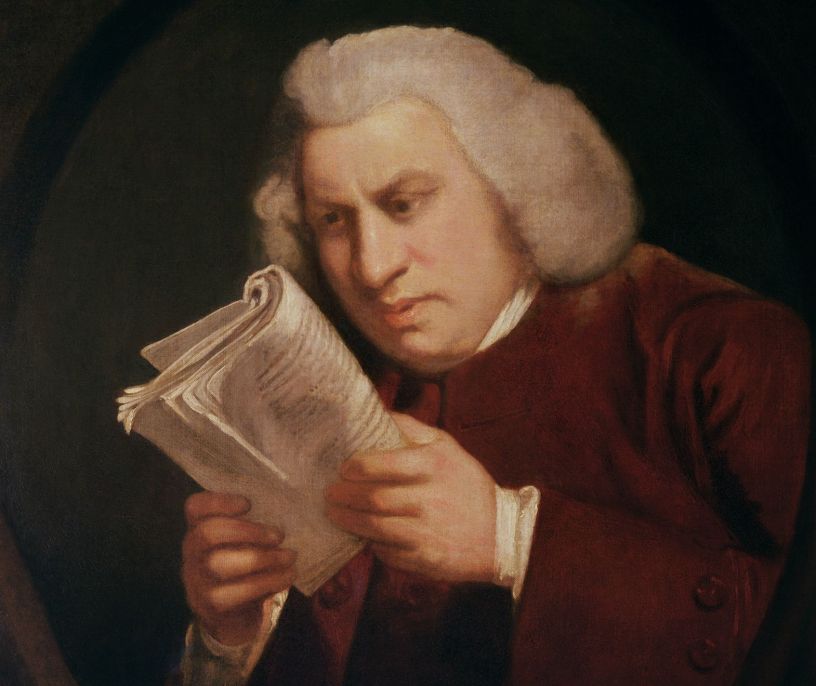
On 13 December, the church remembers Doctor Samuel Johnson, an English writer who made lasting contributions as a poet, playwright, essayist, moralist, literary critic, sermonist, biographer, editor, lexicographer and moralist, 1709 – 1784.
But who was Samuel Johnson?
Samuel Johnson was born in Lichfield in 1709, the son of a bookseller. He attended the local school, and, probably more importantly, eagerly read the books in his father’s shop. In 1728 he entered Pembroke College, Oxford, but left without taking a degree.
It was perhaps appropriate that it was through reading that he came to faith. Boswell recalls him saying: I became a sort of lax talker against religion, for I did not think much against it; and this lasted until I went to Oxford, where it would not be suffered. When at Oxford, I took up Law’s Serious Call, expecting to find it a dull book (as such books generally are), and perhaps to laugh at it. But I found Law quite an overmatch for me; and this was the first occasion of my thinking in earnest of religion after I became capable of rational inquiry.
In an age of generally lax religious observance, Johnson was a dutiful son of the Church of England. A strong High Churchman, in the pre-Tractarian sense of that term, he was tolerant towards Roman Catholicism though not of Nonconformity.
After an unsuccessful teaching career in Lichfield, Johnson went up to London in 1737. He was best known for his dictionary, which, after eight years in the making, was published in 1755 with around 40,000 entries. He was the subject of one of the greatest biographies ever written, James Boswell’s Life of Samuel Johnson, published in 1791.
Some uncertainty surrounds the question of whether Johnson experienced an evangelical conversion in February 1784 in the last year of his life. There is no written record by either Johnson or Boswell, but William Cowper was clearly aware of it since he wrote to John Newton on 11 May 1784 that news of Johnson’s conversion was ‘a singular proof of the omnipotence of Grace’.
Throughout his life Johnson suffered from depression and had a terrible fear of death and judgement and it may have been that at the last he received the assurance of forgiveness and salvation. Certainly, he received Communion eight days before his death in December 1784 and is said to have prayed: Grant O Lord that my whole hope and confidence may be in his merits and in thy mercy: forgive and accept my late conversion, enforce and accept my imperfect repentance…and make the death of thy son Jesus effectual to my redemption.
Dr Samuel Johnson’s Prayer of Dedication
Almighty God, the giver of all good things,
without whose help all labour is ineffectual,
and without whose grace all wisdom is folly:
grant, I beseech Thee, that in this my undertaking,
thy Holy Spirit may not be withheld from me,
but that I may promote Thy glory,
and the salvation both of myself and others.
Grant this, O Lord, for the sake of Jesus Christ.
Amen. Lord bless me. So be it.
Revd Paul A. Carr and extract from ‘Saints on Earth: A biographical companion to Common Worship’ by John H Darch and Stuart K Burns
 revPACman