

This is a copy of my talk given at the Carol Service at Saint Stephen’s in the Anglican Church of Paphos on Sunday 15 December 2024. There were several Bible Readings! You can read/download the service sheet here Carol Service 2024 – St Stephens
This extract from the chapter ‘Marley’s Ghost’ from the novel ‘A Christmas Carol’ by Charles Dickens was read immediately before my talk.
Once upon a time – of all the good days in the year, on Christmas Eve – old Scrooge sat busy in his counting house. It was cold, bleak, biting weather: foggy withal: and he could hear the people in the court outside, go wheezing up and down, beating their hands upon their breasts, and stamping their feet upon the pavement stones to warm them.
The city clocks had only just gone three, but it was quite dark already – it had not been light all day – and candles were flaring in the windows of the neighbouring offices, like ruddy smears upon the palpable brown air.
The fog came pouring in at every chink and keyhole, and was so dense without, that although the court was of the narrowest, the houses opposite were mere phantoms. To see the dingy cloud come drooping down, obscuring everything, one might have thought that Nature lived hard by, and was brewing on a large scale.
The door of Scrooge’s counting house was open that he might keep his eye upon his clerk, who in a dismal little cell beyond, a sort of tank, was copying letters. Scrooge had a very small fire, but the clerk’s fire was so very much smaller that it looked like one coal. But he couldn’t replenish it, for Scrooge kept the coal-box in his own room; and so surely as the clerk came in with the shovel, the master predicted that it would be necessary for them to part. Wherefore the clerk put on his white comforter, and tried to warm himself at the candle; in which effort, not being a man of a strong imagination, he failed.
“A merry Christmas, uncle! God save you!” cried a cheerful voice. It was the voice of Scrooge’s nephew, who came upon him so quickly that this was the first intimation he had of his approach.
“Bah!” said Scrooge, “Humbug!”
He had so heated himself with rapid walking in the fog and frost, this nephew of Scrooge’s, that he was all in a glow; his face was ruddy and handsome; his eyes sparkled, and his breath smoked again.
“Christmas a humbug, uncle!” said Scrooge’s nephew. “You don’t mean that, I am sure?”
“I do,” said Scrooge. “Merry Christmas! What right have you to be merry? What reason have you to be merry? You’re poor enough.” “Come, then,” returned the nephew gaily. “What right have you to be dismal? What reason have you to be morose? You’re rich enough.”
Scrooge having no better answer ready on the spur of the moment, said, “Bah!” again; and followed it up with “Humbug.”
Introduction
Charles Dickens’s novel, A Christmas Carol, first published on 19 December 1843, is one of the best-loved stories set around Christmas time. It has spawned numerous films – not least ‘A Muppet Christmas Carol!’ In his preface to the book, Dickens states that his purpose in writing was to persuade his readers to summon the spirit of Christmas, and benevolence, not just for one week in December, but for all year round.
The book’s main character, of course, is the mean and intimidating Ebenezer Scrooge, who lives to make money and very little else. He certainly has no use for religion or sentimentality in his daily life.

One Christmas Eve, Scrooge receives a terrifying wake-up call. The spirit of his dead business partner, Jacob Marley, who died seven Christmas Eves before, comes to visit. Marley is bound in terrible chains and has been condemned to roam the face of the earth, tormented in death by the things he neglected to value in life.
Scrooge replies: “But Jacob, you were always a good man of business.”
Marley laments: ‘Business? Mankind was my business. The common welfare was my business; charity, mercy, forbearance, and benevolence, were, all, my business.’
Marley goes onto speak about the ‘torture of remorse’ and makes it clear this is Scrooge’s last opportunity to turn from his selfish ways. He warns Scrooge to expect a visit from the spirits of Christmas: Past; Present and Future.
- The Spirit of Christmas Past
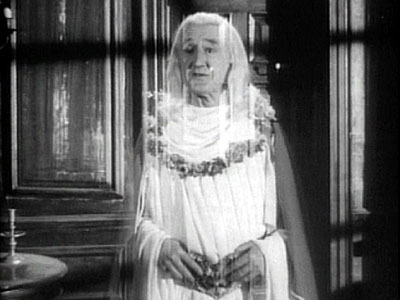
The spirit of Christmas Past takes Scrooge on an unforgettable trip down memory lane to his own childhood. Scrooge is astonished to see old, familiar faces playing happily in the open air.
As the spirit takes him into a schoolroom, however, they see a little boy sitting on his own. Scrooge remembers his loneliness, and how he longed for the presence and warmth of friends. He recalls his past desires for the love and approval of his family, but then sees all the people who tried to stop his slide into selfishness.
He sees his former fiancée, Belle, who complains to him from: ‘All hopes have merged to a master passion; the thought of money engrosses you!’ And then calls of their engagement. Dickens explores the love of money compared with the value of relationships. Scrooge’s insatiable appetite for more consumes him. To him, Christmas has become nothing more than a ‘time for finding yourself a year older, and not an hour richer’.
The celebrity psychologist, Oliver James, in his book Affluenza writes that an obsession with wealth is an epidemic that is sweeping through the English-speaking world. James suggests that the symptoms include always wanting more, despite what we already have, and he writes about the insatiable desire for ‘financial success’ without experiencing contentment.
Jacob Marley’s ghostly visit is a wakeup call for Scrooge and for us and, in his words, we should make sure we haven’t lost out on the things that money can’t buy.
- The Spirit of Christmas Present
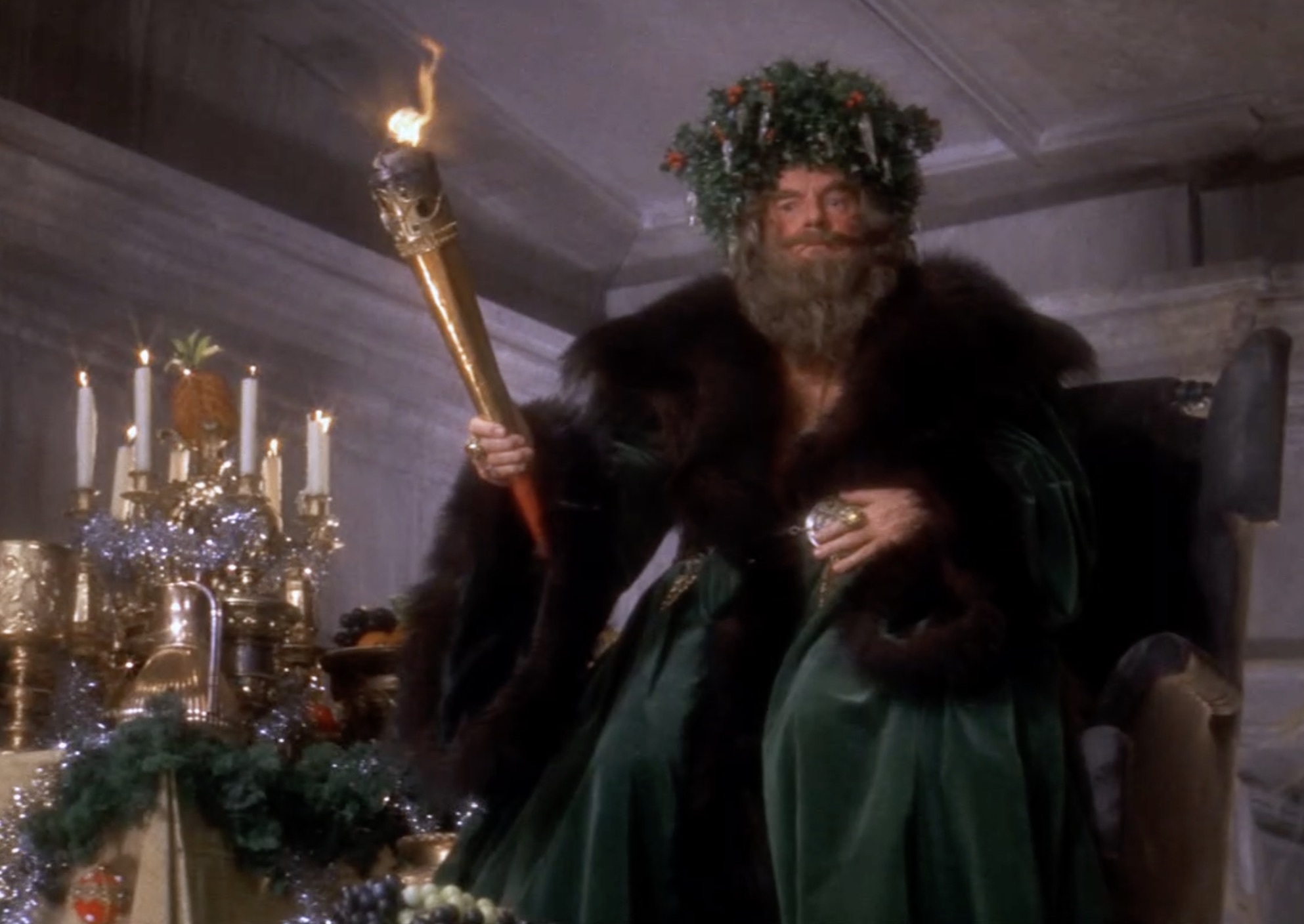
The Spirit of Christmas Present takes Scrooge on a tour of the people he knows. He finds himself standing in the home of his poor clerk, Bob Cratchit, where he feels the warmth of a large family who are making the best of what little they can afford on the small salary Scrooge pays. He experiences their anxiety over the fate of Tiny Tim, the Cratchit’s sick youngest child, who, despite his illness, is still able to pronounce:
God bless us, everyone.
Scrooge is clearly shown the effects of his selfish nature; but the spirit helps him understand that even though he is wholly hard-hearted, others have not entirely given up on him. As they sit down to their feeble Christmas dinner, Cratchit proposes a toast to his boss – despite protests from his wife. Scrooge never saw the need to help anyone but himself.
- The Spirit of Christmas Future
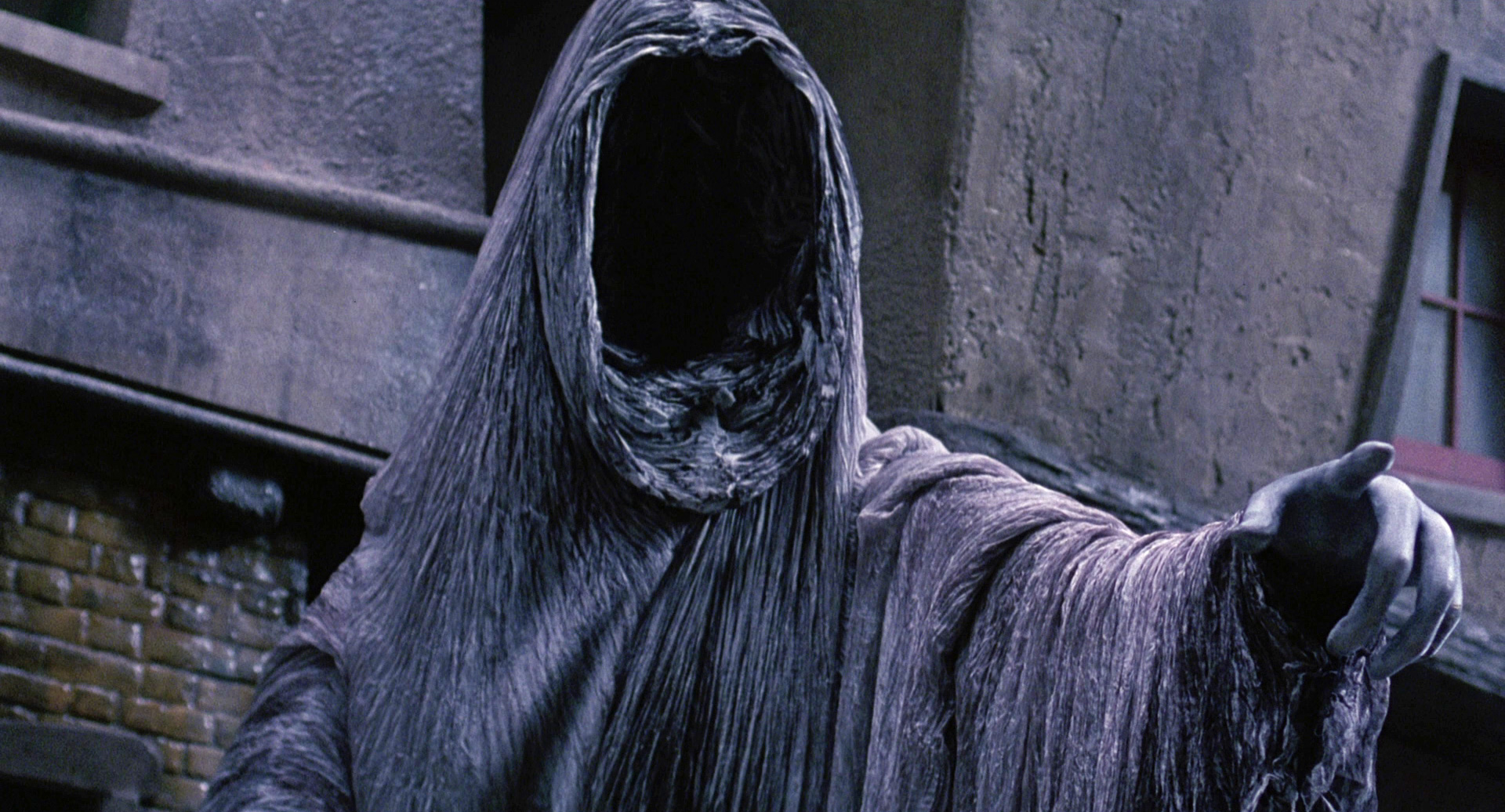
The Spirit of Christmas Future has no face and does not speak. It merely points. Scrooge looks to where the spirit is leading him, and sees the Cratchit family again, worn down in their struggle against poverty, and now without Tiny Tim, who has died for lack of proper medical care. The Spirit takes Scrooge to visit the house of a man who has died in his sleep.
A maid and a cleaner are dividing up his belongings before the undertaker arrives. Two men out in the street are discussing whether it’s even necessary to hold a funeral service, since no one would bother to come. ‘But who is this man?’ asks the miser. The spirit leads him to a grave, whose headstone bears the name ‘Ebenezer Scrooge’.
It’s a chilling reminder that no one lives forever. Many of us recognise the struggles of Scrooge in our own lives. Many of us have been hurt as we grew up. Many of us pass up the offer of friendship or kindness out of a fear of rejection. Scrooge was a man who lived in a prison of his own making, the doors shut and sealed with a bitterness, which he would not let go.
The spirit asks Scrooge to consider himself from God’s perspective: ‘It may be that in heaven’s sight you are more worthless and less fit to live than this man’s child.’
- The Second Chance
This is the life-changing moment when Scrooge understands that it’s now or never. He asks whether it’s possible to mend his ways and so alter his life and destiny. As Christmas morning dawns and he wakes, Scrooge realises that he has been given a reprieve.
He makes a large donation to the charity he rejected the previous day, he anonymously sends a large turkey to the Cratchit home for Christmas dinner and spends the afternoon at Fred’s Christmas party. The following day he gives Cratchit an increase in pay, and begins to become a father figure to Tiny Tim. From then on Scrooge treats everyone with kindness, generosity and compassion, embodying the spirit of Christmas.
Scrooge’s transformation lies at the heart of ‘A Christmas Carol’. It’s one of those great stories of the second chance. He repents and experiences what amounts to a ‘conversion’ experience.
From a selfish, greedy and bitter old man, we see him become a grateful, generous and compassionate figure. A man filled with deep regret sees his life transformed, to the point where he became, as Dickens wrote: ‘As good a friend, as good a master, and as good a man, as the good old city knew.’
Conclusion

Scrooge was given a second chance – just as Dickens believed we have all been given another chance, because of the birth of Jesus, in the greatest Christmas story of all. Just as the spirits of Christmas wanted Scrooge to change for good, God loves each one of us enough to send us a saviour to help us to change our lives for good.
Jesus has come to free us from the chains that bind us. No matter how low we’ve fallen in the past, there is always hope for the future. Just as it wasn’t too late for Scrooge, it’s not too late for you: you can choose to change.
Why not let Jesus be born into your life, this Christmas knowing that you’ve been given a reprieve and the best possible start to a new life and a new hope for the future?
At the beginning of my talk I mentioned how Charles Dickens set out to persuade his readers to summon the spirit of Christmas not just for a week in December, but for all the year round. So let’s listen to ‘Christmas Song For All Year Round’ by Randy Stonehill (An American singer/songwriter).
 revPACman