
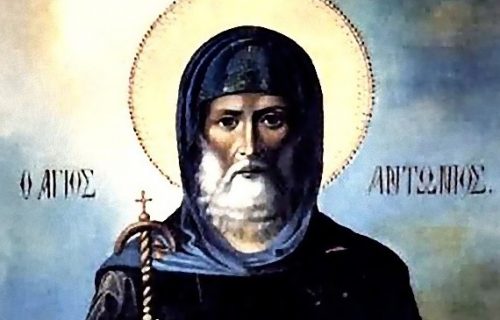
On 17 January the church members Anthony of Egypt, hermit, abbot, 254 – 356. He was also known as Anthony of the Desert, and Anthony the Anchorite. He was a leader among the Desert Fathers, who were Christian monks in the Egyptian desert in the 3rd and 4th centuries
But who was Anthony of Egypt?
Anthony was born into a wealthy family in upper Egypt about 254 AD. At the age of 20, after the death of his parents, he gave all his possessions away and started to live as a recluse, among the local ascetics in his village. From 286 to 306 Anthony lived in solitude, first in a tomb, and then in an abandoned desert fort. Later he moved to the Red Sea, where a monastery was formed, and he remained there until his death at the age of 105 in the year 356.
Anthony did not spend all his life cut off from the world. In 311 he travelled to Alexandria to encourage Christians who had been imprisoned for their faith, and he journeyed there on a further occasion in 355 to confront the Arians whose teaching denied the full divinity of Christ.
During this second trip he met Athanasius, who was so impressed by him that he wrote the story of his life. Within this Life of Anthony Athanasius presents him as an example of the monastic way. His battles with demons in the desert, and the story of his great spirituality served to fuel the growing desire for an authentic Christian life which the Church, with her greater connections with the Empire and State, was beginning to lose.
The Life of Anthony was disseminated widely and was immensely influential in the growth of monasticism. Anthony was a leader almost by default. He sought a life of solitude and contemplation, but discovered that he became a beacon to others seeking an ascetic life. His retreat at Pispir, together with those at Nitria and Scete, quickly became colonies of monks, with Anthony as their leader.
Although unable to read or write, Anthony carried out correspondence not only with other monks, but also with emperors and officials. His replies to the letters he received (and which he never quite knew what to do with) reveal him as one who encouraged others to persevere, and stressed that the first obligation of the monk is to know himself, as only those that know themselves will be able to know God.
The letters present the monastic life as a continual battle in which the believer is aided by the Holy Spirit, who guides him and opens the eyes of his soul. Anthony’s fame spread far through his life and through his biography, and he is recognized as the founder of Western monasticism. [Anthony] called his two companions … and said to them, ‘Let your very breath be always Christ’. Athanasius: Life of Anhtony XCI
A Prayer
Most gracious God,
who called your servant Anthony to sell all that he had
and to serve you in the solitude of the desert:
by his example may we learn to deny ourselves
and to love you before all things;
through Jesus Christ your Son our Lord,
who is alive and reigns with you,
in the unity of the Holy Spirit,
one God, now and for ever.
Amen.
Revd Paul A. Carr and extract from ‘Saints on Earth: A biographical companion to Common Worship’ by John H Darch and Stuart K Burns
 revPACman