
This is a copy of my talk given at Saint Luke’s at 11.00 am in the Anglican Church of Paphos on Sunday 26 January 2025. The Bible readings were Luke 4:14-21 & 1 Corinthians 12:12-31.
Prayer
Heavenly Father,
I thank You for Your word.
By the power of Your Holy Spirit,
May You speak to my heart,
And change my life.
In the precious name of Jesus I pray.
Amen.
Introduction
I’m sure all of you have asserted your democratic right, under the ‘Representation of the Peoples Acts’ to cast your vote in both local and general elections over the years. Leading up to an election, political parties publish their manifestos: an explanation, if you can understand them, what it is they are offering the electorate. We hear all sorts of promises, don’t we, with regards to: Health; Crime; Immigration; Tax Cuts; Austerity and so on. Some people vote at Elections, not always on policies, but on the principle that it’s time for a change. Sometimes, as a result of this, people find themselves having to be satisfied with something less than they would prefer.
But does the Ballot Box really make a difference? Is there such a thing as a political party with good ethics, morals and values at the centre of their policies? Now, I don’t want to be accused of being politically motivated this morning – we all know that politics and religion don’t mix, and so I’ll keep my preferences to myself. But is there such a thing as a Christian manifesto? I think Jesus gives us one in Luke 4:14-21 …
First WORDS
These words are the first words Jesus spoke at the beginning of his ministry after his 40 days in the wilderness. Jesus read from the scroll of the prophet Isaiah (we know it as Isaiah 61, written some 750 years before) and, after reading those words, Jesus said that Isaiah was writing about him. Can you imagine both the horror and indignation around Jesus’ declaration as he claimed to be the Messiah? Is it any wonder that, later in the chapter, they drove him out of town and tried to throw him over a cliff!
Anointed by the SPIRIT
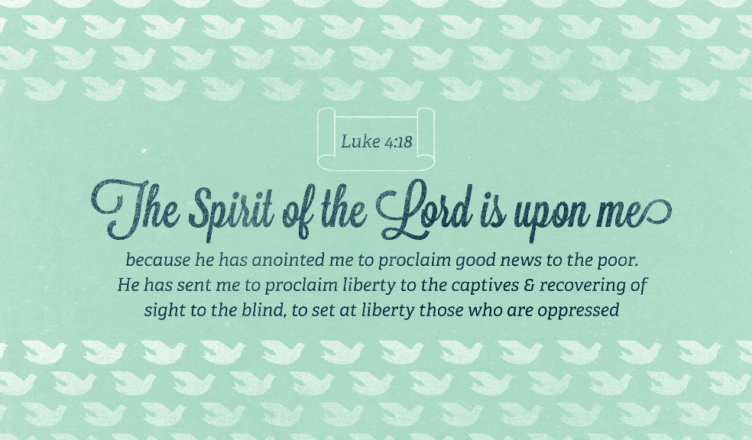
But these words were Jesus’ statement of purpose as to what he was seeking to achieve during his ministry and the reason the anointing of the Holy Spirit was upon him. To be anointed means to be set apart for a task. Jesus was set apart to preach about the Good News of the kingdom of God. Isaiah’s prophecy was that someone would:
… preach good news to the poor, set the prisoners free, make the blind to see and release the oppressed. And all that Jesus did, his healings and miracles, demonstrated that he was God’s chosen Saviour. These words could so easily be Jesus’ manifesto for ministry.
Good News to the POOR
Good News is something that is in such short supply in today’s world. There’s always something on TV, in our newspapers and magazines, which constantly remind us how immoral/violent the world is. Jesus was proclaiming that the day of the Lord’s favour had come. He came to proclaim that the poor would hear good news …
Freedom for the PRISONERS
The Romans imprisoned many people in Jesus’ day, and it would be silly to think that Jesus was going to empty all the jails. Some prisoners deserved to be there – so another meaning was intended. Jesus came to free people from the evil forces that bound them up. In today’s world, that may be from drugs, alcohol, bitterness. Jesus came to free us from the one who delights in dragging us down, the devil himself. Jesus was proclaiming that the day of the Lord’s favour had come. He came to proclaim that the prisoners would be set free … I’ve met more people in prison out of prison than those imprisoned in prison!

Sight to the BLIND
Blindness was a common ailment of Jesus’ time, and we know he healed the blind on many occasions. However, Jesus is speaking about more than physical blindness, he’s speaking about spiritual blindness – which is the greater blindness. Many people are blind to the things of God, and Jesus came to remove barriers to belief. Such as a lack of faith, excuses, anger – things that stop us from seeing how much God really loves us and cares for us. Jesus was proclaiming that the day of the Lord’s favour had come. He came to proclaim that the blind would be given sight.
Release the OPPRESSED
Jews, in Jesus’ day, were oppressed by Roman occupation. But Jesus healed many who were oppressed in different ways. Those oppressed by demons. Those who had crushed spirits and broken dreams. Those who had heavy loads to carry. Jesus promises to raise the spirits of those who feel they have hit rock-bottom in life.
Jesus was proclaiming that the day of the Lord’s favour had come. He came to proclaim that the oppressed would be released. Jesus’ manifesto for ministry was a manifesto of actions and not words. It was a manifesto of meeting people’s needs. Of grace; of mercy; of salvation; of forgiveness; of reaching out. Jesus’ manifesto should be the manifesto for the whole of the Christian church.
God Distributes Gifts to the Church
The Holy Spirit that anointed Jesus is the same Spirit that anoints us – that’s an amazing thought, isn’t it? When the Holy Spirit fell on the church at Pentecost Sunday, it ushered in the empowering presence of God in the lives of Christians to enable them to do wonderful works in Jesus’ name.
As we take a closer look at our reading from 1 Corinthians 12, we see that every single one of us has an important part to play in putting Jesus’ manifesto into practise through the gifts God has given us. In vs12-13 Paul illustrates the diversity and unity within the church using the example of the human body. In vs15-16 he suggests that individual members can’t opt out of this because we all need each other.
Spiritual gifts are given to equip the church to do God’s work. We cannot stand on the fringes and watch the rest of the body struggling knowing that we could be the missing piece to link it all together. Remember, your gift is not for your sake, it is for the sake of the church, 12:7 and enables each individual to operate to their full potential. We need one another.
In vs28, Paul reminds us that it is the sovereign God who distributes gifts to his church and illustrates this by a list of church offices and spiritual gifts. I believe that all Christians have God’s Empowering Presence of the Holy Spirit in their lives – some spiritual gifts may lie dormant for years or they simply haven’t utilised the gifts they’ve been given. It is our responsibility to open the Grace Gift God has given us.
Does anyone still have an unopened Christmas present in their house? I thought not. We don’t receive a present from someone and leave it on the table, unopened, commenting how beautifully wrapped it is and how appropriate the choice of wrapping paper was etc., we open it to see what it is we’ve been given.
Some Christians would argue they’ve never received a particular anointing of the Holy Spirit, yet the Bible makes it clear that all of us received the Holy Spirit when we first became Christians (Ephesians 4:7) and that it is the work of the Holy Spirit within us which affirms our salvation and continues to work in our hearts and lives to make us the perfect bride of Christ.
I recognise that some people become uncomfortable when we talk about the gifts of the Holy Spirit and that’s quite understandable, because we’re talking about a supernatural God who is able to do supernatural things! Yes, some gifts are extra-ordinary (miracles, prophecy) others are quite ordinary (mercy, helps, administration) but given in service to God they are out of this world – because they are! What about the gifts of the Holy Spirit that you have received but have never really understood or appreciated? What gifts are you asking God for? What gifts has God given you? How can you use them for the greater benefit of the church community?
HANDOUT Spiritual Gifts can be put into three main categories: Gifts of Ministry, Service and Manifestations. Some believe there are seven spiritual gifts, some nine, some list twenty three and others suggest that you cannot limit God with what he gives – that’s a viewpoint I would share. In this handout, I want to briefly highlight some of the gifts of the Holy Spirit and what they could mean to you and what their function is in the life of the church. What are the Gifts of HS handout
Conclusion
As you may imagine, I receive letters from all sorts of people about all sorts of things. How about this one from my last parish:
Dear Rector, there are 566 people on the electoral roll of our team ministry. 100 are frail are elderly – that leaves 466 to do all the work. But 80 are young people at school or at college, and that leaves 386 to do all the work. But 150 of these are tired businesspeople – that leaves 236 to do all the work. 150 of these are busy with children, which leaves 86 to do all the work. But 15 live too far away to come here regularly, and that leaves 71 to do all the work. And 69 say they’ve already done their bit for the church. And that leaves you and me. But I’m exhausted, so good luck to you.
Can I encourage you to read through 1 Corinthians 12:12-31 when you get home, and as you look at these gifts, think of people who may have ministered to you using one, or more, of these gifts and get in touch with them to affirm their gifting and encourage them in their ministry. But also have a good look at what gifts the Lord has given you and be encouraged and look for opportunities to use them. May each one of us be willing to use our gifts to live out Jesus’ manifesto in today’s world through the power of His Holy Spirit: … to preach good news to the poor, to proclaim freedom for the prisoners and recovery of sight for the blind, to release the oppressed, to proclaim the year of the Lord’s favour.
COPYRIGHT DISCLAIMER The text contained in this sermon (except where stated) is solely owned by its author, Revd Paul A. Carr. The reproduction, or distribution of this message, or any portion of it, should include the author’s name.
 revPACman