
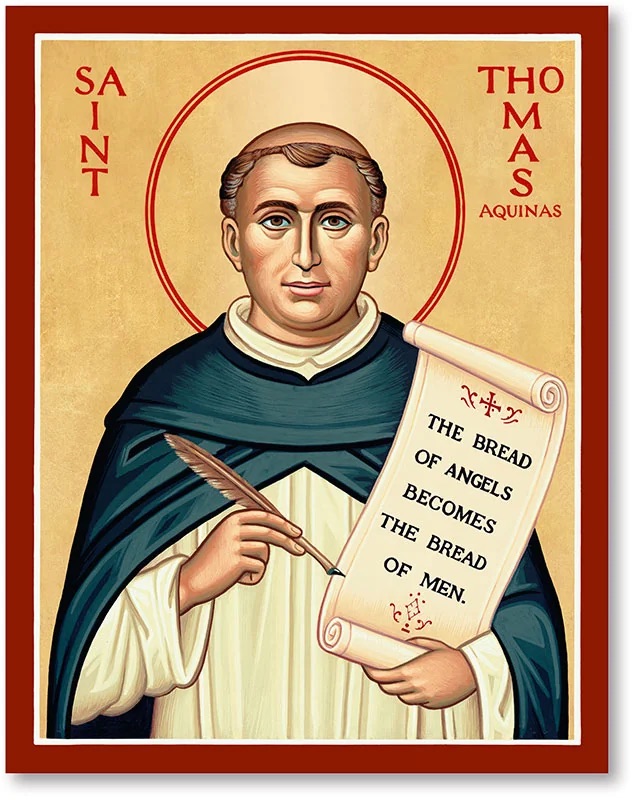
On 28 January the church remembers Thomas Aquinas, priest, philosopher, teacher of the faith, 1225-1274.
But who was Thomas Aquinas?
Thomas, born in 1225, was the youngest son of the Count of Aquina. He was, by all accounts, a large man, who moved slowly and serenely through his daily tasks. He studied at Naples University and his fellow students christened him the ‘dumb Ox’.
In 1244 Thomas joined the Order of Preachers, otherwise known as the Dominican Friars. At this time the Dominicans were spreading rapidly throughout Europe, and in particular focusing their work within the universities. The Dominicans were a relatively new order, and Thomas’ family would have preferred him to join the more established Benedictine order, membership of which opened doors into influential positions in society. In response to his decision to join the Dominicans Thomas’ family kidnapped him in an attempt to make him change his mind. Although they detained him for two years they were unsuccessful.
Thomas also studied at Paris and Cologne, returning to Paris to lecture in 1252. From that time on he taught in both Paris and Italy until he died in 1274. He wrote ‘Summary against the Gentiles’ between 1252 and 1255, and in 1266 began his most famous work, Summa Theologiae, in which he considered key aspects and doctrines of Christianity.
A clear challenge which faced Thomas was whether to integrate or challenge the philosophy of Aristotle which had begun to enjoy a resurgence in the universities. Thomas chose to integrate the philosophy, and combined Aristotle’s teaching with Catholic doctrine, basing his theological considerations on an Aristotelian framework.
Unsurprisingly his views aroused passions and debate, and did not go unopposed. Indeed after his death some of his teachings were relegated or ignored, and it was not until recent centuries (especially since Vatican II) that he has become more widely appreciated.
Thomas is well known for his teaching on the Eucharist in which he defended the doctrine of the Real Presence of Christ. His understanding of Christ continuing the work of redemption through the sacraments was highly influential for the development of Catholic ecclesiology and doctrine.
On 6 December 1273 Thomas announced that he would write no more, and that all he had written was straw. The reasons for this are unclear. It may have been the result of either an immense spiritual experience, or simply a breakdown from overwork. A prayer attributed to Thomas reveals the motives and desires of this forward looking theologian:
Most loving Lord,
grant me a steadfast heart which no unworthy desire may drag downwards;
an unconquered heart which no hardship may wear out;
an upright heart which no worthless purpose may ensnare.
Impart to me also, O God,
the understanding to know you,
the diligence to seek you,
a way of life to please you,
and a faithfulness that may embrace you,
through Jesus Christ my Lord.
Amen.
Extract from Saints on Earth: A biographical companion to Common Worship by John H Darch and Stuart K Burns
 revPACman