
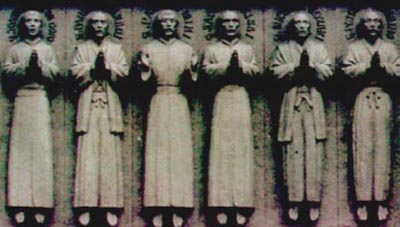
On 6 February the church remembers the Martyrs of Japan, 1597.
But who were the Martyrs of Japan?
In 1854 the American naval Commodore Matthew Perry was received by the new Japanese government of the reforming Meiji dynasty which was beginning the process of opening up that previously closed land to Western trade and influence. Yet among the people of this overwhelmingly Shinto and Buddhist nation Perry was surprised to find a small number of persecuted Japanese Christians who had survived underground, without Bibles or clergy for centuries, and, though somewhat hazy in their understanding of Christian doctrine, had a firm faith in Jesus as Lord.
The Christian faith had been introduced into Japan three hundred years earlier by Jesuit and later by Franciscan missionaries who first arrived in Japan with the Portuguese in 1543. The Jesuit priest Francis Xavier landed at Kagoshima in 1549. He studied the Japanese language for a year and then preached in many of the principal cities. By 1551, when he left Japan, he had established a vigorous Christian community and laid the foundation for the future Christian Church in Japan.
Initially the mission progressed: the first baptism was in 1563 and the first church was built in Kyoto in 1576, but the first decree banishing the propagation of Christianity followed in 1587. Nevertheless, for ten years Christian missionaries experienced a form of relative toleration and by the end of the sixteenth century there were probably about 300,000 baptized believers in Japan.
But after the arrival of Spanish Franciscan and Dominican priests at the beginning of the 1590s quarrels broke out between the different orders and between Spanish and Portuguese nationals.
On 5 February 1597, 6 Franciscan friars and 20 of their converts were executed at Nagasaki, becoming the first martyrs in Japan. They were tied to crosses in a parody of the crucifixion and speared to death. But in spite of local persecutions, the mission continued to expand.
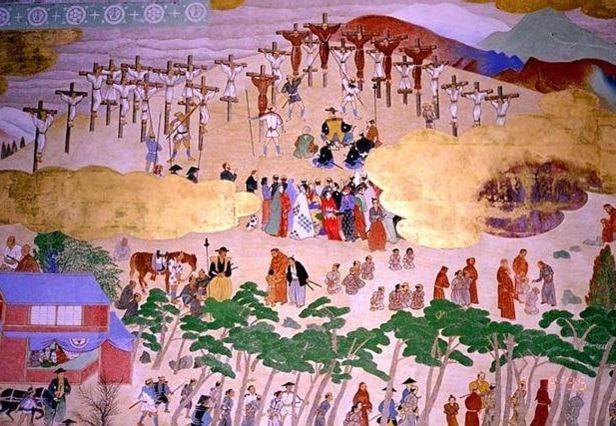
After a short interval of relative tolerance, many other Christians were arrested, imprisoned for life, or tortured and killed; in 1614 an effective edict of persecution was issued and by 1630 the Church was totally driven underground.
A peasant uprising under Christian leadership in Kyushu in 1637/38 was suppressed and, as a result of it, the government closed the country to European traders as well as to Christian missionaries.
Contact with the West was strictly controlled and persecution of Christians continued until Commodore Perry’s arrival in 1854.
A Prayer
O God our Father, who brought the holy martyrs of Japan through the suffering of the cross to the joys of eternal life: Grant that we, encouraged by their example, may hold fast to the faith we profess, even unto death itself; through Jesus Christ our Lord, who lives and reigns with you and the Holy Spirit, one God, now and for ever. Amen.
Extract from Saints on Earth: A biographical companion to Common Worship by John H Darch and Stuart K Burns
 revPACman