
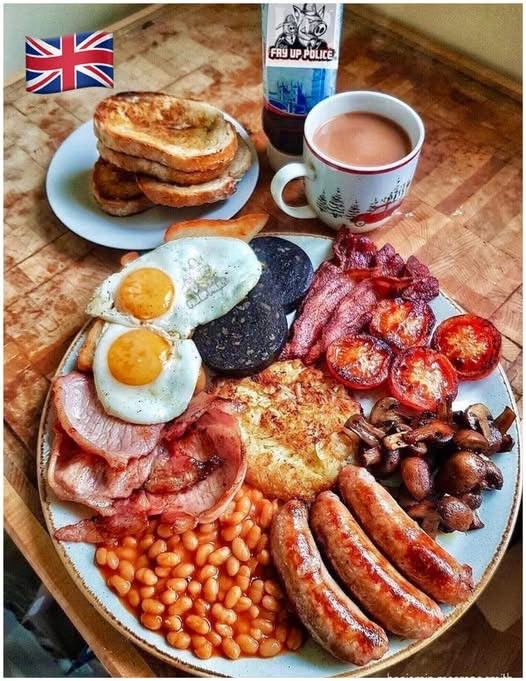
We’re all partial to a full English! And there’s no shortage of options in Cyprus. I’ve often thought about rating the full English’s I’ve eaten here from one to ten – I may do that at some point! The Historian Dan Snow gives us the history of this staple of an English breakfast. He says@
A full English is a bulwark of British cuisine, the roots of which date back to at least the 17th century. The greasy meal does few favours for the international standing of British kitchens, but at home on the archipelago the fry-up is as essential and jealously protected as fish and chips.
In the 18th century, the English breakfast referred to a substantial meal including hot bacon and eggs. It stood in contrast to the lighter ‘continental’ breakfast of mainland Europe. It was to such a meal that travel writer Patrick Brydone referred when in 1773 he delighted in having ‘an English breakfast at his lordship’s.
Although Sir Kenelm Digby proclaimed how ‘Two Poched Eggs with a few fine dry-fryed collops of pure Bacon, are not bad for break-fast’ in a 7th-century recipe, eggs were generally regarded as a luxury on a par with chicken until the early 20th.
Eggs were a part of high-status Victorian breakfasts, however, and the popular cooked breakfast was to some extent an attempt by urbanites to imitate the lifestyle of a country estate. Meanwhile, cookery columns exhorted readers to eat fatty and filling foods, with books like T. C. Duncan’s How to Be Plump (1878) featuring rather self-explanatory advice on ‘healthy eating’.
After World War Two, the dish embraced fried leftover potatoes. Soon avant-garde breakfasters were adding mushrooms, tomatoes, baked beans and black pudding.
The Full English is often claimed to originate among the medieval elite, while some of its constituent elements easily date back to the Bronze Age. Bread, for instance, was a staple in Egypt, Sumer and the Indus Valley, as common in Homer’s Greece as Caesar’s Rome.
On the other hand, tomatoes and potatoes are rather conspicuous due to being New World vegetables not introduced to European cooking until the 150os. This rather brings into question just how English the English Breakfast is.
The ‘Full English Breakfast’ as we know it appears to be early modern at best.
The Full English is the essential item on pejorative lists of British cuisine. But it is also one the few British meals to find favour abroad, resulting in a certain degree of pride over it.
Long breads, including baguettes, had been consumed in France since the mid-18th century. While the origins of the baguette are debatable, one legend is that Napoleon Bonaparte popularised the bread through making it a staple of army rations. Traditional bread loaves took up more space, so a baguette was easier to carry on long marches.
The popularity of the stick-like loaf was enhanced by cheaper flour and new steam oven baking techniques during the 19th century. In 1920, the Parisian authorities first defined the ‘baguette’ in regula-tions, setting its length, weight and price.
During World War Two, the baguette became a symbol of resistance against the German occupation, with bakers secretly baking baguettes containing messages or supplies to aid partisans.
Source ~ ‘History Hit Miscellany’ by Dan Snow
 revPACman