
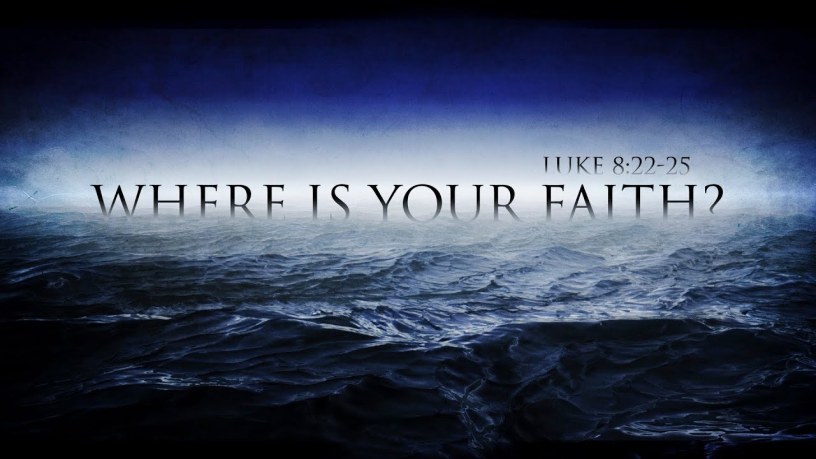
This is a copy of my talk given at Ayia Kyriaki and Saint Luke’s in the Anglican Church of Paphos on Sunday 23 February 2025. The Bible reading was Luke 8:22-25 (NIV).
Prayer
Heavenly Father,
I thank You for Your word.
By the power of Your Holy Spirit,
May You speak to my heart,
And change my life.
In the precious name of Jesus I pray.
Amen.
Introduction
Of all the natural phenomena in the world, the sea is perhaps the most feared. Those who know it well give it a healthy respect. To the rest of us, it appears that the natural world, like the sea, is one of chaos and disorder and we are victims of the blind forces of chance and Mother Nature. However, the Bible teaches that the natural world is the creation of a loving God, who made a beautiful and perfect world.
And whilst this world is not what it was, God is still in control and, when we understand that, then whatever storm we face, be it a storm of nature or a storm in our personal lives, we can have complete confidence that Jesus will not let us go. I want to look at this passage in the form of three questions: two by the disciples and one by Jesus.
1) Why Don’t You Act?
And the first question that is asked by the disciples is: ‘Why don’t you act?’ Well, actually, no-one asks that question but certainly it reflects the mood of the disciples in vs24: ‘Master, Master, we’re going to drown!’ And in Mark’s gospel it’s even stronger as the disciples say to Jesus: ‘Don’t you care if we drown?’ Lord, why don’t you do something? It’s a question we ask ourselves all the time, isn’t it? Why won’t you act?
But why were they asking that question? Well, let’s back track a little bit. Jesus has had a busy day. Matthew and Mark give us more of the background, and they tell us that Jesus has been healing and teaching and huge crowds have been chasing him all day long. So, he says in vs22 that he wants to get to the other side of the lake, perhaps to have a break. And as soon as he steps into the boat and lies down, he falls asleep exhausted. This reminds us just how human Jesus is. He knows full well what we feel like after a long day or when we’re under a lot of stress.
So, Jesus is asleep and suddenly a storm breaks on the Sea of Galilee. The Sea of Galilee is about 8 miles across and 15 miles long and on either side of the lake there are steep gorges which means it’s about 700 feet below sea level. The wind blows down the gorge and the sea is churned up causing severe storms. That’s what happens in vs24: ‘A squall came down on the lake, so that the boat was being swamped, and they were in great danger.’
Now many of these disciples were experienced fishermen. They knew that lake like the back of their hands. They had seen plenty of storms before – but even they were scared by this storm. Matthew uses a word for the storm which literally means earthquake. It was as if the whole sea was shaking. And the waves were sweeping right over the boat. It was a rough storm, and the men feared for their lives. They were in great danger, says Luke.
Now I’m not a great sailor and I spend most of my time being sick, even on a boat sailing down the Paphos coast! I can’t imagine what it must be like to sail on some of the atrocious seas you see on TV. They look pretty scary. And here the disciples, experienced seafarers as they are, are fighting for their lives and they cry out in desperation to the sleeping Jesus. Vs24: ‘Master, master, we’re going to drown!’ Actually, the original is even more dramatic: ‘We’re dying.’ The next big wave that comes over that boat could be the end.
The disciples are utterly terrified, battered and spun around, completely at the mercy of this awesome display of a natural disaster, while Jesus sleeps in the back of the boat. No wonder we read in Mark that the disciples shout at Jesus: ‘Don’t you care if we drown?’ Lord, why don’t you do something? Why don’t you act? Why are you allowing this to happen to us? And surely that is one of the first questions we ask when we too go through stormy seas. Lord why don’t you act? Why don’t you do something?
And it may well be that you are feeling exactly like those disciples. Completely overwhelmed by the storms of life. It may be work, it may be family, it may be illness, it may be a spiritual battle you are facing, a particular temptation that you just cannot shake off. Whatever it is, you are feeling as if one more wave will sink your boat. And you’re crying out: ‘Come on Lord, do something. Why does it feel like you’re doing nothing?’ But it’s important to realise that is a normal reaction to being in a storm.
Christians aren’t immune from the storms of life. Christians get ill, they lose friends and colleagues, they get cancer, they suffer, and they struggle with work and family and money and relationships. But the difference for the Christian is that there is someone in our boat who will not let us go and who will guide us through the storms. Someone who cares very deeply and who has the power to act.
And the comforting news of Luke 8 is that we are not alone, and we can receive help. There is someone with us. And that was something the disciples failed to realise. They simply cried out: ‘Lord, why don’t you act?’ They hadn’t twigged just how powerful and loving and trustworthy that man sleeping in the back of the boat really was. And that brings us to our second question:
2) Who Is This Man?
Because if they’d realised exactly who Jesus was, they wouldn’t have panicked! Now, if you’re a fisherman and you’re in a storm, the last thing you’d probably do is ask a carpenter for help. But that’s what these disciples did that day. Vs24: ‘The disciples went and woke him, saying, ‘Master, Master, we’re going to drown!’ Jesus rebuked the wind and the raging waters; the storm subsided and all was calm.
Our versions say that the storm subsided when the original Greek says: ‘It stopped.’ The storm ceased immediately – when a storm on the Sea of Galilee can last for days. It was a definite, miraculous act. And this is a trick no mere man can play. To stop a storm in mid flow requires extraordinary power. Remember King Canute failing to hold back the tide a few centuries ago? But when Jesus commands nature to stop, it stops. And the disciples’ reaction is one of fear and amazement, and they ask each other: ‘Who is this? He commands even the winds and the water, and they obey him.’
So, what do we conclude about this man? Only one person can wield such power over the forces of nature, over creation itself. And that is God. Listen again to Psalm 65:6 when it speaks about the power God wields, “You still the raging of the seas, the roaring of their waves …”
Luke wants us to grasp that Jesus is God in the flesh. That God has taken on human form and has become a man. That Jesus is the Lord of creation. And as the Lord of heaven and earth, there was no way that this storm was going to take Jesus with it. That’s what the disciples failed to grasp. And it wasn’t as if the disciples didn’t have enough evidence. In the last few chapters Jesus has performed several miracles – if only the disciples had put two and two together, they’d have not been afraid in that boat. And that is often the root of our fear and worry – we forget just who is in our boat.
3) Where Is Your Faith?
It’s one thing to believe in Jesus. Quite another to trust him. And that is what our final question tackles. And this time it is Jesus’ turn to ask the question vs25: ‘Where is your faith?’
Because it’s only when we see and understand who Jesus is that we will truly put our faith in him. And that was the disciples’ problem. Their faith was misplaced. They had failed to see that Jesus was the one they should trust. All the miracles they’d seen, all the words Jesus said pointed to one fact. Jesus was their Lord and God, but they still hadn’t got it. And so, their faith was elsewhere. But wherever their faith was placed, it was not where it should have been that day.
And our problem is that we are so slow to realise that the only place where our faith should be placed is in Jesus, our saviour. All too often we are prone to trusting ourselves. That is often what happens when the storms hit. It’s a sort of self- mechanism for many of us. We feel that we can’t trust anyone. It may be perfectly understandable if we’ve been let down or hurt in the past. But it’s at that point that we need to remember who is the only one who will get us through the storms. We are not alone.
And that actually may be a clue as to why God allows us to go through storms. Why doesn’t God just allow us any easy time? The Bible doesn’t give us a complete answer, but one answer is that our faith might be strengthened. So that when tough times come, when the illness strikes, when work becomes harder, when the family is under great pressure, then we are forced back to the one who made us and loves us. Jesus won’t necessarily stop the storm for us. He may not take the problem away. But there is no doubt he will never leave our side. He will not jump overboard and leave us. If we trust him, he’ll bring us through, however stormy the seas get.
Conclusion
In closing, listen to these words from Paul’s letter to the Romans chapter 8: ‘I am convinced that neither death nor life, neither angels or demons, neither the present nor the future, nor any powers, neither height nor depth, nor anything else in all creation will be able to separate us from the love of God that is in Christ Jesus our Lord.’ Nothing, says Paul, absolutely nothing can separate you from the love of God in Christ.
Yes, sometimes we might cry out to God ‘Why don’t you so something?’ But the fact is he has. He has done enough to bring us through the greatest storm, and he’s proved that he is more than capable of bringing us through any storm in this life. We’re in the hands of his Son, Jesus Christ, the best helmsman we could ever want.
Jesus asks us a question: ‘Where is you faith? Will you trust me? Will you place your life in my hands? If you do, I promise I will never let you go.’
COPYRIGHT DISCLAIMER The text contained in this sermon (except where stated) is solely owned by its author, Revd Paul A. Carr. The reproduction, or distribution of this message, or any portion of it, should include the author’s name.
 revPACman