
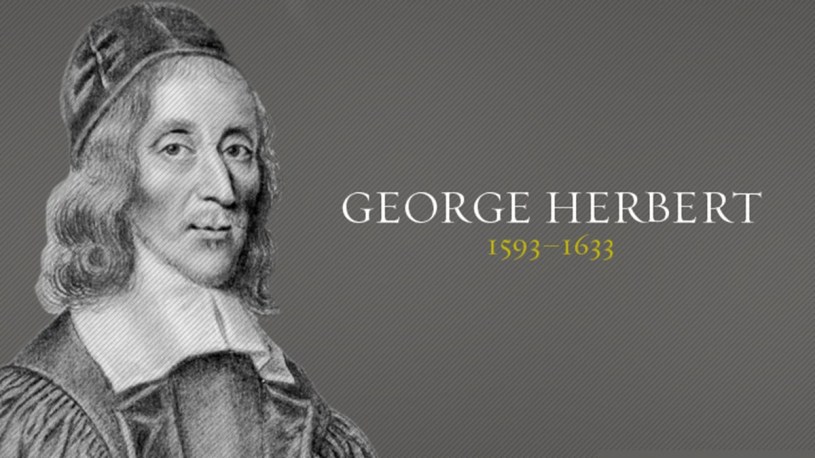
On 27 February the church remembers George Herbert, priest, poet, 1503 – 1633. Herbert is notable for the purity and effectiveness of his choice of words.
But who was George Herbert?
Born at Montgomery in Wales in1593, George Herbert was educated at Westminster School and Trinity College, Cambridge. His original intention was to enter the Anglican ministry but this was overwhelmed by academic achievement and easy entry into the world of politics. He was elected a Fellow of Trinity and in 1618 he was appointed Reader in Rhetoric at Cambridge. Then in 1620 he was elected Public Orator of the university. In 1624 Herbert was elected to Parliament as MP for Montgomery.
This brought him to the attention of King James I, who granted him an annual allowance and seemed likely to make him an ambassador. However, in 1625 the king died and Herbert, resolving to ‘lose himself in an humble way’ turned back from worldly ambition to his long-delayed vocation to ministry.
Ordained deacon in 1626, he was priested four years later when he was presented to the living of Bemerton near Salisbury. Though Herbert was suffering from tuberculosis and only lived for a further three years, he threw himself with vigour into the life of his parish, where he became known as ‘Holy Mr. Herbert’ because of his spiritual, pastoral and liturgical diligence. His book, A Priest to the Temple, or the Country Parson, was an attempt to share his insights of rural ministry with others. But privately he was a prolific writer of poetry and left his poems to his friend Nicholas Ferrar, to publish if he thought them suitable.
They appeared as The Temple in 1633. Herbert’s poems, characterized by a precision of language and written as if to be read aloud, explore and celebrate the ways of God’s love as he had discovered them from personal experience. Herbert was an unambiguously Christian and, some would say, a quintessentially Anglican poet. He wrote no secular verse and his poems are personal and intimate without being sickly, often revealing his own spiritual struggles and the strength and solace he found in the practical work of ministry.
Several of his poems, such as Let all the world in every corner sing, Teach me, my God and King and King of glory, King of peace, were later set to music and remain popular as hymns today. One example of his use of biblical themes in his poetry is Redemption: Having been tenant long to a rich Lord, Not thriving, I resolved to be bold, And make a suit unto him, to afford A new small-rented lease, and cancell th’old. In heaven at his manour I him sought They told me there, that he was lately gone About some land, which he had dearly bought Long since on earth, to take possession. I straight returned, and knowing his great birth Sought him accordingly in great resorts; In cities, theatres, gardens, parks, and courts: At length I heard a ragged noise and mirth Of theeves and murderers: there I him espied Who straight, Your suit is granted said, and died.
Herbert died on 1 March 1633 aged 39 years of age.
A Prayer
King of glory, king of peace,
who called your servant George Herbert
from the pursuit of worldly honours
to be a priest in the temple of his God and king:
grant us also the grace to offer ourselves
with singleness of heart in humble obedience to your service;
through Jesus Christ your Son our Lord,
who is alive and reigns with you,
in the unity of the Holy Spirit,
one God, now and for ever.
Amen.
Extract from ‘Saints on Earth: A biographical companion to Common Worship’ by John H Darch and Stuart K Burns
 revPACman