
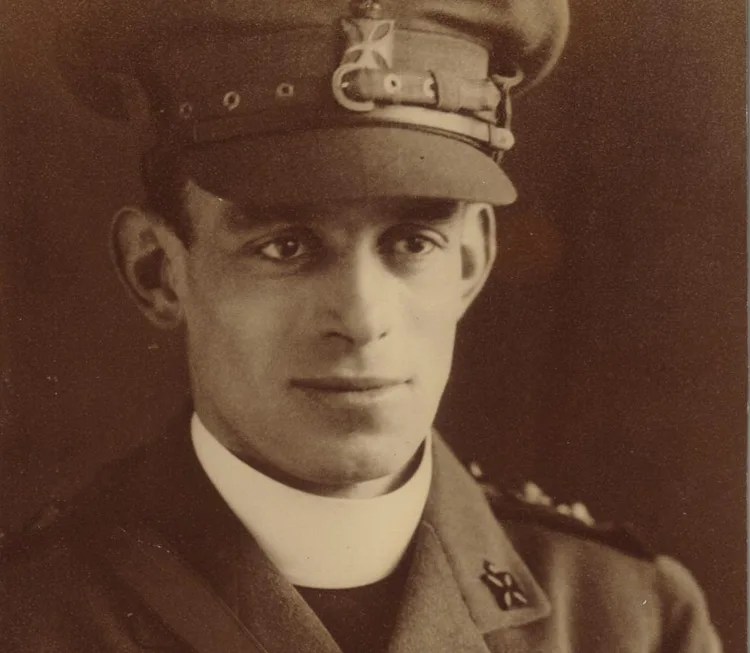
On 8 March the church remembers Revd Geoffrey Studdert Kennedy M.C. priest, poet, also known as ‘Woodbine Willie’ 1883 – 1929.
But who was Studdert Kennedy?
Born in a Leeds vicarage in 1883, Studdert Kennedy was educated at Leeds Grammar School and, in keeping with his Irish ancestry, took a degree at Trinity College, Dublin. He was ordained in 1908. After curacies at Rugby and Leeds he became Vicar of St Paul’s, Worcester in 1914.
In August that year Britain entered the Great War and, like many parish clergy, Studdert Kennedy volunteered for service as a military chaplain, serving in France from 1916 to 1919. He became one of the best known of the Forces’ chaplains, earning the nickname of ‘Woodbine Willie’ from the brand of cigarettes he distributed to the troops to whom he ministered (not so well known was the fact that he simultaneously distributed New Testaments).
As a chaplain in WW1 he was well-known for going into no-man’s-land in the thick of a battle, to comfort wounded soldiers. He was never afraid to be close to the fighting – one celebrated story tells of him crawling out to a working party putting up wire in front of their trench. A nervous soldier challenged him, asking who he was, and he said “The church.” When the soldier asked what the church was doing out there, he replied “Its job.” Noted for his bravery under fire, in 1917 he was awarded the Military Cross after entering ‘no man’s land’ at Messines Ridge to comfort the injured.
After the war he became chief missioner for the Industrial Christian Fellowship – a post which he combined with the living of the Wren church of St Edmund, Lombard Street in the City of London. Despite his indifferent health (he suffered from asthma from childhood) he wore himself out addressing meetings and leading missions across the country.
Studdert Kennedy had the gift of communicating gospel truths to ordinary people who had little time for the Church as an institution. His unorthodox style of ministry and preaching alienated him from some traditional Anglicans, though not King George V, who made him a royal chaplain and made a point of hearing him preach every year.
In his later years he turned to writing and produced several volumes of poetry, usually written in dialect, in an attempt to bring spiritual matters down to earth and to bring before God the sufferings of his people. An example is ‘Indifference’
When Jesus came to Birmingham they simply passed him by, They never hurt a hair of him, they only let him die; For men had grown more tender, and they would not give him pain, They only just passed down the street, and left him in the rain. Still Jesus cried, ‘Forgive them, for they know not what they do’, And still it rained the wintry night that drenched him through and through; The crowds went home and left the streets without a soul to see, And Jesus crouched against a wall and cried for Calvary.
He died, aged 45, in 1929. A crowd of more than 2,000 turned out for his funeral procession, lining from Worcester Cathedral to his old parish church of St Paul’s. They tossed packets of Woodbines onto the passing cortege – a gesture Studdert Kennedy would probably have thoroughly approved of. His life is remembered on a plaque in the cathedral which reads:
Geoffrey Anketell Studdert Kennedy M. C.
A Poet: A Prophet: A Passionate seeker after Truth:
An ardent advocate of Christian Fellowship
Chaplain to H. M. King George V.
Chaplain to the Forces.
Rector of S. Edmund King and Martyr in the City of London
Sometime Vicar of S. Pauls in this City
Born 27 June 1883 Died 8 March 1929.
Remembrance Sunday 2015: Woodbine Willie
Revd Paul A. Carr and extract from Saints on Earth: A biographical companion to Common Worship by John H Darch and Stuart K Burns
 revPACman