
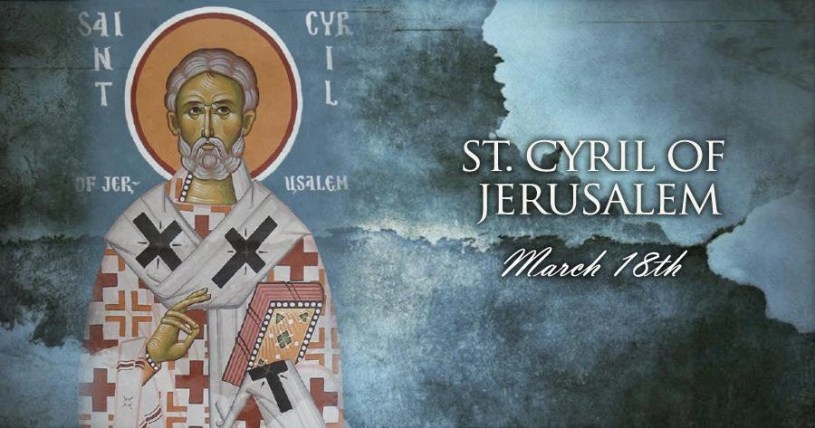
On 18 March the church remembers Cyril, bishop, teacher of the faith and doctor of the church, whose writings are still regarded as masterful expressions of the Christian faith, 315 – 386.
But who was Cyril of Jerusalem?
Cyril was born in 315. Ordained priest in 348, he was soon consecrated as Bishop of Jerusalem in preference to Heraclius, his predecessor Maximus’ designated successor. His period as bishop was turbulent and difficult. Cyril tried to establish his diocese’s freedom from the control of Caesarea, and as a consequence found himself out of favour with the Bishop of Caesarea, Acacius. He was exiled three times, in 357, 360 and 367. In total he spent 16 years of his 35 years as bishop in exile.
Much of Cyril’s exile was on account of his theological beliefs (which clashed with that of Acacius) and the lack of trust he showed in the ability of language to adequately convey doctrine. It has been said that he was probably always orthodox in thought, if not in language!
In the argument concerning the divinity of Christ, Cyril initially agreed with those who said that Christ was ‘of a like nature’ with God. He was suspicious of the influence of what he considered vague terminology in discussions about the presence of the divinity in Christ. Such disagreements in terminology led to misunderstandings and mistrust between Acacius of Caesarea and Cyril. Their relationship was fraught with theological rivalry and tension, and Acacius was instrumental in the councils that sent Cyril into exile. Cyril was ultimately reinstated to full episcopal duties in 378.
Cyril was a teacher, and was in charge of teaching those in preparation for baptism at Jerusalem. Indeed, it may have been his desire to communicate the Christian faith effectively and accurately that led him into doctrinal controversy. Cyril was seeking precision, in an age where diverse opinion was the norm.
Cyril was not only active in theological debate and teaching. He was known as a protector of the poor, who willingly sold church property (property that had often been bequeathed by emperors and their families) and used the money gained to feed the poor. These actions were held against him on more than one occasion.
Many of Cyril’s sermons and lectures have survived, and they reveal much about the life and teaching of the Early Church. He is remembered as a teacher of the Church, and as one who, although orthodox in thought, sought clarification of doctrine. He is an early example of those Christian leaders whose lot was often to be misunderstood because of the questions that he asked rather than the answers that he gave.
An excerpt from one of his lectures illustrates his teaching skill and his drive for precision: And why did He call the grace of the Spirit water? Because by water all things subsist; because water brings forth grass and living things; because the water of the showers comes down from heaven; because it comes down one in form, but works in many forms…Thus also the Holy Spirit, being one, and of one nature, and indivisible, divides to each His grace, according as He will: and as the dry tree, after partaking of water, puts forth shoots, so also the soul in sin, when it has been through repentance made worthy of the Holy Spirit, brings forth clusters of righteousness. Catechetical Lectures XVI
Cyril participated in the Second Ecumenical Council at Constantinople in 381 which condemned two different forms of Arianism and added statements about the Holy Spirit to the Nicene Creed of 325. St. Cyril of Jerusalem died in 387, and was named a Doctor of the Church by Pope Leo XIII in 1883.
A Prayer
O God, who through the Bishop Saint Cyril of Jerusalem
led your Church in a wonderful way
to a deeper sense of the mysteries of salvation,
grant us, that we may so acknowledge your Son
as to have life ever more abundantly.
Through our Lord Jesus Christ, your Son,
who lives and reigns with you
in the unity of the Holy Spirit,
God, for ever and ever. Amen.(from The Roman Missal)
Revd Paul A. Carr and extract from ‘Saints on Earth: A biographical companion to Common Worship’ by John H Darch and Stuart K Burns
 revPACman