
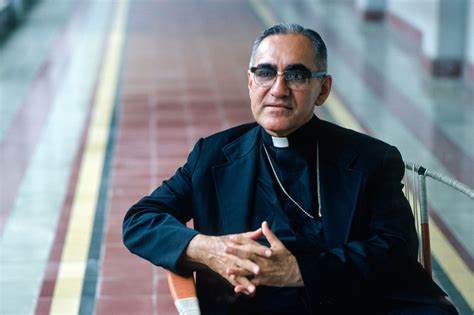
On 24 March the church remembers Óscar Romero, archbishop, martyr, and Patron Saint of El Salvador, 1917-1980.
But who was Óscar Romero?
Born in Cuidad Barrios in El Salvador in 1917, Oscar Romero, also known as Óscar Arnulfo Romero y Galdámezwas, was ordained to the Roman Catholic priesthood in Rome in 1942 before returning home the following year. As a parish priest in the diocese of San Miguel Romero gained a reputation as a hard worker in the traditional priestly mould with a taste for asceticism and a particular devotion to the Blessed Virgin Mary (his birthday was the Feast of the Assumption).
Perhaps not surprisingly, after gaining considerable parochial experience he began, in 1967, to rise in the church hierarchy becoming Secretary to the Episcopal Conference of El Salvador. In due course he became Auxiliary Bishop of San Salvador and later Bishop of Santiago de Maria. Much influenced by the conservative Opus Dei movement, he was a staunch opponent of the increasingly popular school of liberation theology.
It was an irony that in an age of liberation theology, Romero was appointed Archbishop of San Salvador in 1977 precisely because of his conservative and traditionalist views and his personal devotion to the papacy. But like Thomas Becket seven hundred years earlier, Romero’s new responsibilities made him look afresh at relations between Church and State. He began to see that social unrest and poverty were the result of government repression and the Church was not exempt from the spiral of violence in Salvadorian society.
Several priests were murdered and the expulsion of a number of (allegedly Marxist) Jesuits forced Romero to speak out. Right-wing Latin American governments were accustomed to being criticized by parish priests who ministered to the poor and were influenced by liberation theology. But to be criticized by the nation’s archbishop was a very different matter.
A convert to liberation theology, Romero condemned violence and championed the right of the poor to economic and social justice. He even went so far as to issue a pastoral letter from the Salvadorian bishops endorsing proportionate counter-violence to the oppressive policies of the right-wing regime. Nevertheless he sought to act as mediator between the rival groups and was nominated for the Nobel Peace Prize. His achievement was to maintain a balance between extremist groups, receiving death threats from both left and right wing paramilitary groups
Romero’s strong stance against the oppressive government – thousands were imprisoned, tortured, murdered, or disappeared – and his relentless efforts to speak out against injustice often put him at odds with powerful figures. Despite facing threats and persecution, Romero remained steadfast in his commitment to upholding the dignity and rights of all individuals.
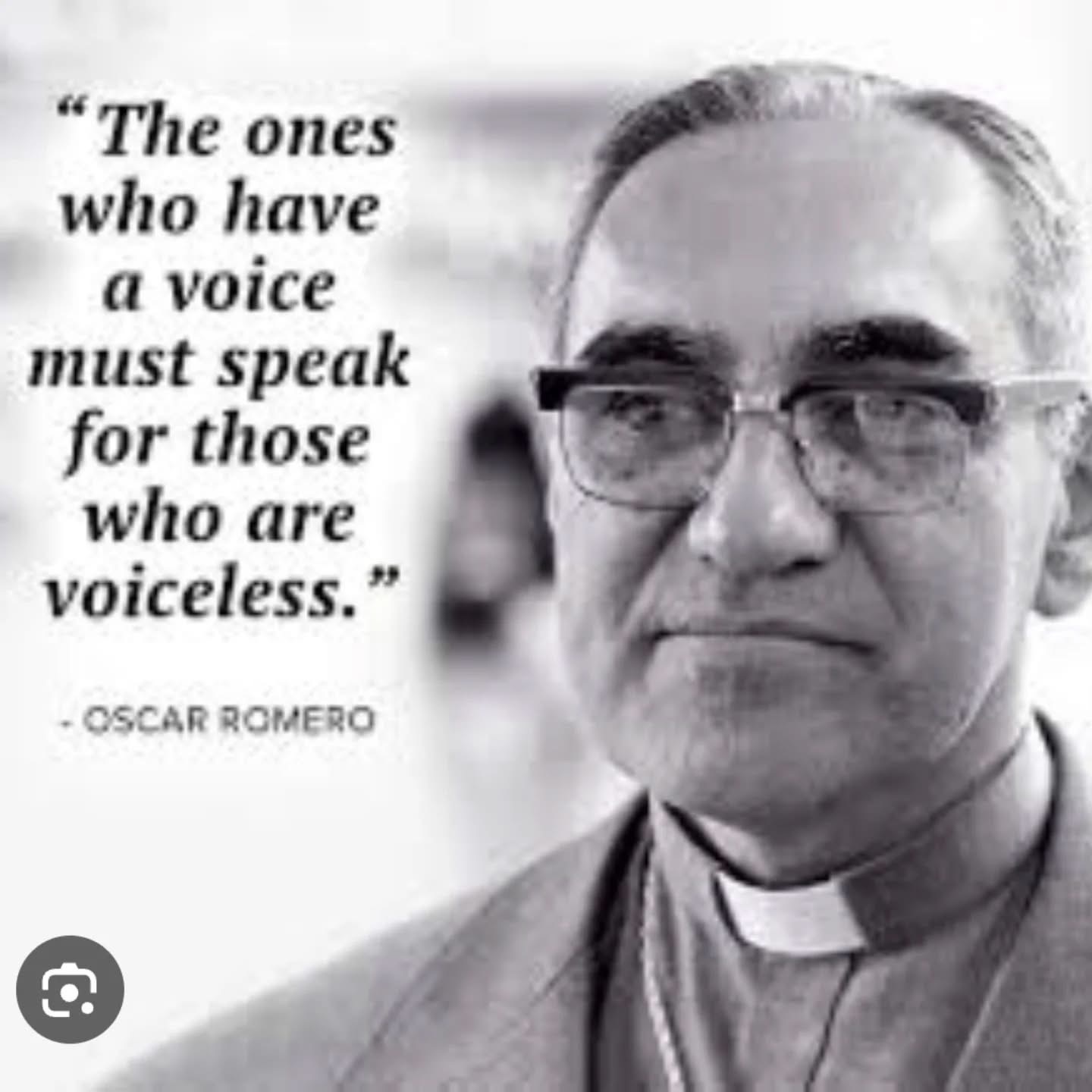
Romero denounced the violence in his Sunday sermons and became known as the voice of the voiceless and it was perhaps only a matter of time before he was murdered as he was celebrating Mass on 24 March 1980 aged 62 years of age.
Romero was beatified on 23 May 23 2015, and canonized as a Saint on 14 October 14 2018, by the Roman Catholic Church. His beatification and canonization recognize his martyrdom and his unwavering commitment to defending human rights and standing up for the poor.
The Romero Prayer
It helps, now and then, to step back and take the long view.
The Kingdom is not only beyond our efforts; it is even beyond our vision.
We accomplish in our lifetime only a fraction of the magnificent enterprise that is God’s work.
Nothing we do is complete, which is another way of saying that the kingdom always lies beyond us.
No statement says all that could be said. No prayer fully expresses our faith. No confession brings perfection. No pastoral visit brings wholeness. No program accomplishes the church’s mission. No set of goals and objectives includes everything.
This is what we are about.
We plant the seeds that one day will grow. We water the seeds already planted, knowing that they hold future promise. We lay foundations that will need further development. We provide yeast that produces effects far beyond our capabilities.
We cannot do everything and there is a sense of liberation in realizing that. This enables us to do something and to do it well. It may be incomplete, but it is a beginning, a step along the way, an opportunity for the Lord’s grace to enter and do the rest.
We may never see the end results, but that is the difference between the master builder and the worker.
We are workers, not master builders; ministers, not messiahs.
We are prophets of a future not our own.
Bishop Ken Untener
Romero’s legacy is one of courage, compassion, and commitment to social justice. He continues to inspire people around the world to stand up for the oppressed and work towards a more just and equitable society.
For many years the following quote by Óscar Romero was printed on the front of my preaching file. A reminder to be fearless in the pulpit!
A church that doesn’t provoke any crisis, a gospel that doesn’t unsettle, a word of God that doesn’t get under anyone’s skin, a word of God that doesn’t touch the real sin of the society in which it is being proclaimed — what gospel is that? Very nice, pious considerations that don’t bother anyone, that’s the way many would like preaching to be. Those preachers who avoid every thorny matter so as not to be harassed, so as not to have conflicts and difficulties, do not light up the world they live in.
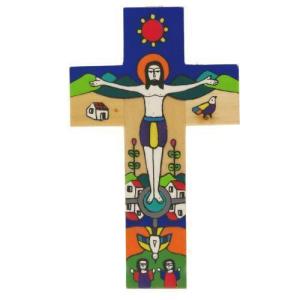
Created to mark the 30th anniversary of Romero’s death in 2014, this has become known as the “Romero Cross.” On the back of the cross is a quote from the martyr: “As a Christian, I do not believe in death without resurrection. If I am killed, I shall rise again in the Salvadoran people.”
Revd Paul A. Carr and extract from ‘Saints on Earth: A biographical companion to Common Worship’ by John H Darch and Stuart K Burns
 revPACman