
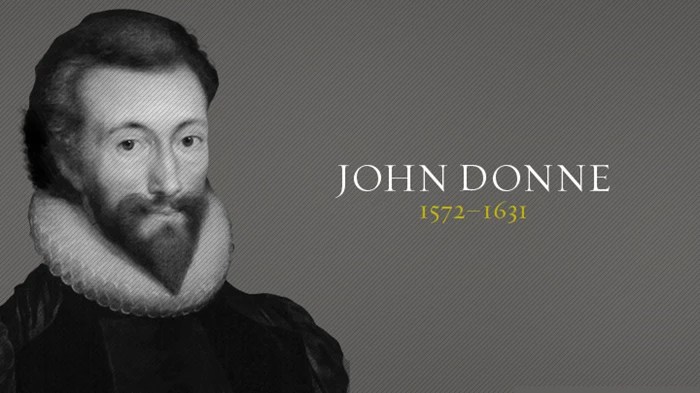
On 31 March the church remembers John Donne, soldier, scholar priest, poet, 1572-1631.
But who was John Donne?
John Donne was born into a Roman Catholic family in London in 1572. His father, an ironmonger, died when Donne was four. After periods of study at both Oxford and Cambridge, he came down without a degree and began the study of law at Lincoln’s Inn in 1592. About two years later he relinquished the Roman Catholic faith and conformed to the Church of England, possibly in order to qualify for a career in government service. But whatever his motives Donne took his new-found Anglican faith seriously.
In 1596, he joined the naval expedition led by the Earl of Essex against Cadiz in Spain. On his return to England in 1598 he was appointed private secretary to Sir Thomas Egerton, Lord Keeper of the Seal and in 1601 he secretly married Egerton’s 16 year old niece, Anne More. This lost him his job and earned him a short period of imprisonment. But in a few short years he had turned from a debauched and sceptical youth into both a faithful husband and a man of faith.
During the next few years Donne made a meagre living as a lawyer. A book he wrote in 1610, encouraging Roman Catholics to take the Oath of Allegiance to the king, brought Donne to the notice of James I who may have suggested that he consider a career in the Church. Certainly, he was appointed as a royal chaplain a few months after his ordination in 1615.
Donne continued to write poetry, but most of it remained unpublished until 1633. In 1617 his wife died, and, in his bereavement, Donne turned fully to his vocation as an ordained minister. From 1621 until his death he was Dean of St Paul’s, and with a growing reputation as a preacher, drew large crowds to hear him, both at the Cathedral and at Paul’s Cross, the nearby outdoor pulpit.
Largely forgotten by the century after his death, Donne’s reputation was restored in the 1920s when Ezra Pound and T. S. Eliot openly acknowledged their literary debt to him. Today, Donne is recognized as one of the greatest of the seventeenth-century ‘Metaphysical’ poets, many of whom, like George Herbert, were influenced by his work. Unlike George Herbert, however, Donne wrote both sacred and secular poetry. And his main themes of human love and divine love remain ever relevant, as demonstrated in this extract from Holy Sonnet:
Batter my heart three-personed God; for, you As yet but knock, breathe, shine and seek to mend; … But I am betrothed unto your enemy, Divorce me, untie or break that knot again, Take me to you, imprison me, for I Except you’ enthrall me, shall never be free, Nor ever chaste, except you ravish me.
Revd Paul A. Carr and extract from ‘Saints on Earth: A biographical companion to Common Worship’ by John H Darch and Stuart K Burns
 revPACman