
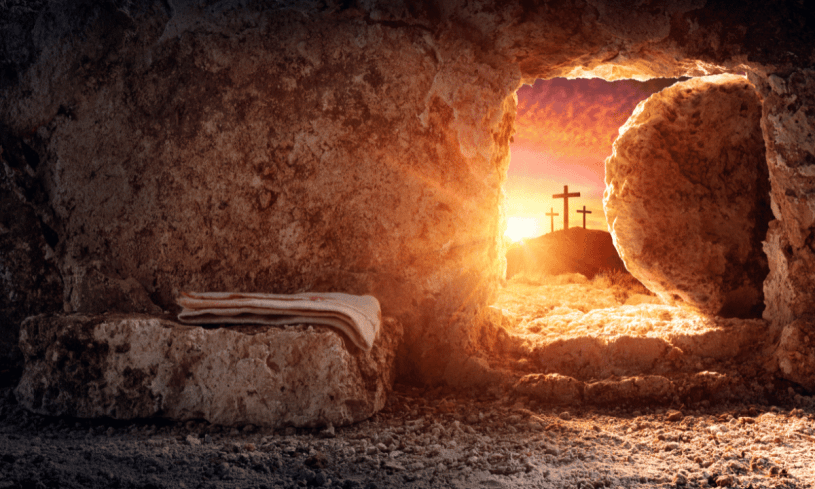
This is a copy of my talk given at Saint Stephen’s in the Anglican Church of Paphos on Easter Sunday 20 April 2025. The Bible reading was John 20:1-18.
Prayer
Heavenly Father,
I thank You for Your word.
By the power of Your Holy Spirit,
May You speak to my heart,
And change my life.
In the precious name of Jesus I pray.
Amen.
Easter Sunday is the cornerstone of the Christian faith. The resurrection of Jesus Christ is not merely a story of the past, but a powerful declaration of life, salvation, and hope for today and the days to come. If you’ve seen my social media posts this past week, you’ll know my header has been: Easter – the epic story of love sacrifice and hope.
Easter Sunday is the story of the impossible – a dead man rises. If Jesus didn’t rise from the dead, as Paul wrote in 1 Corinthians 15, our faith is futile; our preaching is useless (no comments please!); we are still dead in our trespasses and sins; and we, (KJV) of all people, would be most miserable!
Easter Sunday is the story of the ultimate triumph over evil, as God demonstrates his victory over death, the curse of this world, and it’s the ultimate story of love and forgiveness. And the resurrection isn’t just a story that sits 2,000 years ago in history. It has meaning and hope for us today that can radically change the way we live our lives, transform the darkest of situations and heals even the most broken of hearts.
A few years ago, the world’s top historians gathered together and made a list of the 100 most significant events in the history of the world for Time Magazine. There were discussing things like the discovery of America, the invention of the airplane, nuclear fusion, the first printing press etc. Number four on the list of the most significant historical events was the life of Jesus.
Now, initially, I was a bit upset that they hadn’t put Jesus at number one, but then I realised they’d forgotten the most important part anyway. They’d put the Life of Jesus. If Jesus had lived and then died like everybody else, that’s probably about the best you could say about Him – number four.
But what makes Jesus different is that He not only died on a cross and was buried in a tomb. He came back to life. And nobody else has ever done that! And that’s what makes the resurrection of Jesus to be the most significant event in the history of the world – because it’s never been done. It’s a first, an original and, to date, still an absolute ‘one off.’
And the world, as a consequence of this empty tomb, has never been the same again. History revolves around this one, unique, amazing, event. The writer and Atheist, Richard Dawkins, said: “If the resurrection is not true Christianity becomes null and void.” It’s probably the only thing he’s ever written when I’d agree with him!
Of course, there are those who doubt the resurrection ever took place. So, let’s spend a few moments looking at some of the reasons we can believe in the validity of Jesus’ resurrection.
Jesus Didn’t Die On The Cross.
Some suggest that Jesus fainted from loss of blood and exhaustion and that he was resuscitated later. However, Jesus had undergone Roman flogging and been nailed to a cross for six hours. The soldiers were clearly convinced Jesus was dead, or they would not have taken his body down.
The Disciples Stole Jesus’ Body.
And started a rumour that He had risen from the dead. However, a Roman guard (some of the most vicious and ruthless soldiers the world has ever seen), were keeping watch on the tomb. For them, failure in duty meant instant death. It would have been a miracle for a demoralised group of disciples – who’d fled in fear of their lives when Jesus was arrested – to overpower the SAS of the ancient world!
The Authorities Stole Jesus’ Body.
If the Jewish or Roman authorities had Jesus’ body in their possession why, when the disciples were preaching Jesus’ resurrection in Jerusalem, didn’t they produce the body or, if they’d taken it, explain where His body lay to quash the rumour that Jesus had risen from the dead?
Jesus’ Appearances To His Disciples.
Not only did Jesus appear before Mary, Peter and the ‘other disciple’ in John 20, he also appeared to over 500 of his disciples on eleven different occasions over a period of 40 days. Remember doubting Thomas, who would only believe if he could put his hands into the holes in Jesus’ hands and feet? On one occasion Jesus insisted on eating fish to prove to them that he was not a ghost (Luke 24:39-43). We’re not talking about the resuscitation of a corpse here, but a resurrection from the dead.
Charles Colson was the first member of President Richard Nixon’s team to be jailed over the Watergate scandal in the 1970s. He became a Christian in prison and founded Prison Fellowship. He once said:
I know the resurrection is a fact, and Watergate proved it to me. How? Because 12 men testified they had seen Jesus raised from the dead, then they proclaimed that truth for 40 years, never once denying it. Everyone was beaten, tortured, stoned and put in prison. They would not have endured that if it weren’t true. Watergate embroiled 12 of the most powerful men in the world-and they couldn’t keep a lie for three weeks. You’re telling me 12 apostles could keep a lie for 40 years? Absolutely impossible.
Changed Lives.
I guess the most telling testimony of all must be the changed lives of those early Christians. Those disciples, who deserted Jesus to save their own skins, were so transformed by their experience in the weeks after Easter that they were willing to be put to death themselves rather than deny the fact that they had met the risen Jesus.
The Church.
Mark Tully, at the end of his BBC TV series Lives of Jesus, a few years ago said:
Jesus was probably a failure in his own time … He taught in strange riddles. He didn’t convince his fellow Jews. And he didn’t overthrow Rome. From that failure I have come to what, for me, is the most important conclusion of all. That the hardest, apparently least historical article of Christian faith, the resurrection, must have happened. If there had been no miracle after Jesus’ death, there would be no grounds for faith in a failed life. No resurrection … no church.
The resurrection explains us! It establishes who we are and why there are 2.4 billion Christians in the world. Because the resurrection happened – the church happened.
I recognise that the empty tomb may be difficult to grasp, that it may push your understanding to breaking point. But that is no reason not to believe in it, and in what it points to – a God who cares so much that he entered our world and shows us a better way to live.
History is littered with politicians, religious leaders, academics, researchers, lawyers, detectives, who have all attempted to prove that Jesus didn’t rise from the dead, yet their conclusions, however disagreeable to them (and, sometimes to us), state that only a resurrection from the dead can adequately account for the phenomenon they were investigating. The writer Philip Yancey wrote:
In many respects I find an un-resurrected Jesus easier to accept. Easter makes him dangerous. Because of Easter, I have to listen to his extravagant claims and can no longer pick and choose from his sayings. Moreover, Easter means he must be loose out there somewhere.
And if Jesus is ‘loose out there somewhere’ then we have a responsibility to look for him, don’t you think? But it’s not a game of hide and seek! God doesn’t hide so we have to look for him in obscure places, he revealed himself to us through Jesus.
Perhaps this morning you’re asking yourself, can the very little I know about Jesus be true? Is there a niggling doubt in your mind that Jesus could be who he said he was: the Son of God and our Saviour?
Could it be time for you to start believing in a God who has the power to change lives? Might it be time for you to start taking your faith seriously.
If you were to die tonight and you were entering into heaven, what would you say?” Think about the thief on the cross. I can’t wait to speak to him, one day, to ask him, “How did that work out for you? You’d never been in a Bible study. You’d never got baptized. You didn’t know a thing about church membership. And yet, you made it! How did you make it? That’s what the angel must have said at the gates of heaven:
“What are you doing here?”
“Well, I don’t know.”
“What do you mean, you don’t know?”
“Well, ’because I don’t know.”
“Really? This is quite unusual, excuse me while I get my supervisor.”
So, the supervisor angel comes: “We’ve just a few questions for you. First of all, are you clear on the doctrine of justification by faith?”
The guy says, “I’ve never heard of it in my life.”
“And what about … Let’s just go to the doctrine of Scripture immediately.”
This guy’s just staring.
“And what do you know about the 39 Articles of Religion?” The supervisor angel asks (He’s an Anglican!!).
No response!
Eventually, in frustration, the supervisor Angels asks: “On what basis are you here?”
And the thief replies: “The man on the middle cross said I could come.”
Now, that is the right answer.
That’s why Martin Luther says most of our Christian life is outside of us, in the sense that we know that we’re not saved by good works, we’re not saved as a result of our church attendance, but we’re saved as a result of what Jesus, ‘the man on the middle cross’ has done for us.
But you know, in closing, following Jesus is a risky business. When Jesus is around, He messes everything up! He’s an inconvenience. He shocks us. He changes us. He turns our lives upside down (or downside up!). He challenges us about our morals and values and priorities. Dangerous and strange things happen when we follow Jesus.
When we follow ‘the man on the middle cross,’ our lives are never the same again.
Behold the man upon a cross,
My sin upon His shoulders;
Ashamed, I hear my mocking voice
Call out among the scoffers.
It was my sin that held Him there
Until it was accomplished;
His dying breath has brought me life –
I know that it is finished.
Christos Anesti (Χριστός Ανέστη) “Christ is Risen.”
Alithos Anesti (Aληθώς ανέστη!) “Truly, He is Risen.”
COPYRIGHT DISCLAIMER The text contained in this sermon (with thanks to Alistair Begg for his ‘Thief on the Cross’ illustration – with a few tweaks from me!) is solely owned by its author, Revd Paul A. Carr. The reproduction, or distribution of this message, or any portion of it, should include the author’s name.
 revPACman