
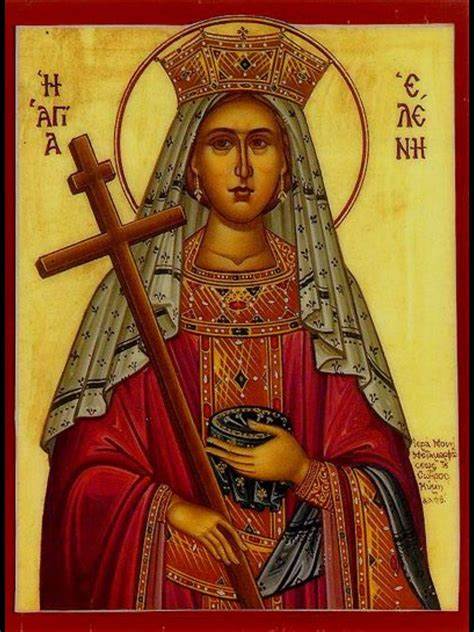
On 21 May the church remembers Saint Helena, protector of the Holy Places and Patron Saint of new discoveries, Archaeologists and Divorced Couples, 274-330.
But who was Saint Helena?
Born at Drepanum in Bithynia, in Asia Minor and born into a poor family and lower class in the Roman culture of the day. St. Ambrose described Helena as a “good stable-maid.” Helena rose from humble origins to become the concubine of Emperor Constantius Chlorus. Helena bore Constantius a son in 274, named Constantine. Helena was banished by Constantius in 292 when he ended their relationship so that he could marry Theodora, the step-daughter of Augustus Maximian as part of his political ambitions.
Helena returned to Rome in honour in 306 when her son Constantine became sole ruler of the Roman Empire. She was made ‘most noble woman’ and honoured throughout the Empire. Constantine ordered all to honour his mother. He even had coins minted, bearing her image. Through her son’s influence, Helena became a Christian in 312, and fully embraced the Christian life. She became renowned as one who lived modestly and gave charitably, a protector of religious buildings and as a woman who sought out relics of the Christian faith.
With her title of Augusta Imperatrix, Helena was given free reign over the imperial treasury. She was tasked with locating relics of Christian tradition. Her most famous ‘achievement’ was the recovery of the supposed cross of Christ, an event attested to by Ambrose, and recorded in fifth-century church histories. She was held in special honour by the Church as the mother of the Emperor who legalized the Christian faith.
Between the years 326-328, Helena took a trip to the Holy Places in the Middle East. During her journey, Helena had many churches constructed, including the one at the site of Jesus Christ’s birth – the Church of the Nativity, Bethlehem and another at the site of his ascension – Church of Eleona on the Mount of Olives.
During this time Jerusalem was still being rebuilt after Titus’ destruction. Around the year 130, Emperor Hadrian had a temple built over the site of Jesus’ death. This temple was believed to be dedicated to Venus. Helena had this temple destroyed and chose a site in this location to be excavated. This led to the discovery of three crosses.
Tradition says Helena brought a woman near death to the crosses. There she had the woman place a hand on all three crosses. Nothing happened when she touched the first two crosses, but when she placed her hand on the third cross she suddenly recovered. Helena declared the third cross to be the True Cross. At this site, Constantine ordered the Church of the Holy Sepulchre to be built.
Theodoret of Cyrus, an influential theologian, wrote that during her search, Helena also discovered the nails of the crucifixion. She had one of the nails placed in Constantine’s helmet and one in the bridle of his horse to aid him with their miraculous powers. Churches were built at these sites, as well.
Several of the relics believed to be found by Helena are located in Cyprus. Among these are parts of Jesus’ tunic, pieces of the holy cross, and pieces of the rope used to tie Jesus to the cross. When Helena returned to Rome from Jerusalem in 327, she brought parts of the True Cross back with her. She stored these in her palace’s chapel. They can still be seen to this day, though her palace has been converted to the Basilica of the Holy Cross in Jerusalem.
Helena was renowned for helping not only individuals, but entire communities through her works of charity. She often sought out to help the poor and destitute. She would visit churches and leave them with rich donations. Helena was a very devout servant of God, so much so that one would easily believe her to have been a follower of Jesus Christ from birth. Through her influence and work, Christianity continued to spread throughout the known world.
Helena died around 330 with her dearly devoted son by her side. She was then buried in the Mausoleum of Helena outside of Rome. Her sarcophagus can be seen in the Pio-Clementine Vatican Museum.
Saint Helena Prayer of Thanksgiving
Most Merciful God, who blessed your servant Helena with such grace and devotion to you that she venerated the very footsteps of our Saviour; Grant unto us the same grace that, aided by her prayers and example, we also may always behold your glory in the cross of your Son. Through the same Jesus Christ our Lord; who lives and reigns with you, in the unity of the Holy Spirit, one God, for ever and ever. Amen.
Revd Paul A. Carr and extract from ‘Saints on Earth: A biographical companion to Common Worship’ by John H Darch and Stuart K Burns
 revPACman