
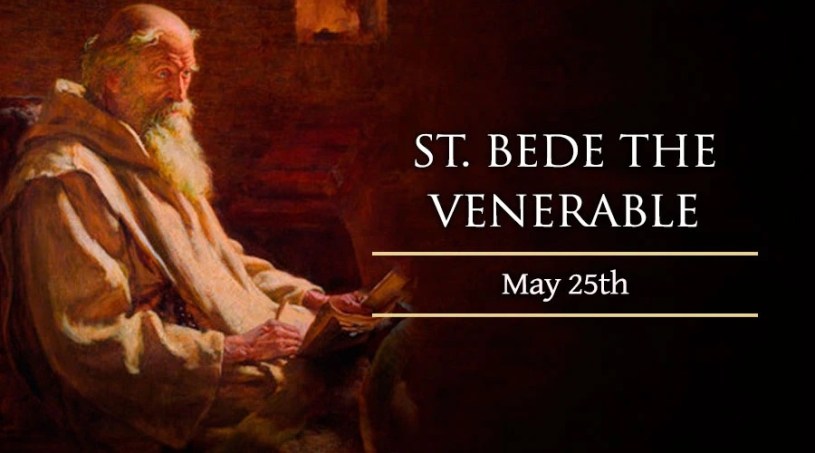
On 25 May the church remembers the Venerable Bede, Patron Saint of lectors, scholars, English writers, and historians, 672-735.
But who was Bede?
Bede was an English monk, historian, and scholar who lived in the Kingdom of Northumbria. He is at times referred to as the Venerable Bede or Bede the Venerable.
Bede was born in 672 near Jarrow in the North East of England. He was given as a child oblate at the age of seven to the double-monastery of Monkwearmouth-Jarrow. It had only recently been founded by St. Benedict Biscop Baducing (often nicknamed Bennett). St. Bennett was famous for his wonderful library. It was the perfect place for St. Bede to spend his childhood as he found his voracious appetite for knowledge to be thoroughly satiated.
Bede excelled at his studies so much that he was ordained as a deacon at the young age of seventeen. He was ordained a priest by St. John of Beverley at the age of thirty, and was put in charge of the classroom which prompted him to write his first books. His works soon got him into trouble as his inquisitive mind questioned the established norms. He was accused of heresy for denying the Earth to be 5,500 years old at the time of Jesus, preferring a number closer to 4,000. He explained himself and was not charged with heresy.
The controversy that surrounded these early works did not slow St. Bede down and he kept writing throughout his life. Although he made his own views very clear, he was a prolific transmitter of information from the earlier Church Fathers. He refused to become the abbot of his monastery a number of times, preferring to focus on his work of writing. His written works are almost innumerable, and are not entirely translated into English even today.
Bede was a prolific writer and many of his works have survived to the present day. His work was extremely influential in the generations after his death. His most famous work, the Historia Ecclesiastica Gentis Anglorum (Ecclesiastical History of the English People), has been a vital source for the study of early English history for centuries. For this reason, he is remembered by some as the ‘Father of English History.’
His theological writings were extensive and included a number of Biblical commentaries and other works of exegetical erudition. Another important area of study for Bede was the academic discipline of computus, otherwise known to his contemporaries as the science of calculating calendar dates.
One of the more important dates Bede tried to compute was Easter, an effort that was mired in controversy. He also helped popularize the practice of dating forward from the birth of Christ (Anno Domini—in the year of our Lord), a practice which eventually became commonplace in medieval Europe. He is considered by many historians to be the most important scholar of antiquity for the period between the death of Pope Gregory I in 604 and the coronation of Charlemagne in 800.
Bede was moreover a skilled linguist and translator, and his work made the Latin and Greek writings of the early Church Fathers much more accessible to his fellow Anglo-Saxons, which contributed significantly to English Christianity. Bede’s monastery had access to an impressive library which included works by Eusebius, Orosius, and many others.
Open Wide the Door of My Heart
Lord God almighty,
open wide the door of my heart
and illumine it with the grace of the Holy Spirit,
that I may seek what is pleasing to your will.
Guide my thoughts and my heart,
and lead my life in the way of your commandments,
that I may always seek to fulfill them,
and that I may grasp the eternal joys of the heavenly life;
through Jesus Christ our Lord. Amen.Venerable Bede
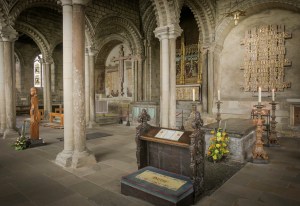
Bede is buried in Durham Cathedral. Bede’s shrine was destroyed in 1540, along with that of Cuthbert, and Bede was buried beneath the original site. A simple chest tomb was built above him, made from Egglestone marble. It was dismantled in 1831 when the grave was opened by Canon James Raine. When the chest tomb was rebuilt afterwards, the top was engraved with the text traditionally used on his grave: Hac sunt in fossa Bedae Venerabilis ossa which means ‘In this grave are the bones of the Venerable Bede’.

Bede’s canonization was confirmed in 1899, by Pope Leo XIII, who also declared him a Doctor of the Church. He is the only native of Great Britain to achieve this designation.
Prayer
Almighty God, who has enriched your church with the learning and holiness of your servant Bede: Grant us to find in Scripture and disciplined prayer the image of your Son our Saviour Jesus Christ, and to fashion our lives according to his likeness, to the glory of your great Name and to the benefit of your holy church; through the same Jesus Christ our Lord. ᴀᴍᴇɴ.
Rev Paul A. Carr
 revPACman