
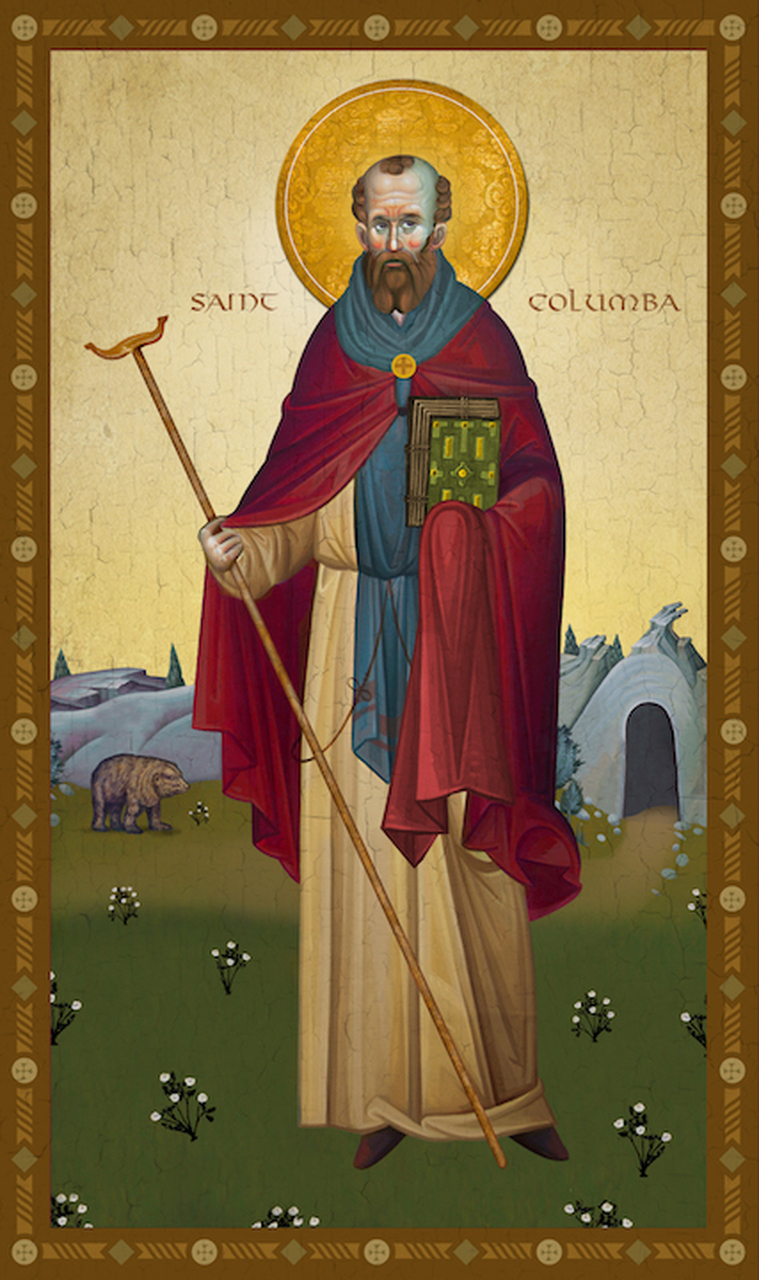
On 9 June the church remembers Saint Columba, abbot, missionary, He is a patron saint of Scotland and Iona, and one of the three patron saints of Ireland, along with St. Patrick and St. Brigid. He is also revered as the patron of the city of Derry, Northern Ireland; poets; and bookbinders and is invoked against floods, 521 – 597.
But who was Columba?
Columba, otherwise known as Colum Cille, which means ‘Dove of the Church’, was born at Gartan in Donegal in 521. He was a descendant of the pagan High King Niall, and a member of the prominent clan of Ui Neill. Columba was educated in Irish monasteries by some of the leading figures of his day, including Finian of Clonard and Finian of Moville, as would befit a member of the royal line. He was one of a group of privileged clergy who dominated the Irish Church.
Columba founded two monasteries in Ireland, at Derry (546) and Durrow (556), before he relocated to Iona, off the west coast of Scotland, with twelve companions. Iona was given to him for a monastery by the ruler of the Irish Dalriada. Columba reputedly went into exile on the island, as a result of his part in the battle of Culdrebene (about 563) – a monastic disagreement which turned violent. Columba lived the rest of his life in Scotland, returning to Ireland only for short periods of time, usually for an official occasion.
From Iona Columba visited Bridei, King of the Picts and according to Bede converted him. In 574 Columba anointed Aeda’n mac Gabrian as King of the Scots of Dalriada, and a year later attended a convention of the kings at Druim Cett in Ireland. Columba obviously retained his influence in certain circles, despite his choice of the monastic life.
At Druim Cett, Columba argued for the preservation of the Bards of Ireland, and sought clarification from the Irish king on the role of the Irish in Scotland. From Iona, Columba was perfectly placed to evangelize both the Picts, and the kingdom of Da’l Riata in north-east Ireland.
It has been traditional to see Columba as the Apostle of Scotland, and to credit him for the conversion of numerous Picts. In reality however, Columba was more of a figurehead for the Irish in Scotland, and others who came after him evangelized the Picts, no doubt building upon his foundations.
Columba did establish at least two churches in Inverness, but spent much of his energy setting up the monastery at Iona and training its members. When the influence of Iona in Scotland and Northumbria is considered, Columba’s efforts can be said to have been a wise investment.
The Iona Community, an ecumenical religious community comprised of laypersons and clergy, was founded in 1938 to carry on the spirit of Columba’s mission. The group has performed valuable restoration of the island’s monastic ruins and hosts services at the renovated Iona Abbey. A pilgrimage path known as Slí Cholmcille (the St. Columba Way) was established in the 21st century in Ireland and Scotland. The path features several trails that follow important sites in the saint’s life.
A Prayer
Almighty God,
who filled the heart of Columba
with the joy of the Holy Spirit
and with deep love for those in his care:
may your pilgrim people follow him,
strong in faith, sustained by hope,
and one in the love that binds us to you;
through Jesus Christ your Son our Lord,
who is alive and reigns with you,
in the unity of the Holy Spirit,
one God, now and for ever. Amen.
Revd Paul A. Carr and extract from ‘Saints on Earth: A biographical companion to Common Worship’ by John H Darch and Stuart K Burns
 revPACman